Phase 2 professional guide
EMDR Phase 2 preparation and readiness: what the record should show
A therapist-focused framework for documenting informed consent, alliance, process understanding, stop signals, regulation capacity, supports, and remote-session readiness before reprocessing.
By the EMDRSuite Editorial Team
Product claims checked against the current EMDRSuite code and interface.
No independent clinical reviewer is named for this guide.
Preparation is a phase, not a pass-fail score
Phase 2 supports informed participation in the EMDR process and is shaped by the individual formulation. A single checklist score cannot establish readiness, and time spent in preparation is not evidence of failure or delay by itself.
The record should distinguish what was explained, what the patient understood or questioned, what was practised or observed, and which concerns remain. It should not turn generic resource names into proof that preparation is sufficient.
Document the collaborative frame
Relevant preparation records may include informed consent, expectations, therapeutic alliance, the patient's ability to communicate present experience, an agreed stop or pause signal, and the distinction between current safety and memory material.
These are not administrative decorations. They help the therapist understand whether the process is collaborative and whether changes in state, contact, or consent can be noticed and responded to during a session.
Describe capacities and context without prescribing a script
Preparation can involve education, affect regulation, dual-attention capacity, adaptive resources, supports, and planning between sessions. Which elements are needed, how they are developed, and how readiness is assessed depend on the case and the therapist's training.
Possible dissociation or complex presentations require competent assessment and may call for consultation or additional expertise. An online article or software checklist should never supply a universal threshold, a self-guided exercise, or a shortcut around that assessment.
Separate grounding, resourcing, dual attention, and readiness
Grounding usually aims to increase attention to the current environment when contact or orientation is changing. Resourcing may develop access to adaptive information or support; dual attention concerns contact with target material and the present therapeutic context. These functions can overlap, but the labels are not interchangeable and none proves readiness.
The printable preference plan records individual signs, accessible options, unhelpful prompts, pause controls, therapist checks, and remote contingencies. A method can be ineffective or counterproductive, so observe response, stop when contact worsens, and use assessment, consultation, or the emergency plan when indicated.
Add the remote layer before opening the target
For distance work, readiness also includes the exact location, privacy, reliable two-way contact, a backup channel, the patient's ability to stop the stimulus, and a plan for technical interruption or emergency. A successful camera test does not establish clinical readiness.
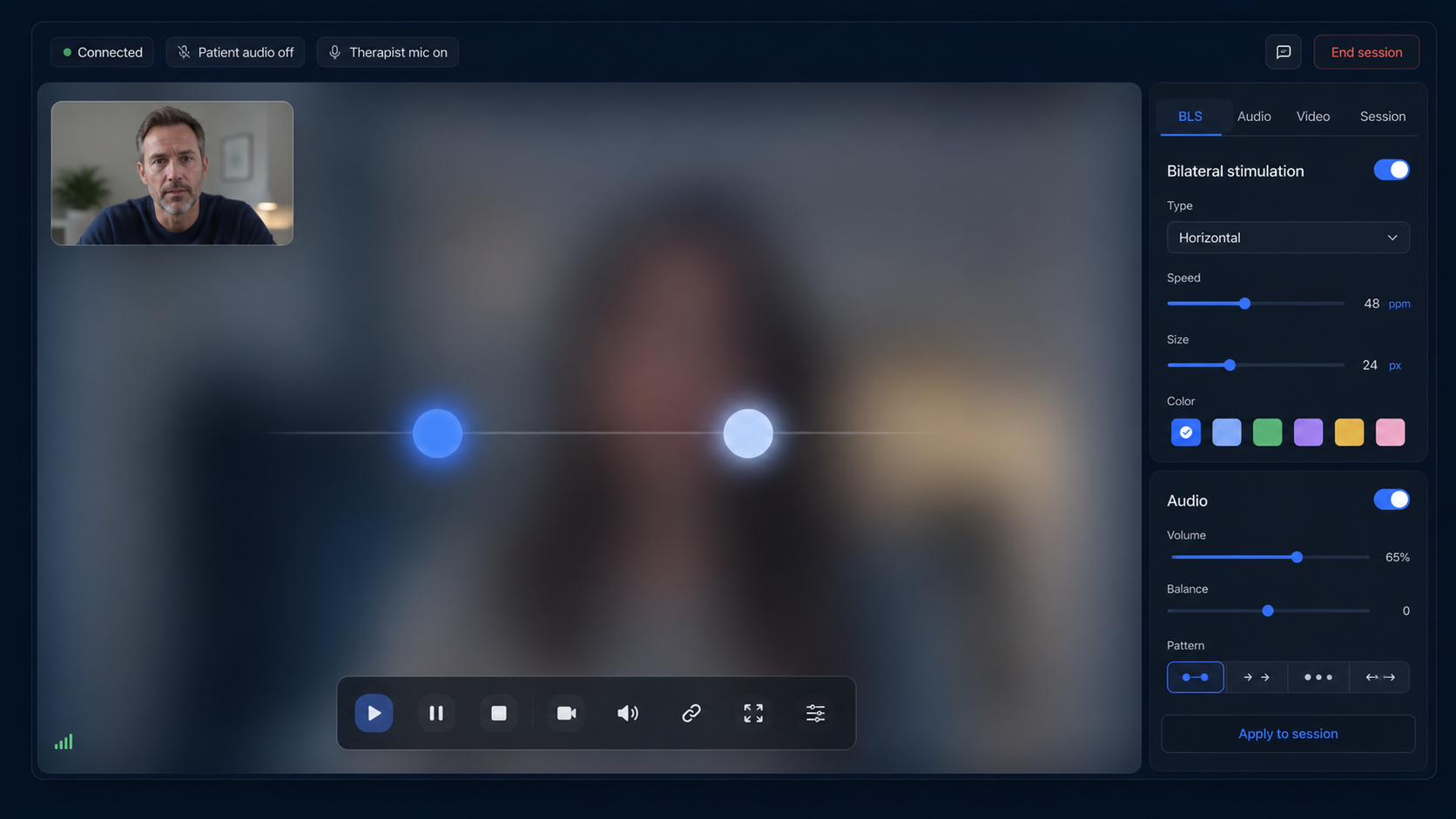
EMDRSuite keeps video, patient access, BLS controls and therapist documentation in one room. The platform can reduce technical switching; it cannot establish consent, stability, appropriateness, or the decision to move into assessment and reprocessing.
Phase 2 discussion resource
Printable grounding and present-orientation preference plan
Draft this collaboratively before it is needed. It records individual preferences and observations; it is not a universal grounding script or readiness test.
No server storage · no autosave · close or reload to clear
Collaborative drafting aid, not treatment, crisis advice, a grounding protocol, or evidence of readiness. Use the authorized clinical and contingency records required for the practice.
FAQ
EMDR Phase 2 preparation
How long should EMDR Phase 2 take?
There is no universal duration. Preparation follows the individual formulation, readiness, response, context, and professional judgment.
Is a calm or safe place enough to prove readiness?
No. A named resource is not a complete readiness assessment and should not be treated as a pass-fail item.
Are grounding techniques the same as EMDR Phase 2?
No. Grounding may support present orientation, but Phase 2 is broader and an individual response to one technique does not establish readiness.
Does readiness include dissociation screening?
Relevant dissociative symptoms may need competent assessment using methods appropriate to the therapist's training and context; this guide does not prescribe a tool or cutoff.
Can EMDRSuite decide when Phase 3 should begin?
No. The therapist makes that decision based on assessment, consent, formulation, readiness, and current conditions.
References
EMDR Phase 2 preparation and readiness: what the record should show
EMDRSuite
Put the guide into practice with EMDRSuite
Run remote EMDR with visual BLS, bilateral sounds, secure patient links, video-ready sessions, saved settings, and notes.
Continue with related EMDR guides