EMDR clinical framework
EMDR session structure: eight phases and printable session map
See how the eight-phase treatment course differs from one appointment, reprocessing sets, closure, and reevaluation; use a private printable session map.
By the EMDRSuite Editorial Team
Product claims checked against the current EMDRSuite code and interface.
No independent clinical reviewer is named for this guide.
Why therapists search for an EMDR eight-phase worksheet
The standard framework gives trained clinicians a shared map for organizing treatment, from history taking and preparation through assessment, processing, installation, body scan, closure, and reevaluation. A list of phase names is useful orientation, but it is not a treatment script or a substitute for training.
The printable session map below keeps one neutral field per phase and asks the therapist to record only what was actually reviewed or delivered. It stays in the browser, does not submit or save entries, and leaves phases blank when they were not reached.
What software can support without practising therapy
A well-designed clinical workspace can keep the phase sequence visible, make SUD and VOC values quick to enter, connect cognitions and processing sets, and preserve a concise timeline. It should never decide when to proceed, what intervention to use, or how to respond clinically.
The strongest design is quiet: therapist-only documentation, clear patient boundaries, editable records, multilingual screens, and no need to move between a video call, spreadsheet, timer, and paper worksheet.
Continuity matters during and after the session
Autosave protects work when a browser closes or a connection becomes unstable. Linking the worksheet to the correct patient and session makes it possible to review the previous clinical trail and edit entries when appropriate.
This continuity turns a static checklist into a usable professional record while preserving the therapist's own formulation and language.
Evaluate the tool, not only the template
Before adopting software, test the full journey: opening the worksheet during a call, changing phases, entering and editing ratings, recovering after interruption, reopening a previous session, and separating therapist notes from the patient interface.
EMDRSuite is built for qualified professionals and supports the technical workflow around EMDR. It does not provide self-guided treatment or replace accredited education, supervision, informed consent, emergency planning, or clinical judgment.
EMDR session structure
Five layers from the treatment course to one appointment
The eight phases organize a complete course of therapy. They are not eight equal agenda items that every client must complete in every EMDR session.
Longitudinal treatment course
Scope
Across the work from initial history and planning through preparation, target work, closure, reevaluation, and eventual ending.
What may be structured
A revisable formulation, past-present-future treatment plan, readiness, consent, goals, measures, target sequence, and response over time.
Do not assume
The phases are not equal in duration, strictly linear, or all completed in one appointment. Earlier phases may be revisited.
Opening and reevaluation
Scope
At the beginning of a later session, especially after previous reprocessing or when new information may change the plan.
What may be structured
Current safety and consent, between-session experience, prior target response, symptoms and function, new material, and the decision for today.
Do not assume
The last target, last SUD, or unfinished worksheet does not automatically determine what happens next.
Work selected for today
Scope
The phase or clinical task that fits the current formulation, readiness, available time, setting, and patient preference.
What may be structured
History, preparation, target assessment, phases 4–6 reprocessing, future-oriented work, review, documentation, or another appropriate task.
Do not assume
A session is not incomplete because it focused on preparation, assessment, reevaluation, or a necessary return to an earlier phase.
Reprocessing set cycle
Scope
A smaller loop within relevant reprocessing work, not the whole appointment and not the whole eight-phase treatment.
What may be structured
Therapist-guided attention, a brief period of bilateral stimulation, a check-in on what is noticed, and a responsive next clinical decision.
Do not assume
A timer, number of sets, lower SUD, or software event cannot decide dose, completion, safety, fidelity, or the next intervention.
Closure and continuity
Scope
Before the appointment ends and in the handoff to the next review, whether target processing is complete or incomplete.
What may be structured
Present orientation, current state, agreed between-session plan, relevant documentation, contingency steps, and what will be reevaluated next.
Do not assume
Closure is not proof that a target is resolved, the patient is universally stable, or treatment should end.
Use the printable map to record only what was actually reviewed or delivered. Leave other phases blank. It stays in the browser and does not replace the authorized record, protocol training, readiness assessment, or clinical judgment.
Eight-phase documentation resource
Printable EMDR 8 phases worksheet and session map
Record only what was actually assessed, discussed, or delivered. Leave a phase blank when it was not reached; a completed box does not establish fidelity, readiness, safety, or treatment completion.
No server storage · no autosave · use Clear all fields before leaving
Reference and documentation aid for appropriately trained professionals. It is not an EMDR protocol, script, fidelity scale, readiness test, risk assessment, or instruction to proceed through phases in one session.
FAQ
EMDR session structure
What are the eight phases of EMDR?
At a public overview level they are history taking, preparation, assessment, desensitization, installation, body scan, closure, and reevaluation. Their clinical application requires appropriate professional training.
Is the printable eight-phase worksheet a protocol?
No. It is a browser-only documentation map, not a script, fidelity scale, readiness test, risk assessment, or instruction to move through phases.
Does EMDRSuite tell therapists what to do clinically?
No. It organizes documentation and session tools; formulation, pacing, interventions, safety decisions, and treatment remain the therapist's responsibility.
Does the printable worksheet save patient information?
No. Entries are not submitted or autosaved and disappear when the page is closed or reloaded.
References
EMDR session structure: eight phases and printable session map
EMDRSuite
Put the guide into practice with EMDRSuite
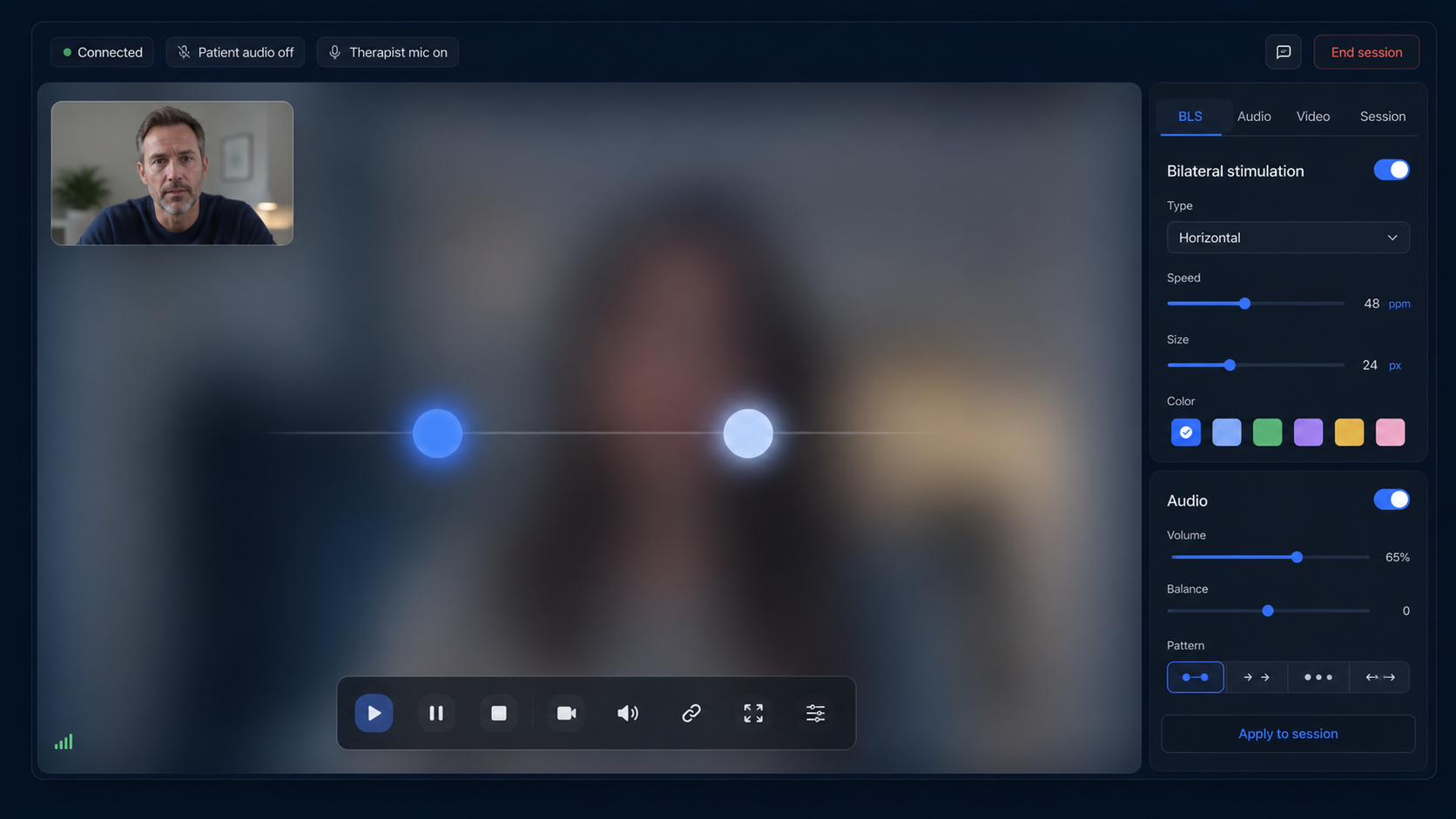
Run remote EMDR with visual BLS, bilateral sounds, secure patient links, video-ready sessions, saved settings, and notes.
Continue with related EMDR guides