Professional EMDR glossary
EMDR terms glossary for therapists: phases, BLS, SUD, VOC, and targets
A concise professional glossary connecting common EMDR terms with the eight-phase framework, assessment records, bilateral stimulation, and treatment-planning context.
By the EMDRSuite Editorial Team
Product claims checked against the current EMDRSuite code and interface.
No independent clinical reviewer is named for this guide.
Use definitions as orientation, not instruction
Shared terminology helps therapists read training materials, compare documentation, explain software fields, and communicate in supervision. A short definition cannot provide the assessment, formulation, pacing, procedural detail, or judgment required to apply EMDR therapy.
This glossary therefore describes where a term sits in the professional framework without turning it into a script, intervention recommendation, or self-guided exercise.
Keep each term connected to its context
SUD and VOC are interpretable only beside the selected target, wording, phase, and moment. BLS names a technical component, not the whole therapy. A target sequence plan is a revisable clinical map, not an automated list.
Good documentation preserves these distinctions so that labels remain useful across assessment, session work, closure, and reevaluation.
Expect language to vary across training and regions
Abbreviations, translations, and preferred terms can differ between programs, professional communities, and countries. Therapists should use the terminology required by their training, employer, jurisdiction, and documentation policy.
The definitions here are educational summaries grounded in recognized public sources and are not presented as a replacement for current manuals, accredited education, consultation, or supervision.
Professional terminology
EMDR terms glossary
- EMDR therapy
- Eye Movement Desensitization and Reprocessing, an eight-phase psychotherapy approach that must be delivered within appropriate professional training, assessment, and clinical judgment.
- Adaptive Information Processing (AIP) model
- The theoretical model used to explain EMDR therapy's understanding of how insufficiently processed experiences may remain linked with present disturbance.
- Bilateral stimulation (BLS)
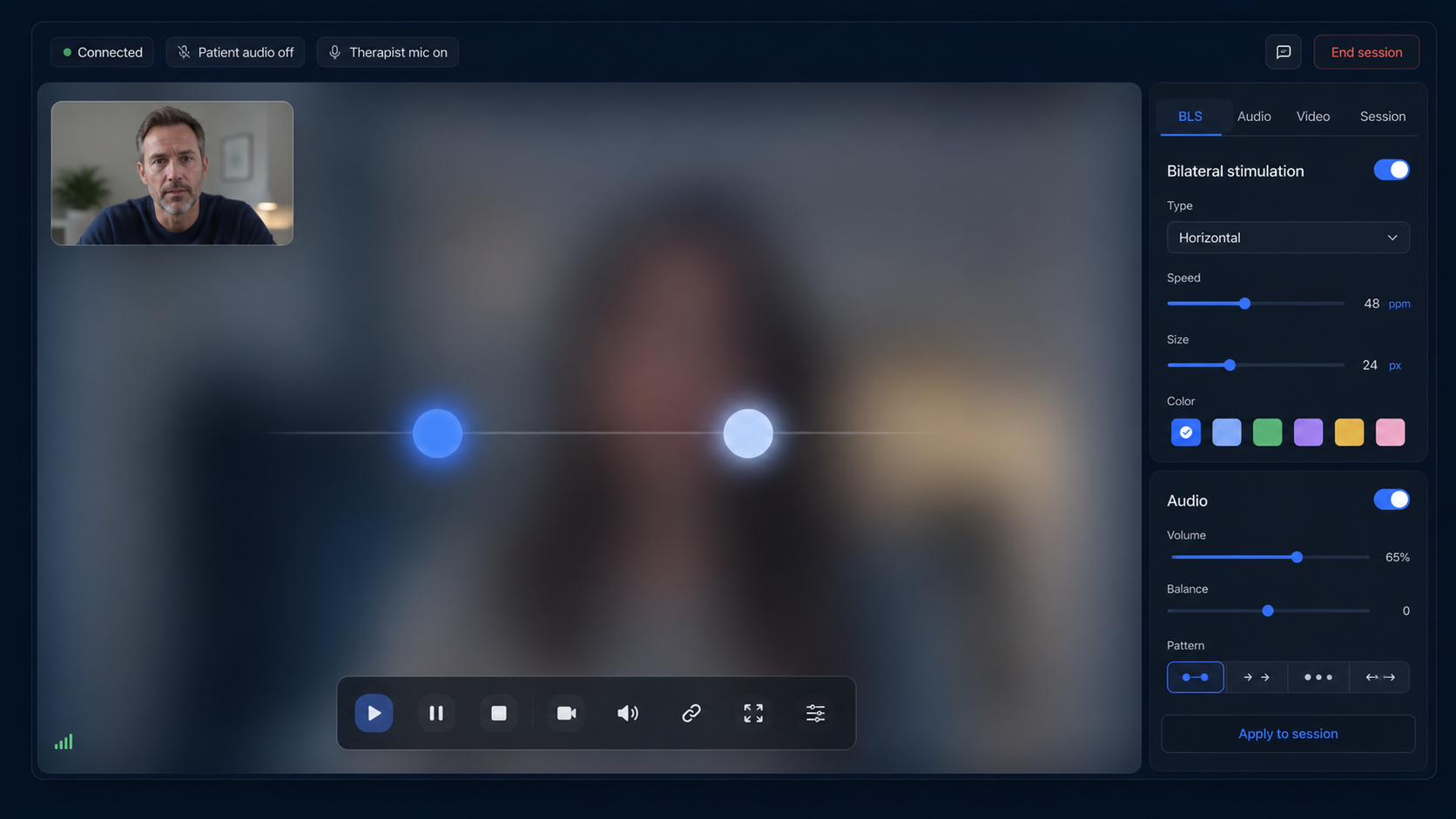
- Alternating visual, auditory, or tactile stimulation used as one component of the EMDR process; the modality and pacing are clinical decisions.
- Dual attention
- The simultaneous orientation to aspects of a selected memory and to the safety and context of the present therapeutic setting.
- Target
- The memory, event, situation, trigger, or representation selected by the trained therapist and patient for assessment or work within the treatment plan.
- Target sequence plan
- A revisable map of potentially relevant past events, present triggers, and future situations; it is not an automatic order generated by software.
- Negative cognition (NC)
- A negative belief about the self currently associated with the selected target and identified during assessment.
- Positive cognition (PC)
- The preferred adaptive belief about the self linked to the selected target, whose felt validity may be recorded with VOC.
- SUD
- Subjective Units of Disturbance, commonly recorded from 0 to 10 for current disturbance associated with the selected target.
- VOC
- Validity of Cognition, commonly recorded from 1 to 7 for how true the selected positive cognition feels in relation to the target.
- Body scan
- The sixth phase in the standard eight-phase framework, involving attention to current bodily response after the preceding work.
- Closure
- The seventh phase, in which the therapist ends the session according to the clinical state, whether or not the selected target is complete.
- Reevaluation
- The eighth phase, used to review prior work, current response, and information relevant to ongoing treatment planning.
- Future template
- Work concerning an anticipated future situation within the therapist's broader case formulation and treatment plan.
FAQ
EMDR terms glossary
What does EMDR stand for?
Eye Movement Desensitization and Reprocessing.
Is bilateral stimulation the same as EMDR therapy?
No. BLS is one component used within a broader eight-phase psychotherapy approach.
Are SUD and VOC diagnostic tests?
No. They are subjective scales used within the clinical process and interpreted in context by the therapist.
Can this glossary be used as an EMDR protocol?
No. It offers orientation to terminology only and does not replace training, manuals, supervision, or clinical judgment.
References
EMDR terms glossary for therapists: phases, BLS, SUD, VOC, and targets
EMDRSuite
Put the guide into practice with EMDRSuite
Run remote EMDR with visual BLS, bilateral sounds, secure patient links, video-ready sessions, saved settings, and notes.
Continue with related EMDR guides