Brain injury, overlapping symptoms, and rehabilitation
EMDR after traumatic brain injury or concussion: PTSD evidence and adaptations
A therapist guide to EMDR after concussion or traumatic brain injury, PTSD differential assessment, cognitive and medical needs, limited EMDR evidence, adaptations, and coordination.
By the EMDRSuite Editorial Team
Product claims checked against the current EMDRSuite code and interface.
No independent clinical reviewer is named for this guide.
TBI, post-concussion symptoms, and PTSD overlap without being identical
Headache, dizziness, fatigue, poor sleep, irritability, concentration and memory problems can follow brain injury and can also be intensified by pain, PTSD, depression, medication, sleep disorder, or other medical factors. Symptom overlap does not prove that difficulties are only neurological or only psychological.
Clarify injury mechanism, severity indicators, loss or alteration of consciousness, amnesia, imaging and medical findings where available, current neurological symptoms, rehabilitation, cognition, PTSD criteria, mood, substances, function, and new or worsening red flags. Psychotherapy must not delay medical assessment.
Treat the assessed condition, not the assumption about its cause
VA guidance recommends structured assessment to distinguish PTSD and TBI-related sequelae and notes that recommended PTSD treatment can work for many people with a TBI history. The broader systematic review found favorable results mainly for CBT-based PTSD treatments, while overall study quality was low and evidence for other therapies was weaker.
EMDR is a PTSD treatment, not a treatment that heals brain tissue, reverses concussion, restores cognition, or proves which condition caused a symptom. Coordinate with neurology, rehabilitation, primary care, psychiatry, neuropsychology, or other services according to need and consent.
Direct EMDR evidence is limited to small uncontrolled or single-case work
A retrospective series reported improvement after EMDR in 16 people with acquired brain injury and PTSD. A later multiple-baseline study included only four people, two with TBI and two with stroke; all improved in PTSD symptoms, with no consistent cognitive improvement.
These findings support feasibility research, not broad effectiveness or safety conclusions across mild, moderate, severe, recent, or progressive neurological conditions. Do not generalize from acquired brain injury to every concussion or from PTSD improvement to neurological recovery.
Adaptations follow functional assessment, not a generic TBI protocol
Consider shorter segments, repetition, written or visual reminders, simpler instructions, breaks, fatigue and sensory load, accessibility, support-person involvement with consent, and coordination with cognitive rehabilitation. Preserve the core treatment rationale and record why each adaptation is needed and whether it helps.
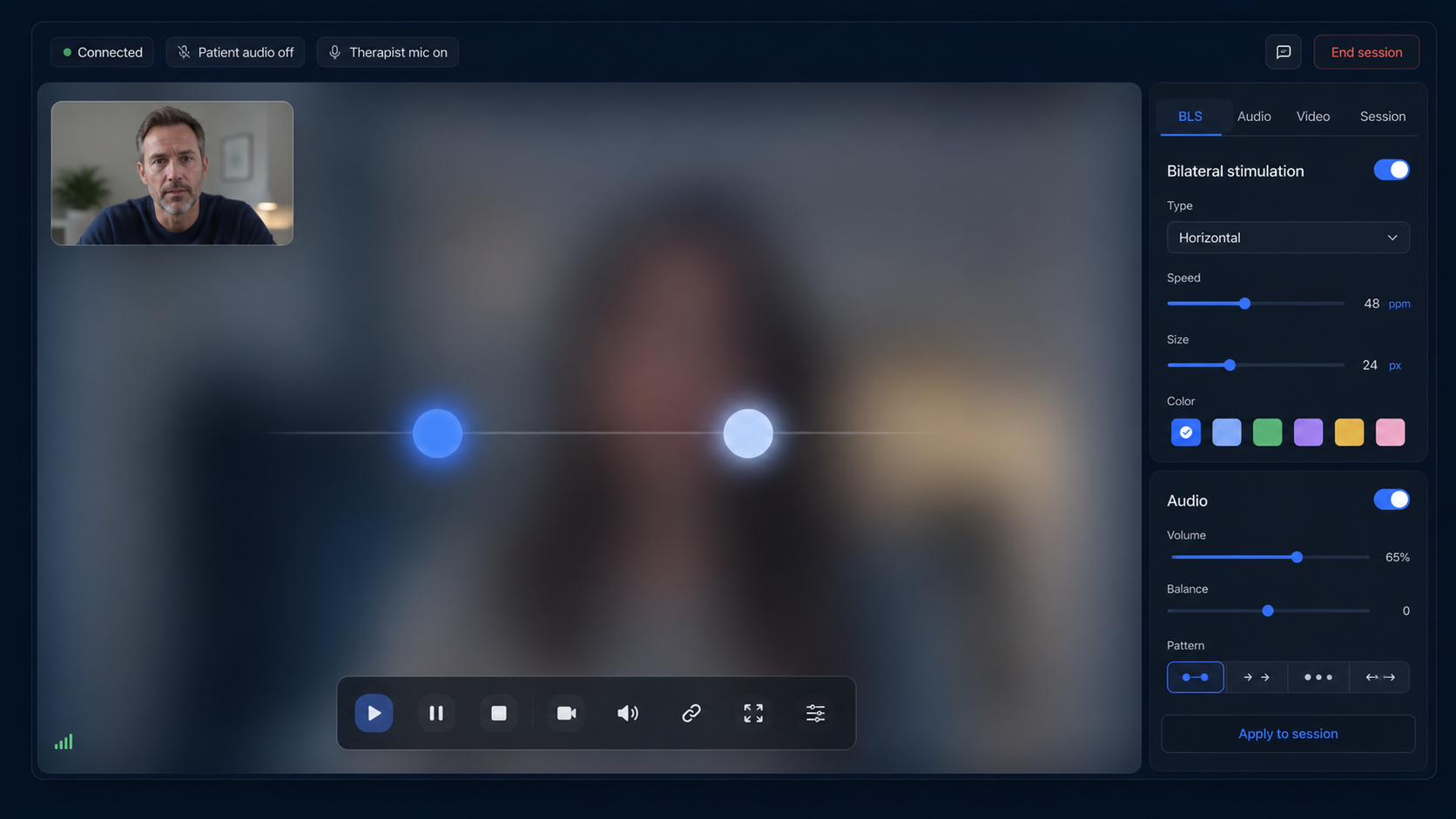
EMDRSuite can change visual and auditory bilateral-stimulation settings and store clinician-entered notes. It does not assess concussion, cognition, neurological red flags, visual or vestibular tolerance, decision-making capacity, or medical fitness for remote trauma treatment.
FAQ
EMDR traumatic brain injury
Can EMDR treat a concussion or heal a brain injury?
No. It may be considered for assessed PTSD or trauma symptoms; it does not repair neurological injury.
Do cognitive symptoms rule out trauma-focused therapy?
Not automatically. Their severity, cause, functional impact, retention, consent, and support needs require individual assessment.
How strong is direct EMDR evidence after TBI?
It is limited to small case-based studies; broader PTSD-after-TBI evidence is stronger for CBT-based treatments.
Can EMDRSuite screen neurological safety?
No. It is not a medical, neuropsychological, vestibular, or cognitive assessment system.
References
EMDR after traumatic brain injury or concussion: PTSD evidence and adaptations
EMDRSuite
Put the guide into practice with EMDRSuite
Run remote EMDR with visual BLS, bilateral sounds, secure patient links, video-ready sessions, saved settings, and notes.
Continue with related EMDR guides