Two trauma-focused treatments, no universal winner
EMDR vs prolonged exposure for PTSD: differences and evidence
Compare EMDR and prolonged exposure for PTSD: procedures, verbal detail, homework, guideline status, direct and indirect evidence, preferences, and software limits.
By the EMDRSuite Editorial Team
Product claims checked against the current EMDRSuite code and interface.
No independent clinical reviewer is named for this guide.
Both are trauma-focused, but the session tasks differ
Prolonged Exposure typically includes psychoeducation, repeated in-vivo approach to safe avoided situations, imaginal exposure or recounting of the trauma memory, and processing of what was learned. Homework is commonly part of the model. EMDR uses eight phases, target assessment, brief attention to memory elements alongside bilateral stimulation, closure, and reevaluation.
EMDR does not require a continuous, detailed verbal retelling in the same way as standard imaginal exposure, although the person still approaches traumatic material. Neither treatment should be reduced to exposure alone or to eye movements alone, and actual delivery should follow competent training and the relevant manual.
Guidelines support both without naming one universal winner
The VA/DoD overview identifies PE, CPT, and EMDR among the trauma-focused psychotherapies with the strongest evidence for PTSD. NICE recommends EMDR and several trauma-focused CBT approaches. A recommendation means each can be a valid option; it does not mean they are interchangeable or equally suitable in every service and case.
Choice should consider diagnosis, goals, informed preference, prior treatment, current safety, comorbidity, ability to complete the treatment tasks, clinician competence, practical access, and local guidance. Avoidance alone is not a reason to promise an easier therapy, and preference should be informed by an accurate description of both.
Comparative research does not justify simple superiority claims
A network meta-analysis included 98 randomized trials and 5,567 participants across PTSD psychotherapies. Several approaches, including EMDR and PE, reduced symptoms after treatment; the authors said planning should be tailored to patient needs, characteristics, and clinician expertise. Indirect rankings are not the same as a definitive head-to-head result.
An older direct pilot randomized only 22 people. Both treatments reduced PTSD and depression; its observations about speed and dropout are too small to establish superiority. Broader exposure research finds large benefits against inactive controls and generally small differences against other trauma-focused treatments. Long-term comparative certainty remains limited.
Compare a real treatment plan, not brand slogans
Ask what happens in and between sessions, how progress and adverse changes are measured, how risk and dissociation are assessed, what training and supervision apply, when the plan is reviewed, and what alternatives exist. Session counts, emotional intensity, homework burden, dropout, and speed should not be guaranteed from group averages.
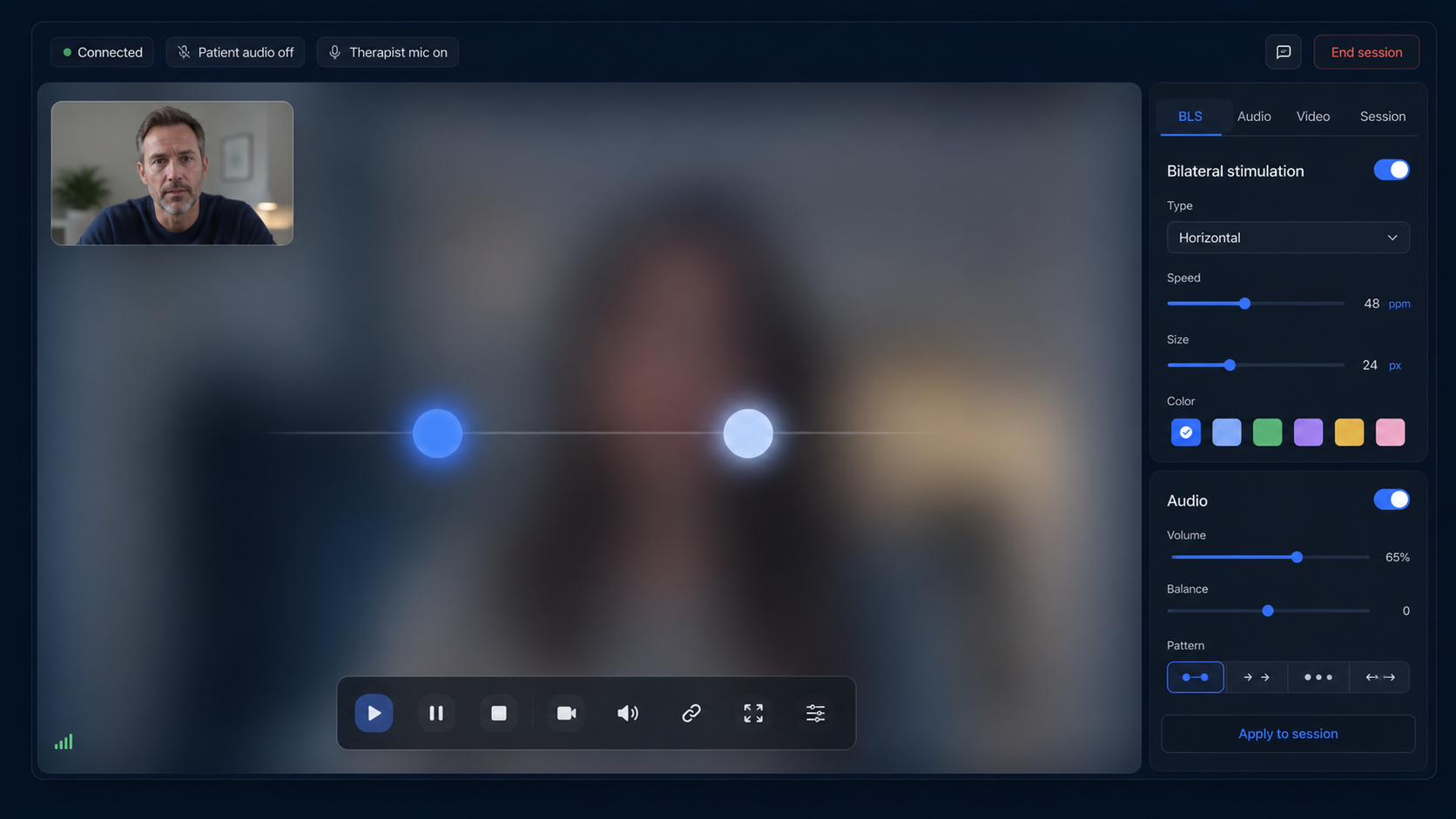
EMDRSuite is designed to support therapist-led EMDR video sessions and bilateral stimulation. It does not deliver Prolonged Exposure, train clinicians in PE, select a PTSD treatment, compare expected outcomes, or diagnose suitability. A technical platform test validates operation, not a clinical choice.
FAQ
EMDR vs prolonged exposure
Is EMDR better than prolonged exposure?
Evidence supports both for PTSD, but it does not establish a universal winner. The decision should be individualized and informed.
Does EMDR involve exposure to trauma memories?
It involves attending to traumatic material, but its procedure differs from standard PE and does not usually require continuous detailed recounting.
Does PE always require homework?
Homework and in-vivo practice are commonly central to PE, but the exact plan should be explained by the treating clinician.
Can EMDRSuite deliver PE?
No. It supports EMDR session technology and does not provide a PE protocol or treatment decision.
References
EMDR vs prolonged exposure for PTSD: differences and evidence
EMDRSuite
Put the guide into practice with EMDRSuite
Run remote EMDR with visual BLS, bilateral sounds, secure patient links, video-ready sessions, saved settings, and notes.
Continue with related EMDR guides