Treat trauma and ADHD as related but distinct clinical questions
EMDR and ADHD: trauma evidence, limits, and session adaptations
What EMDR can and cannot treat in people with ADHD, how trauma and ADHD overlap, what the evidence shows, and practical adaptations for therapist-led sessions.
By the EMDRSuite Editorial Team
Product claims checked against the current EMDRSuite code and interface.
No independent clinical reviewer is named for this guide.
ADHD and trauma can coexist without being the same condition
Inattention, restlessness, impulsivity, sleep problems, emotional dysregulation, and working-memory difficulty can appear in ADHD, PTSD, or both. A trauma history does not establish ADHD, and an ADHD diagnosis does not prove that every difficulty is trauma-driven. Assessment should clarify childhood onset, settings, impairment, trauma symptoms, other conditions, and current risk.
NICE states that ADHD diagnosis requires a specialist assessment and that coexisting conditions should be included in a holistic treatment plan. A clinician can formulate how trauma and ADHD interact while preserving separate targets and outcome measures.
EMDR is not an established treatment for core ADHD symptoms
A 2025 network meta-analysis covered 113 randomized trials and 14,887 adults. EMDR was not among the supported ADHD interventions; stimulants and atomoxetine were the only options with short-term benefit on core symptoms supported by both self and clinician ratings. NICE recommends ADHD-focused care rather than EMDR for ADHD itself.
The directly relevant EMDR publication is a single child case report involving ADHD and adverse childhood experiences. It can generate a hypothesis about treating traumatic experiences, but it cannot show that EMDR treats ADHD, replace controlled trials, or justify promising better attention, impulse control, or executive function.
Adapt delivery without diluting clinical reasoning
For a person who has ADHD and an indicated trauma target, consider shorter explanations, visible structure, one instruction at a time, planned movement breaks, reduced visual clutter, explicit transitions, and frequent checks of task understanding. Adjust bilateral stimulation collaboratively rather than assuming that faster, brighter, or more intense input will improve attention.
Track trauma outcomes separately from ADHD symptoms and everyday functioning. Coordinate with ADHD care when relevant, and review sleep, medication timing, sensory needs, substance use, dissociation, and fatigue without advising medication changes outside scope.
Software supports access; it does not diagnose or treat ADHD
Remote work should include a technical rehearsal, camera framing, a clear stop signal, a reconnection plan, and a way to reduce competing notifications. Accessibility preferences belong in informed consent and can change across sessions.
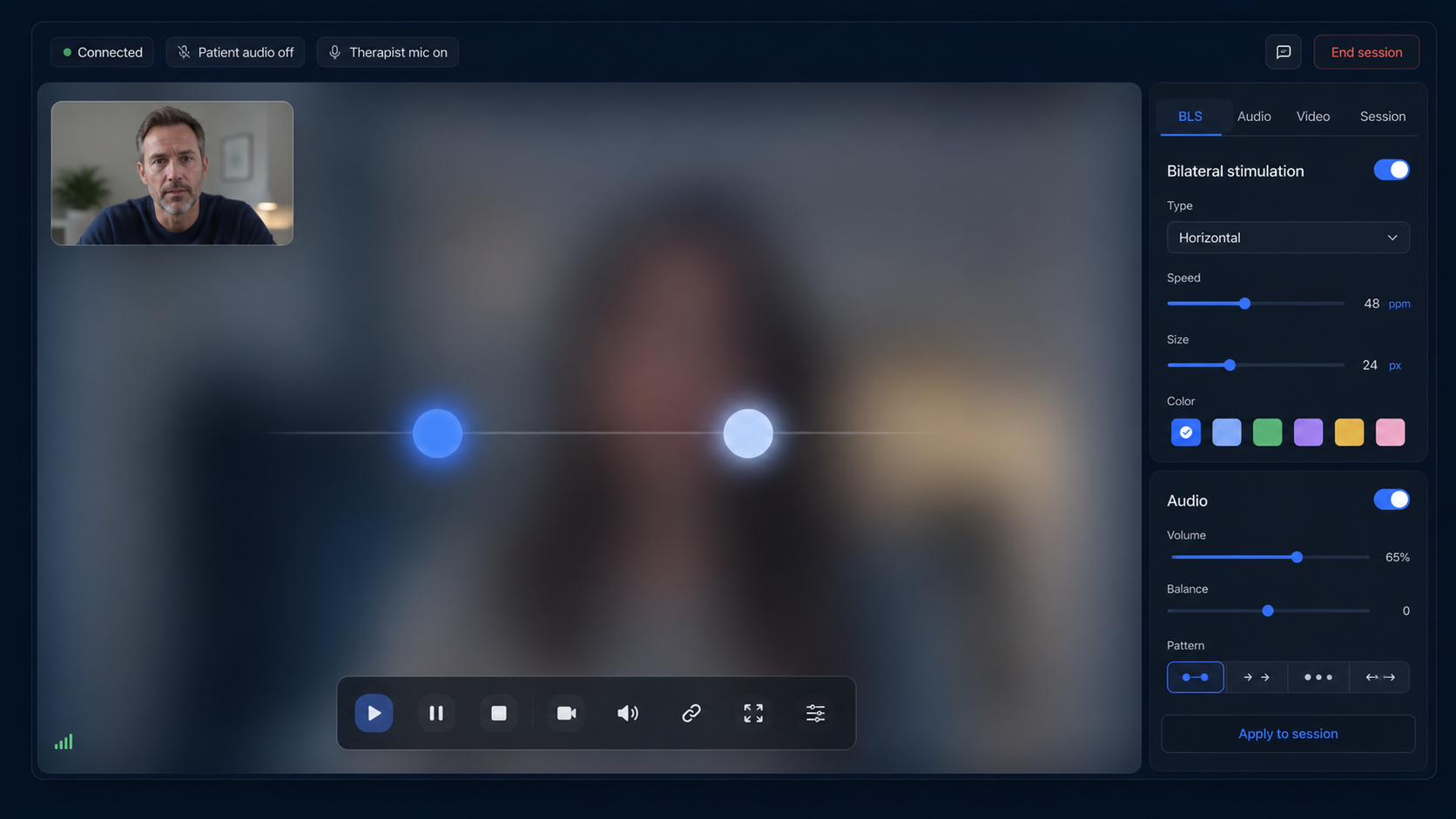
EMDRSuite provides live video and therapist-controlled visual or auditory bilateral stimulation. It does not diagnose ADHD or PTSD, distinguish their symptoms, recommend medication, measure executive function, select targets, or prove treatment response. Clinical assessment and adaptations remain the therapist's responsibility.
FAQ
EMDR and ADHD
Can EMDR cure ADHD?
No evidence establishes EMDR as a treatment or cure for core ADHD symptoms. It may be considered for a separately assessed trauma-related condition.
Can ADHD symptoms be mistaken for trauma symptoms?
They can overlap. Diagnosis requires developmental history, symptoms across settings, impairment, trauma assessment, and qualified clinical judgment.
Should bilateral stimulation be faster for ADHD?
There is no universal ADHD speed. Pace and modality should follow the task, response, comfort, and clinical protocol.
Does EMDRSuite assess ADHD?
No. It supplies session technology and does not diagnose, score, or treat ADHD.
References
EMDR and ADHD: trauma evidence, limits, and session adaptations
EMDRSuite
Put the guide into practice with EMDRSuite
Run remote EMDR with visual BLS, bilateral sounds, secure patient links, video-ready sessions, saved settings, and notes.
Continue with related EMDR guides