Psychotherapy and medical neuromodulation are different treatment categories
EMDR vs TMS: PTSD evidence, indications, and clinical differences
Compare EMDR and transcranial magnetic stimulation by procedure, PTSD and depression evidence, regulation, medical screening, burden, and remote-care limits.
By the EMDRSuite Editorial Team
Product claims checked against the current EMDRSuite code and interface.
No independent clinical reviewer is named for this guide.
EMDR is psychotherapy; TMS is clinician-delivered neuromodulation
EMDR uses an eight-phase psychotherapy protocol, target-memory assessment, dual attention and bilateral stimulation while the patient remains engaged with a therapist. TMS uses a powered coil at the scalp to induce magnetic fields and electrical activity in selected cortical regions; protocol, dose and medical oversight differ by indication and device.
Eye movements on a screen are not transcranial stimulation. Similar words such as stimulation, processing or neural change do not make BLS a magnetic treatment, and neither treatment should be selected from a mechanism slogan alone.
PTSD recommendations and regulatory indications are not interchangeable
The 2023 VA/DoD guideline strongly recommends EMDR among individual trauma-focused psychotherapies and found insufficient evidence for or against repetitive TMS for PTSD. A 2026 combat-PTSD review found that three randomized trials with 116 participants did not show a statistically significant pooled advantage over sham, despite improvement within TMS groups.
FDA clearance cited for TMS concerns major depression in specified patients, not a blanket PTSD indication and not proof of superiority to EMDR. Diagnosis, comorbidity, prior treatment, local authorization and the exact device protocol all matter.
Choice depends on the condition being treated and treatment burden
Clarify whether the primary target is PTSD, major depression, both, or another condition. Compare guideline position, contraindications, access, session frequency, cost, travel, patient preference, psychotherapy readiness, adverse effects and how outcomes will be measured.
A patient may receive psychotherapy and a medical treatment in the same care plan, but evidence for each indication and for the combination must be stated separately. Improvement after one component does not reveal which mechanism caused it.
A remote BLS platform is not a TMS device
Remote EMDR still requires identity, location, privacy, emergency planning, stop signals, camera and audio contingencies. TMS requires medical equipment, trained operation, device-specific screening and in-person safety processes.
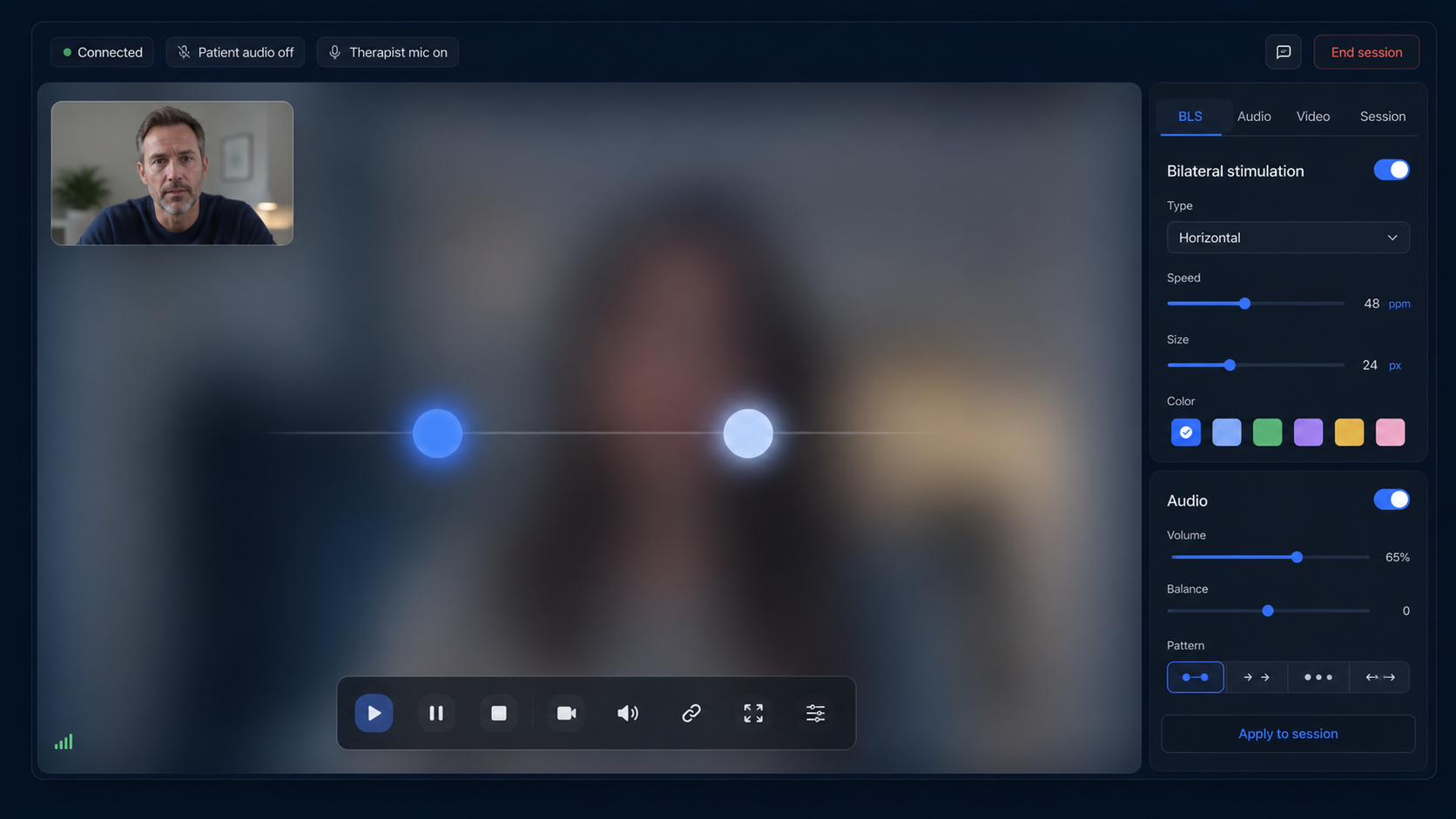
EMDRSuite provides therapist-controlled visual or auditory bilateral stimulation and video. It does not deliver TMS, emit magnetic pulses, position a treatment coil, prescribe stimulation or monitor medical contraindications.
FAQ
EMDR vs TMS
Is EMDR the same as TMS?
No. EMDR is psychotherapy; TMS is device-based medical neuromodulation.
Is TMS approved for PTSD?
Do not infer that from a depression clearance. PTSD authorization and guidance depend on jurisdiction, device and current evidence.
Which is better for PTSD?
Major PTSD guidelines support EMDR; current TMS evidence does not establish superiority over EMDR.
Can EMDRSuite provide TMS?
No. It provides remote EMDR communication and BLS controls, not magnetic stimulation.
References
EMDR vs TMS: PTSD evidence, indications, and clinical differences
EMDRSuite
Put the guide into practice with EMDRSuite
Run remote EMDR with visual BLS, bilateral sounds, secure patient links, video-ready sessions, saved settings, and notes.
Continue with related EMDR guides