Bilateral stimulation does not record or train brain waves
EMDR vs neurofeedback for PTSD: evidence and practical differences
Compare EMDR and EEG or fMRI neurofeedback by treatment task, PTSD evidence, equipment, sham controls, outcome monitoring, and remote-practice boundaries.
By the EMDRSuite Editorial Team
Product claims checked against the current EMDRSuite code and interface.
No independent clinical reviewer is named for this guide.
The active tasks and equipment are different
EMDR organizes trauma treatment through eight phases and asks the patient to notice memory-linked material during brief sets of BLS. EEG neurofeedback measures electrical activity at sensors and returns a contingent signal intended to train regulation; fMRI neurofeedback uses a different imaging-based signal.
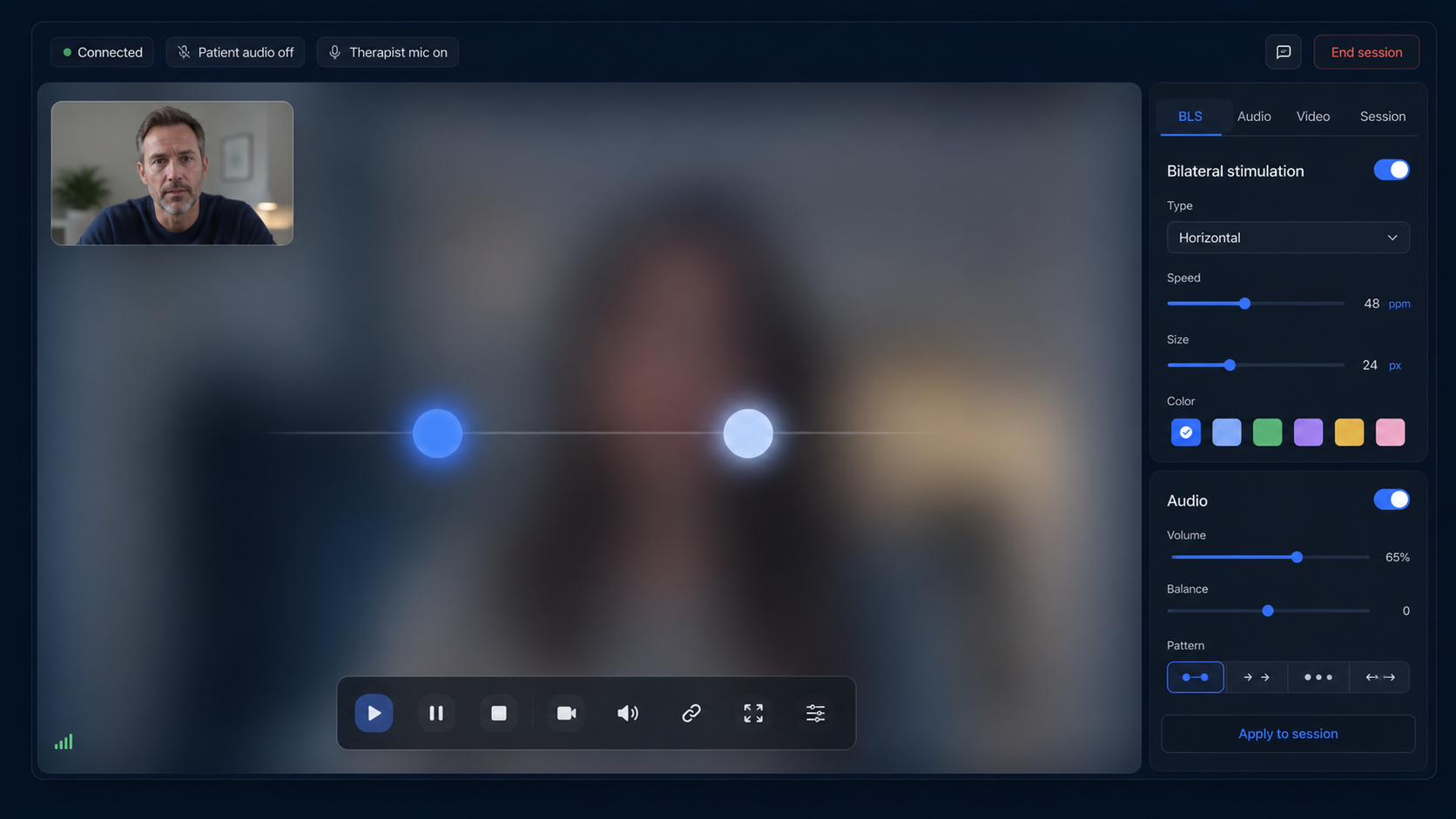
A moving dot does not measure a brain rhythm. Visual feedback, bilateral stimulation and neurofeedback may all appear on screens, but their inputs, targets, protocols, operator competencies and claims are not interchangeable.
Neurofeedback is promising, but certainty and protocols vary
A GRADE review pooled four randomized trials with 123 participants and judged the evidence very uncertain. A later review included ten controlled studies and 293 participants, but emphasized small samples, heterogeneous populations and varied quality. A sham-controlled EEG trial randomized 38 participants.
The 2023 VA/DoD guideline found insufficient evidence for or against neurofeedback for PTSD while strongly recommending EMDR. No direct randomized EMDR-versus-neurofeedback trial establishes equivalence or a winner.
Compare claims at the same level
Separate symptom change from demonstrated learning of a neural target, and separate EEG from fMRI protocols. Ask about sham control, blinded assessment, adverse-event reporting, durability, operator training, equipment quality and whether the protocol is adjunctive or intended as treatment.
For EMDR, measure PTSD symptoms, functioning, dropout and adverse effects while documenting the actual protocol. A choice should follow diagnosis, informed preference, access and competence rather than a promise to reset or regulate the brain.
EMDRSuite is not neurofeedback equipment
Remote EMDR requires a private location, emergency plan, stop control and reconnection procedure. Neurofeedback additionally requires validated acquisition hardware, signal quality, artifact handling and protocol-specific interpretation.
EMDRSuite provides video and therapist-controlled BLS. It does not record EEG, calculate brain feedback, train neural rhythms, or replace neurofeedback equipment.
FAQ
EMDR vs neurofeedback
Is EMDR a type of neurofeedback?
No. EMDR does not depend on measuring and returning a live neural signal.
Does neurofeedback have PTSD evidence?
Small controlled studies are promising, but guideline certainty remains insufficient and protocols vary.
Has neurofeedback been compared directly with EMDR?
No direct randomized comparison was identified in the sources reviewed.
Does EMDRSuite read brain waves?
No. It controls audiovisual BLS and video without EEG or fMRI acquisition.
References
EMDR vs neurofeedback for PTSD: evidence and practical differences
EMDRSuite
Put the guide into practice with EMDRSuite
Run remote EMDR with visual BLS, bilateral sounds, secure patient links, video-ready sessions, saved settings, and notes.
Continue with related EMDR guides