Evidence-based foundation
What is EMDR therapy? A professional overview beyond eye movements
A source-led explanation of EMDR as an eight-phase psychotherapy, how AIP informs formulation, where bilateral stimulation fits, and what trained practice requires.
By the EMDRSuite Editorial Team
Product claims checked against the current EMDRSuite code and interface.
No independent clinical reviewer is named for this guide.
EMDR is a psychotherapy, not a moving dot
Eye Movement Desensitization and Reprocessing is a structured psychotherapy approach. Bilateral stimulation is one component inside a wider process that includes history taking, preparation, target assessment, reprocessing, installation, body scan, closure, and reevaluation.
Reducing EMDR to eye movements or a lightbar removes the formulation, therapeutic relationship, consent, observation, and clinical decisions that give the procedures their context. A video or self-guided stimulus is therefore not equivalent to EMDR therapy delivered by a suitably trained professional.
AIP is the clinical model, not a settled biological explanation
The Adaptive Information Processing model organizes how EMDR clinicians understand experiences that remain linked with present disturbance and adaptive information that may support change. It informs case conceptualization, target planning, and reevaluation.
AIP should be named as the model used by EMDR therapy rather than presented as a directly proven account of brain function. Clinical models, treatment-outcome evidence, and laboratory research on specific mechanisms answer different questions and should not be collapsed into one claim.
The eight phases form a recursive course of treatment
The phases describe a complete treatment framework, but they are not eight equal boxes completed once in a fixed sequence. New information can return the work to history, preparation can recur, every session requires closure, and later contact includes reevaluation.
This distinction matters in documentation and software. A phase label can orient the record, but it cannot establish readiness, successful processing, target completion, or the next clinical action without the therapist's assessment of the whole case.
Professional delivery carries responsibilities that a tool cannot assume
Training, supervision, scope of competence, informed consent, assessment, risk management, cultural context, documentation, and applicable professional rules remain part of the intervention. The exact obligations vary by profession, setting, and jurisdiction.
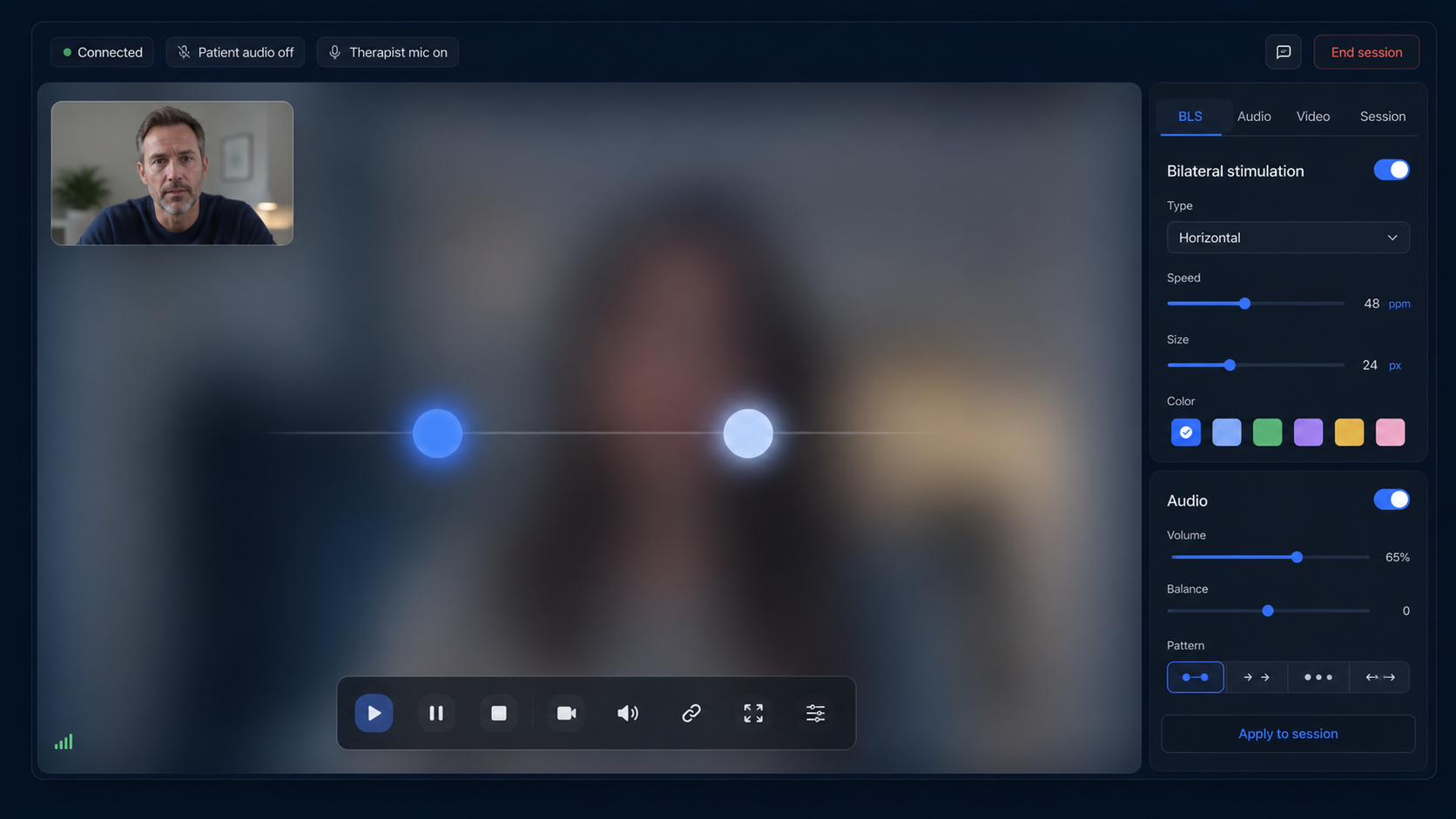
EMDRSuite provides therapist-controlled video, bilateral stimulation, patient access, worksheets, and session records. It does not deliver therapy autonomously, diagnose, select targets, determine suitability, or replace EMDR training and clinical supervision.
FAQ
what is EMDR therapy
Is EMDR the same as bilateral stimulation?
No. Bilateral stimulation is one component used within a broader eight-phase psychotherapy and clinician-led treatment plan.
Does EMDR require eye movements?
Eye movements are common, while some guidance also describes alternating taps or tones when appropriate. Modality and pacing are clinical decisions.
Is the AIP model a proven neurological mechanism?
AIP is EMDR therapy's clinical and theoretical model. It should not be described as a settled biological mechanism.
Can EMDR software provide therapy by itself?
No. Software can support delivery and records, but assessment, consent, formulation, intervention, monitoring, and follow-up belong to the trained therapist.
References
What is EMDR therapy? A professional overview beyond eye movements
EMDRSuite
Put the guide into practice with EMDRSuite
Run remote EMDR with visual BLS, bilateral sounds, secure patient links, video-ready sessions, saved settings, and notes.
Continue with related EMDR guides