Mechanism and uncertainty
How does EMDR work? AIP, working memory, and what remains uncertain
Separate EMDR's AIP clinical model from working-memory and other mechanism hypotheses, and communicate the evidence without overstating what bilateral stimulation proves.
By the EMDRSuite Editorial Team
Product claims checked against the current EMDRSuite code and interface.
No independent clinical reviewer is named for this guide.
Start by separating three levels of explanation
A clinical model describes how a therapy organizes case understanding and intervention. A component study asks what changes when one element is added or removed. A biological mechanism explains the causal processes that produce an outcome. Evidence at one level does not automatically prove another.
EMDR's AIP model belongs to the first level. Outcome trials address whether a treatment package helps a defined population. Eye-movement and dual-task experiments investigate narrower processes. A credible explanation tells the reader which level each statement occupies.
Working-memory research offers a testable account
One hypothesis is that recalling an emotional image while performing a demanding secondary task competes for limited working-memory resources. Laboratory studies and meta-analytic work report reductions in vividness or emotionality under some dual-task conditions.
These findings support a plausible process but do not by themselves explain the full clinical course of EMDR. Laboratory memories, short-term ratings, treatment targets, therapeutic interaction, and durable outcomes are not interchangeable measures.
Other accounts and unresolved questions remain
Orienting responses, attentional flexibility, memory reconsolidation or updating, extinction-related learning, physiological changes, and contextual or relational factors have all been discussed. The evidence does not justify presenting one complete neural story as settled.
Research also asks whether task type, speed, complexity, modality, and fit with the person's capacity alter effects. Results about eye movements cannot automatically be transferred to tones, taps, animations, or a particular software setting.
Uncertainty should improve practice, not weaken it
Therapists can explain that EMDR is a structured psychotherapy with guideline support for PTSD while being transparent that its complete mechanism is still studied. This is more accurate than promising that bilateral stimulation synchronizes hemispheres, rewires the brain, or guarantees processing.
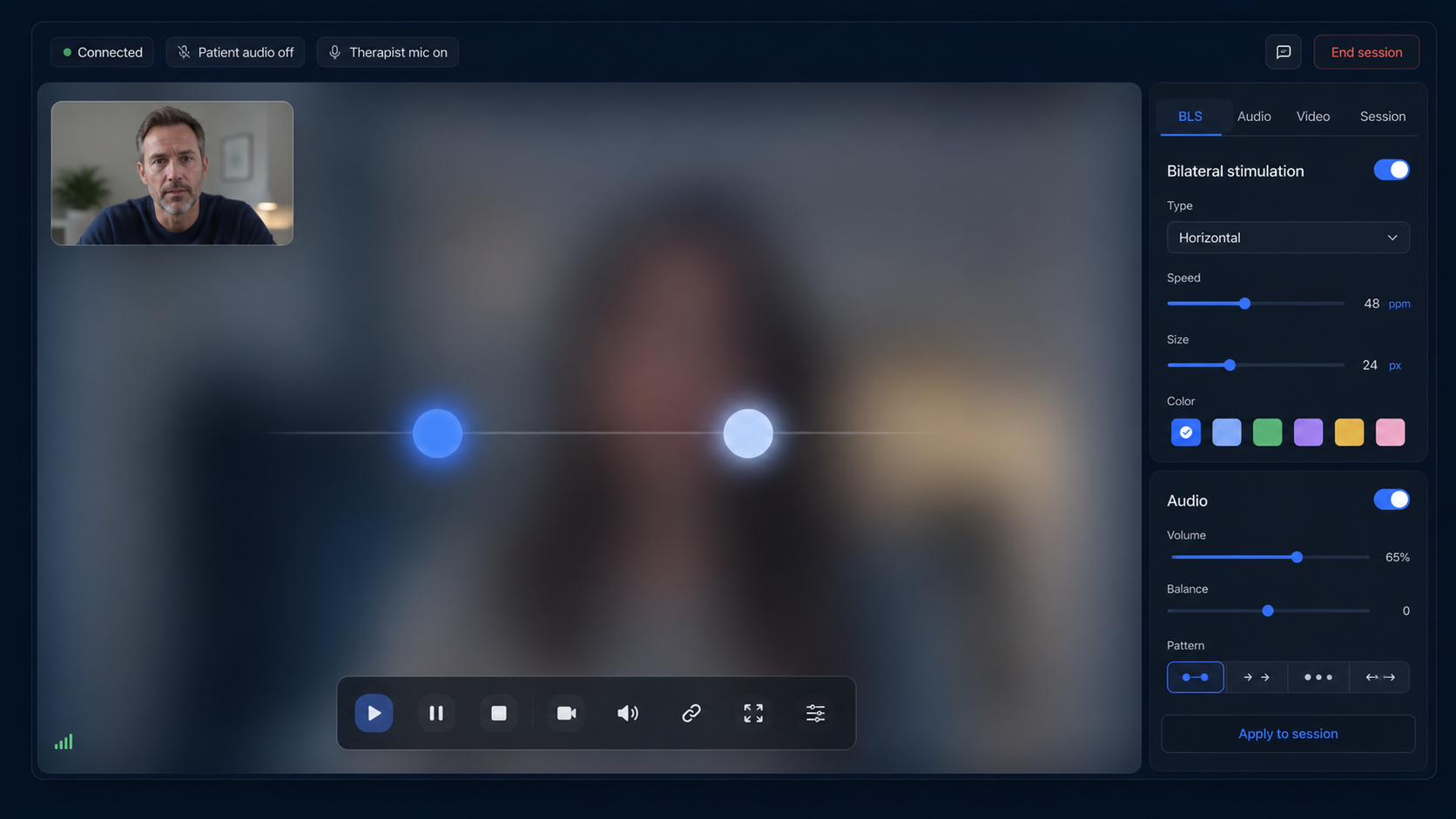
EMDRSuite exposes stimulus controls to the therapist and keeps the patient able to pause. It does not infer an optimal cognitive load, biological response, dose, or outcome from speed, modality, eye movement, or session duration.
FAQ
how does EMDR work
Is working-memory theory the proven explanation for EMDR?
It is a prominent, testable hypothesis with supporting evidence, but it does not settle the complete mechanism of the therapy.
Does bilateral stimulation synchronize the brain hemispheres?
That simplified claim is not an established explanation and should not be presented as fact.
Do laboratory changes in memory vividness prove clinical effectiveness?
No. They can inform mechanism research, but clinical outcomes require applicable treatment studies.
Can software calculate the ideal BLS speed from mechanism research?
No. Research does not support an automatic universal dose; modality and pacing remain clinician-led and person-specific.
References
How does EMDR work? AIP, working memory, and what remains uncertain
EMDRSuite
Put the guide into practice with EMDRSuite
Run remote EMDR with visual BLS, bilateral sounds, secure patient links, video-ready sessions, saved settings, and notes.
Continue with related EMDR guides