Nomenclature, processing continuum, and evidence
EMD restricted processing versus standard EMDR: differences and evidence
A therapist guide to EMD restricted processing, EMDr and standard EMDR terminology, randomized findings, clinical pacing, fidelity, documentation, and evidence limits.
By the EMDRSuite Editorial Team
Product claims checked against the current EMDRSuite code and interface.
No independent clinical reviewer is named for this guide.
EMD, EMDr, and EMDR are not interchangeable labels
Training materials use EMD for tightly restricted focus, EMDr for a more limited associative range, and EMDR for standard unrestricted reprocessing within the full eight-phase treatment. Capitalization and definitions are not fully standardized across trainers, publications, and services.
Record the actual procedure, purpose, target, phase, prompts, return-to-target pattern, bilateral task, stopping criteria, and relationship to the treatment plan rather than relying on a label alone. Eye Movement Desensitization is also used in research for interventions that may not match a particular training continuum.
A 91-person trial did not show added benefit from eye movements
A 2022 trial randomized 91 adults with PTSD to an EMD intervention or retrieval-only active control. Both contained history, planning, preparation, assessment, and closure; the EMD arm added eye movements. Symptoms and quality of life improved over time, but there were no significant group-by-time differences through three months.
This study tests one defined EMD package and the additive eye-movement question. It does not show that every restricted-processing approach is ineffective, and it does not establish equivalence with full standard EMDR.
Earlier comparative evidence was also small and inconclusive
A 1994 trial randomized 36 people with PTSD to EMD, image habituation, or applied muscle relaxation. All groups improved relative to waiting list, benefits persisted at three months, and differences between active groups were not demonstrated.
Small samples, older methods, heterogeneous nomenclature, and different comparators make broad claims unsafe. A recent clinical framework explicitly describes case illustrations rather than an efficacy study and says they do not permit causal inference.
Restricted processing is a pacing decision, not an automatic safety guarantee
A narrower attentional range may be chosen to contain activation or preserve present orientation, but restriction can also interrupt useful associative processing or become avoidance. Define why it is being used, what is monitored, when to stop, and what evidence would support moving toward, remaining with, or leaving the approach.
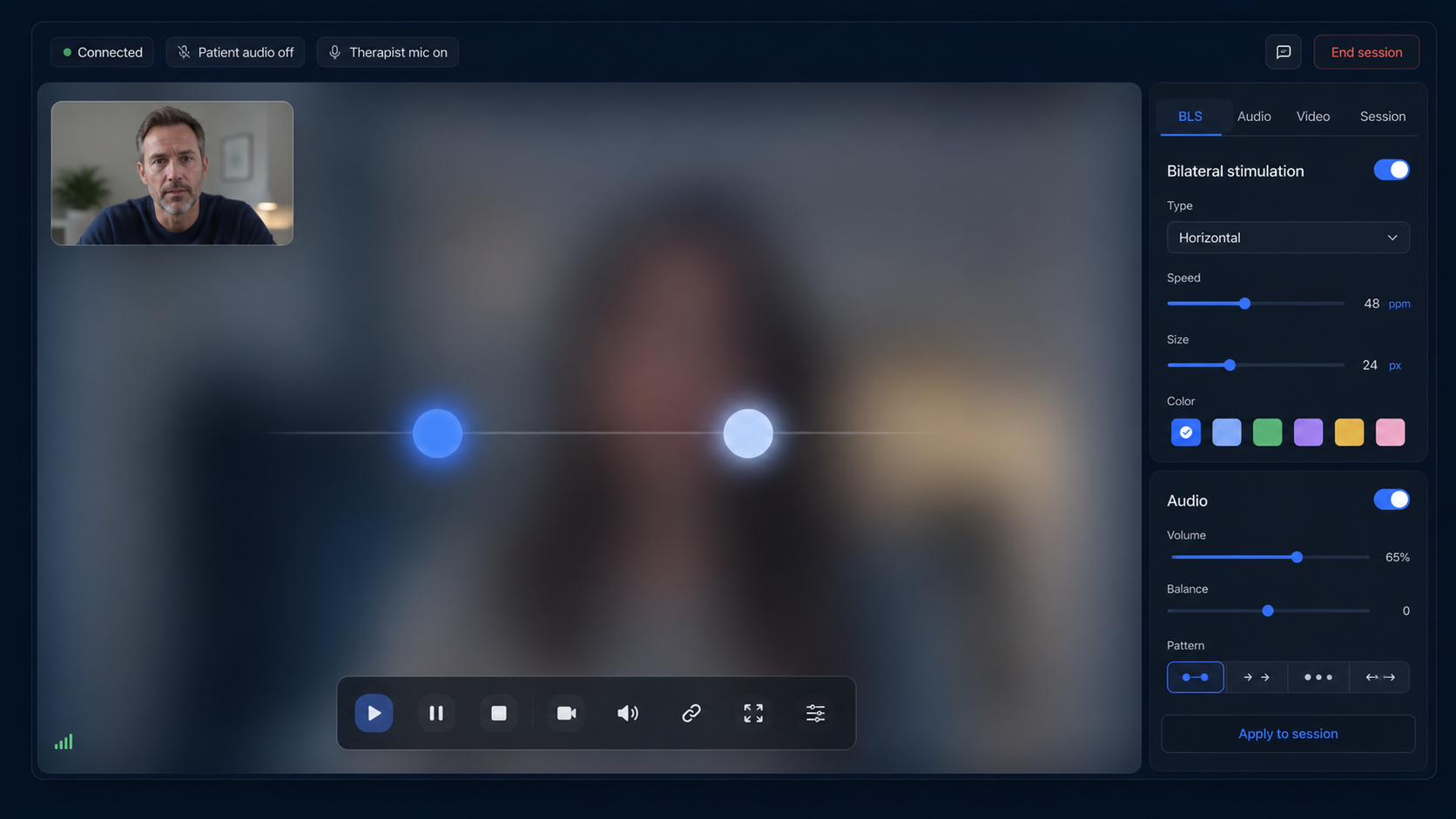
EMDRSuite allows the therapist to control stimulation and document a session. It does not enforce EMD, EMDr, or standard EMDR fidelity, choose a processing range, detect overwhelm or dissociation, or provide the training needed to make those decisions.
FAQ
EMD restricted processing
What is the difference between EMD and EMDR?
EMD usually denotes more restricted focus, while standard EMDR permits broader associative processing within the full eight-phase treatment; terminology varies.
Is restricted processing proven safer?
No general safety superiority is established. It remains a clinical pacing choice requiring monitoring.
Did eye movements improve outcomes in the 91-person EMD trial?
No significant added group-by-time benefit was found over retrieval only in that study.
Can EMDRSuite select EMD or EMDR automatically?
No. It provides controls, not protocol selection, fidelity assessment, or clinical judgment.
References
EMD restricted processing versus standard EMDR: differences and evidence
EMDRSuite
Put the guide into practice with EMDRSuite
Run remote EMDR with visual BLS, bilateral sounds, secure patient links, video-ready sessions, saved settings, and notes.
Continue with related EMDR guides