Present orientation, dual attention, and dissociation
EMDR CIPOS for dissociation: evidence, present orientation, and limits
A therapist guide to CIPOS in EMDR, present orientation and safety, the 30-person non-clinical study, dissociation assessment, evidence limits, training, and remote care.
By the EMDRSuite Editorial Team
Product claims checked against the current EMDRSuite code and interface.
No independent clinical reviewer is named for this guide.
CIPOS is designed around present orientation, not diagnostic shorthand
CIPOS means Constant Installation of Present Orientation and Safety. It alternates limited contact with distressing material and deliberate reorientation to the present, aiming to preserve dual attention when dissociative detachment or loss of present context may interfere with trauma-focused work.
A dissociation score, diagnosis, freeze response, blank mind, or difficult session does not automatically prescribe CIPOS. Clarify the dissociative phenomenon, differential diagnoses, triggers, orientation, amnesia, parts or identity experiences where relevant, risk, function, goals, and the clinician's competence.
The direct experiment involved 30 healthy students, not PTSD patients
The published study compared a shortened CIPOS condition with exposure only in 30 healthy university students aged 20 to 30 using autobiographical distress scripts and subjective and physiological measures. Participants rated subjective distress reduction more favorably with CIPOS, while effects were small and the design was mechanistic.
The authors explicitly state that the study does not establish effects in ongoing trauma therapy or in patients with PTSD and calls for replication and clinical research. It cannot prove safety or efficacy for severe dissociation, dissociative identity disorder, complex PTSD, psychosis, or remote treatment.
Present orientation is one treatment need, not a complete dissociation plan
Work with complex dissociative disorders may require longitudinal assessment, phase-oriented treatment, attention to amnesia and internal conflict, crisis and self-harm management, medication or medical review, consultation, and coordination. An adjunct technique cannot replace that treatment frame.
Document what loss of dual attention looks like for the individual, how it will be noticed, what stop or reorientation plan is agreed, whether the intervention improves engagement and function, and whether it delays, enables, or destabilizes the indicated treatment.
Remote delivery needs a real-world orientation and interruption plan
Confirm current location, privacy, emergency and backup contacts, what happens if video or audio fails, how the therapist recognizes reduced orientation, which present-context cues are accessible, and how the session will close. Do not rely on a screen animation as evidence of safety.
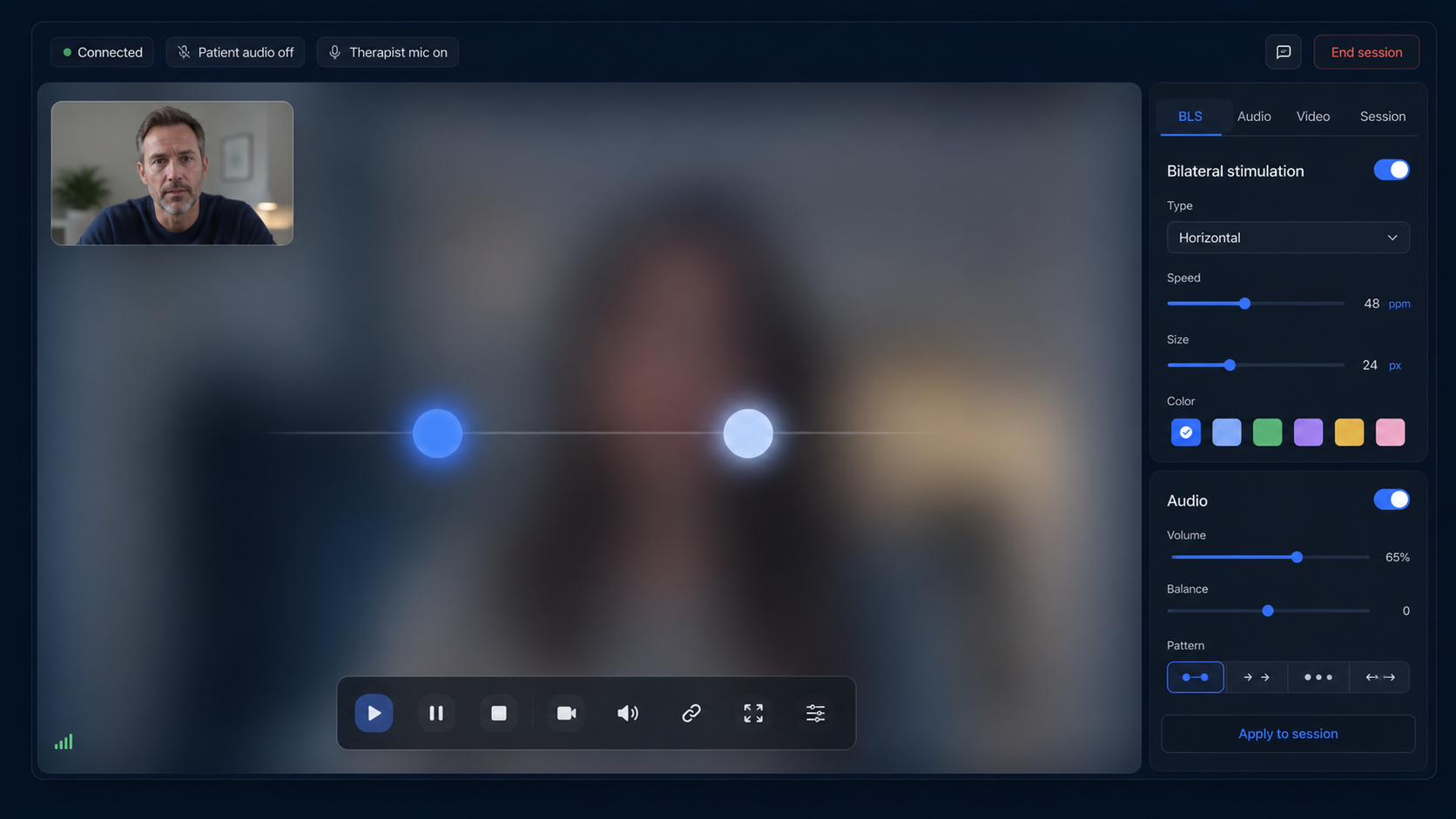
EMDRSuite can support bilateral stimulation and therapist-patient communication. It does not diagnose dissociation, monitor orientation, recognize switching or shutdown, administer CIPOS, provide crisis response, or verify competence in complex dissociative disorders.
FAQ
EMDR CIPOS dissociation
What does CIPOS stand for?
Constant Installation of Present Orientation and Safety.
Is CIPOS proven for dissociative identity disorder?
No. The direct published experiment used 30 healthy students, not patients with DID or PTSD.
Does dissociation always require CIPOS before EMDR?
No. Dissociation is heterogeneous and technique choice requires individualized assessment and formulation.
Can EMDRSuite detect loss of present orientation?
No. It cannot assess dissociation, dual attention, switching, or clinical safety.
References
EMDR CIPOS for dissociation: evidence, present orientation, and limits
EMDRSuite
Put the guide into practice with EMDRSuite
Run remote EMDR with visual BLS, bilateral sounds, secure patient links, video-ready sessions, saved settings, and notes.
Continue with related EMDR guides