A patient-centered map without a scripted promise
First EMDR session: what to expect, ask, and prepare
What may happen in a first EMDR appointment: assessment, preparation, consent, treatment planning, possible processing, questions to ask, and what software cannot decide.
By the EMDRSuite Editorial Team
Product claims checked against the current EMDRSuite code and interface.
No independent clinical reviewer is named for this guide.
The first appointment is usually broader than eye movements
EMDR is an eight-phase psychotherapy, not a light moving across a screen. Early work normally includes history, current symptoms and goals, treatment planning, explanation of the method, consent, and preparation. The therapist may ask about risk, dissociation, medical or substance factors, supports, privacy, and what helps you regain present orientation.
The exact sequence varies with the service, information already collected, session length, urgency, and your needs. A clinician should not promise that every first appointment includes bilateral stimulation, but it is also inaccurate to declare that processing can never begin in the first meeting. Assessment, consent, readiness, and a workable plan determine the pace.
You keep control and do not have to provide every detail
A therapist may help identify a memory, image, belief, emotion, body sensation, or current trigger. EMDR does not require a public, exhaustive narrative of every traumatic detail. You can ask why a question matters, request a pause, decline to answer, and discuss how much detail is clinically useful.
Preparation should include what bilateral stimulation may look or sound like, a stop signal, how distress will be monitored, how the session will end, and what to do between appointments. For online work, confirm location, privacy, camera and audio permissions, a backup contact method, and what happens if the connection drops.
Useful questions test competence and fit
Ask about the therapist's EMDR training and credential context, experience with your presenting problem, how they assess readiness and dissociation, alternatives, expected review points, adverse changes, and how progress will be measured. No responsible therapist can guarantee a number of sessions or a particular emotional reaction.
A good explanation separates established evidence for PTSD from weaker or condition-specific evidence elsewhere. It should also distinguish standard EMDR from derived techniques or adaptations and explain why any departure is being proposed. Consent is an ongoing conversation, not a form that removes your right to stop.
Software can support a session but cannot conduct the assessment
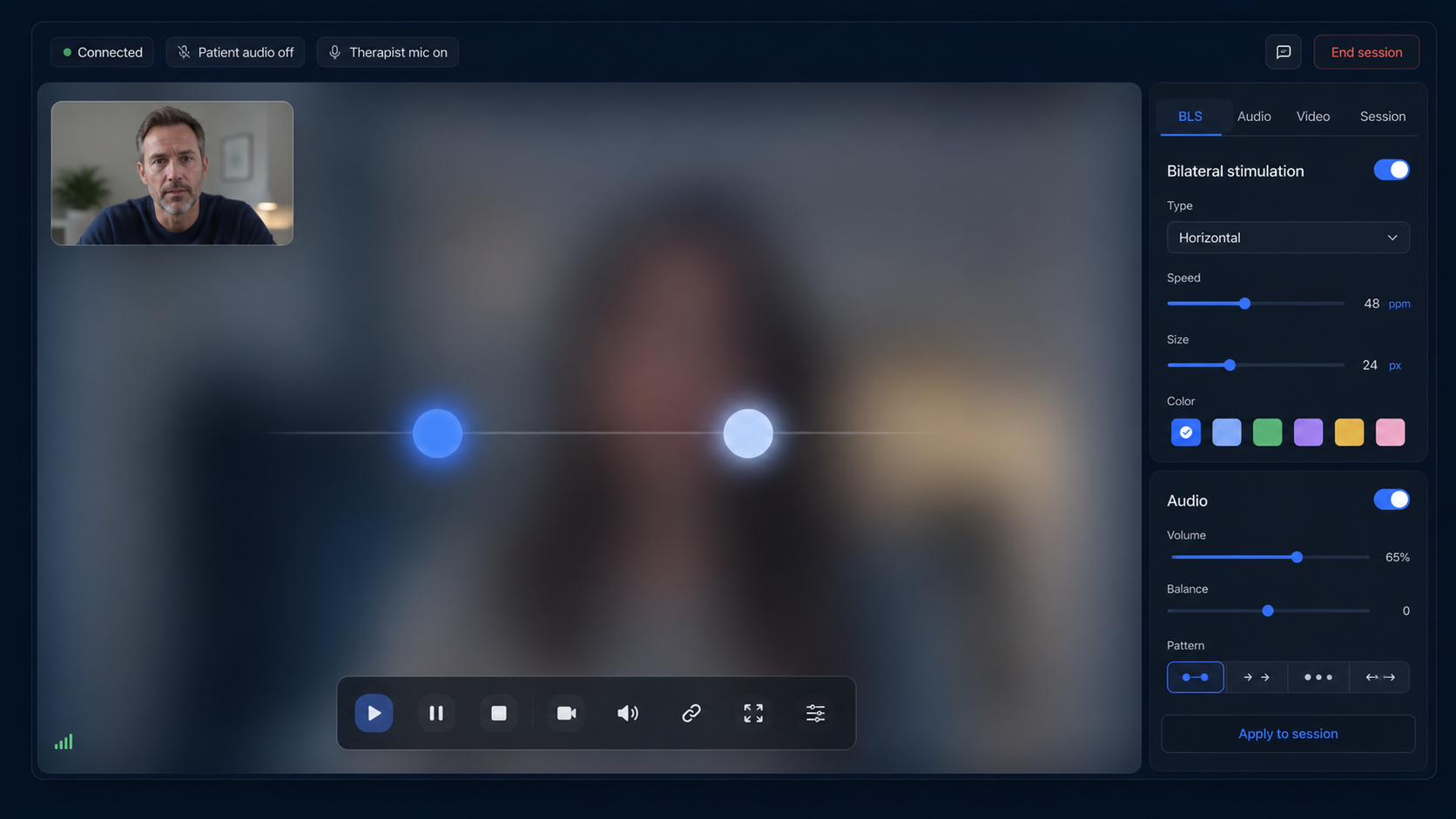
EMDRSuite can provide a private session room, video, and therapist-controlled visual or auditory bilateral stimulation. It does not diagnose PTSD, choose a target, assess readiness, monitor dissociation, obtain clinical consent, respond to emergencies, or decide whether processing should start.
Before real clinical use, therapist and patient can test entry, permissions, sound direction, visual comfort, pause, reconnection, and the backup channel without using patient data. Clinical responsibility, records, local legal duties, and emergency planning remain with the treating professional and service.
FAQ
first EMDR session what to expect
Will I process trauma in my first EMDR session?
Possibly, but not necessarily. The pace depends on prior assessment, consent, readiness, session context, and clinical judgment.
Do I have to tell the full trauma story?
No. EMDR does not require an exhaustive verbal account, and you can discuss what level of detail is useful and tolerable.
Can I stop bilateral stimulation?
Yes. Agree on a clear stop signal and tell the therapist whenever you need to pause or change course.
Can EMDRSuite tell whether I am ready?
No. It provides technical session controls, not clinical assessment or treatment decisions.
References
First EMDR session: what to expect, ask, and prepare
EMDRSuite
Put the guide into practice with EMDRSuite
Run remote EMDR with visual BLS, bilateral sounds, secure patient links, video-ready sessions, saved settings, and notes.
Continue with related EMDR guides