EMDR clinical practice
EMDR BLS speed and set length: clinical pacing without a universal dose
A professional guide to BLS speed, set duration, modality, observation, patient feedback, remote delivery, and why research does not define one automatic EMDR dose.
By the EMDRSuite Editorial Team
Product claims checked against the current EMDRSuite code and interface.
No independent clinical reviewer is named for this guide.
A set is a clinical interval, not a product dosage
EMDRIA defines a set as the period during which the patient engages in bilateral stimulation during reprocessing. Speed, duration, modality, visual range, comfort, task demand, and what happens between sets form part of a therapist-led process with observation and patient feedback.
Published descriptions often report example intervals, but they do not establish a universal number of passes, seconds, pixels, beats per minute, or sets for every patient and target. A preset can support continuity; it must not be presented as an evidence-certified therapeutic dose.
Experimental speed findings are not an automatic prescription
Analogue studies in non-clinical participants found that faster eye movements can impose greater working-memory load and reduce rated vividness more than slower movement under specific laboratory conditions. Another experiment did not support tailoring speed to measured working-memory capacity.
Those findings inform mechanism hypotheses, not a validated clinical calculator. Participants, tasks, outcomes, devices, cycle definitions, and exposure periods differ from individual psychotherapy. They cannot tell software which speed will be effective, tolerable, safe, or protocol-consistent for the person in front of the therapist.
Pacing responds to process, contact, and accessibility
The therapist considers the purpose and phase, patient preference and feedback, eye comfort, visual tracking, sensory or motor needs, fatigue, activation, dual attention, dissociation, processing response, and the ability to stop. Modality may change when visual, auditory, or tactile delivery is not accessible or suitable.
Stop or pause takes priority when the patient requests it, contact is uncertain, the stimulus stutters, physical discomfort appears, orientation changes, or safety needs review. More speed or longer sets are not a correction for every apparent block and should not replace reassessment.
Remote technology must reproduce the chosen setting reliably
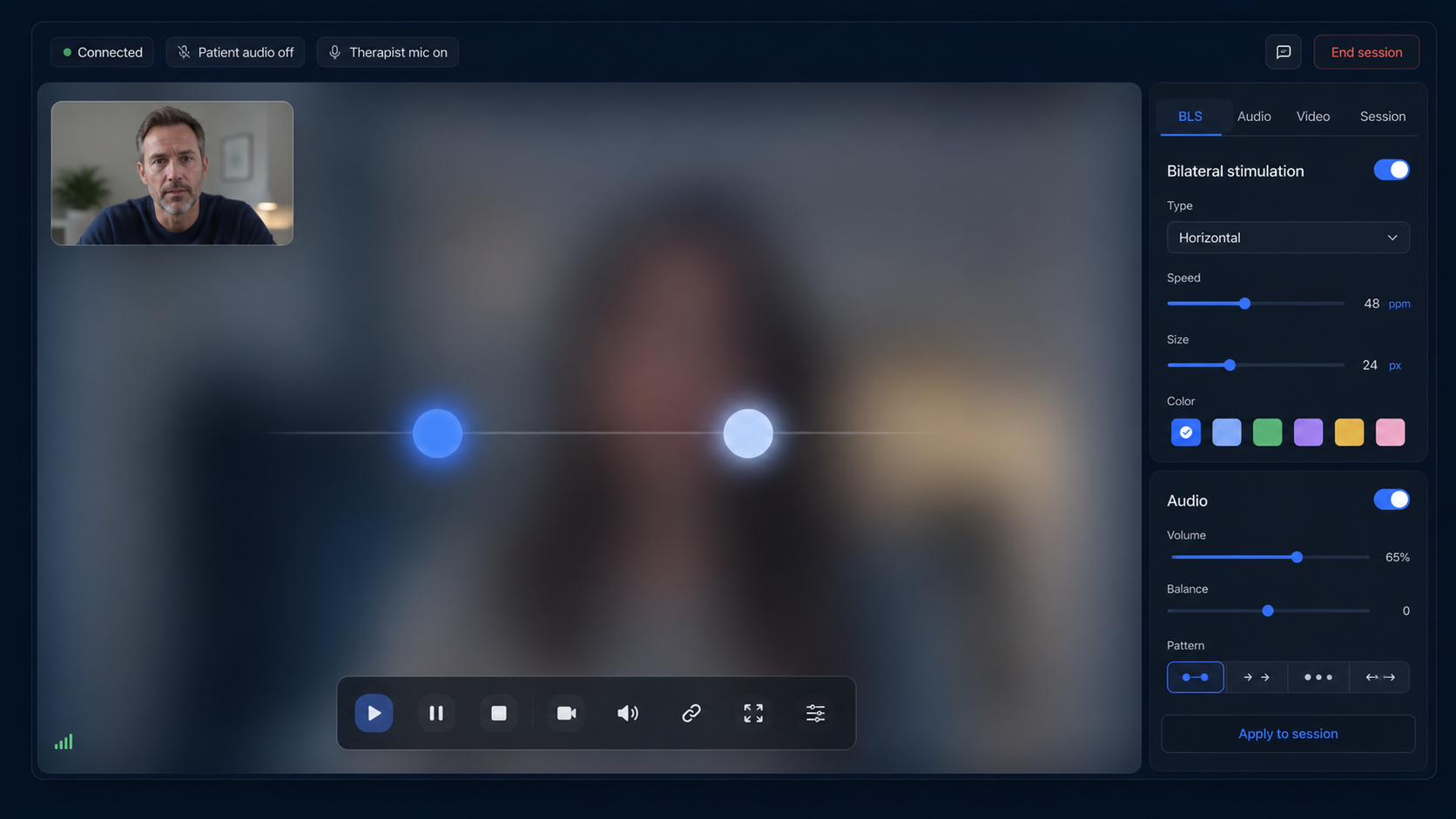
Test the actual patient screen, frame rate, movement range, headphones, stereo orientation, volume, latency, pause, stop, reconnection, and fallback. Record the therapist-selected setting in understandable units and the observed response, without implying that the platform measured treatment effect.
EMDRSuite lets the therapist control visual and auditory BLS and stop it immediately in the shared room. It does not recommend speed, set length, modality, or number of repetitions; interpret processing; or replace protocol training, supervision, accessibility assessment, and clinical responsibility.
FAQ
EMDR BLS speed
What is an EMDR BLS set?
It is a period of bilateral stimulation within the therapist-led process, followed by observation or feedback according to the clinical protocol.
What is the correct EMDR eye-movement speed?
No universal speed is established for every person, target, phase, and modality. Selection and adjustment remain clinician-led.
Do faster movements always work better?
No. Laboratory findings about working-memory load do not establish universal clinical superiority, tolerability, or safety.
Can EMDRSuite choose BLS speed automatically?
No. It provides controls and saved settings while the qualified therapist selects and monitors their clinical use.
References
EMDR BLS speed and set length: clinical pacing without a universal dose
EMDRSuite
Put the guide into practice with EMDRSuite
Run remote EMDR with visual BLS, bilateral sounds, secure patient links, video-ready sessions, saved settings, and notes.
Continue with related EMDR guides