BLS modality guide
Visual, auditory, and tactile BLS in remote EMDR
Compare visual, auditory, and tactile bilateral stimulation for remote EMDR, including browser delivery, headphones, external hardware, patient fit, and contingency planning.
By the EMDRSuite Editorial Team
Product claims checked against the current EMDRSuite code and interface.
No independent clinical reviewer is named for this guide.
Modality is a clinical choice, not a feature race
Visual, auditory, and tactile stimulation create different sensory demands. A longer feature list does not determine which modality fits a patient, a phase of work, or a particular set. The qualified therapist selects, monitors, and adjusts the modality within the clinical plan.
Remote delivery adds practical variables: screen size, visual comfort, headphones, household privacy, connectivity, and whether separate tactile hardware is available.
Visual BLS can be rendered in the patient browser
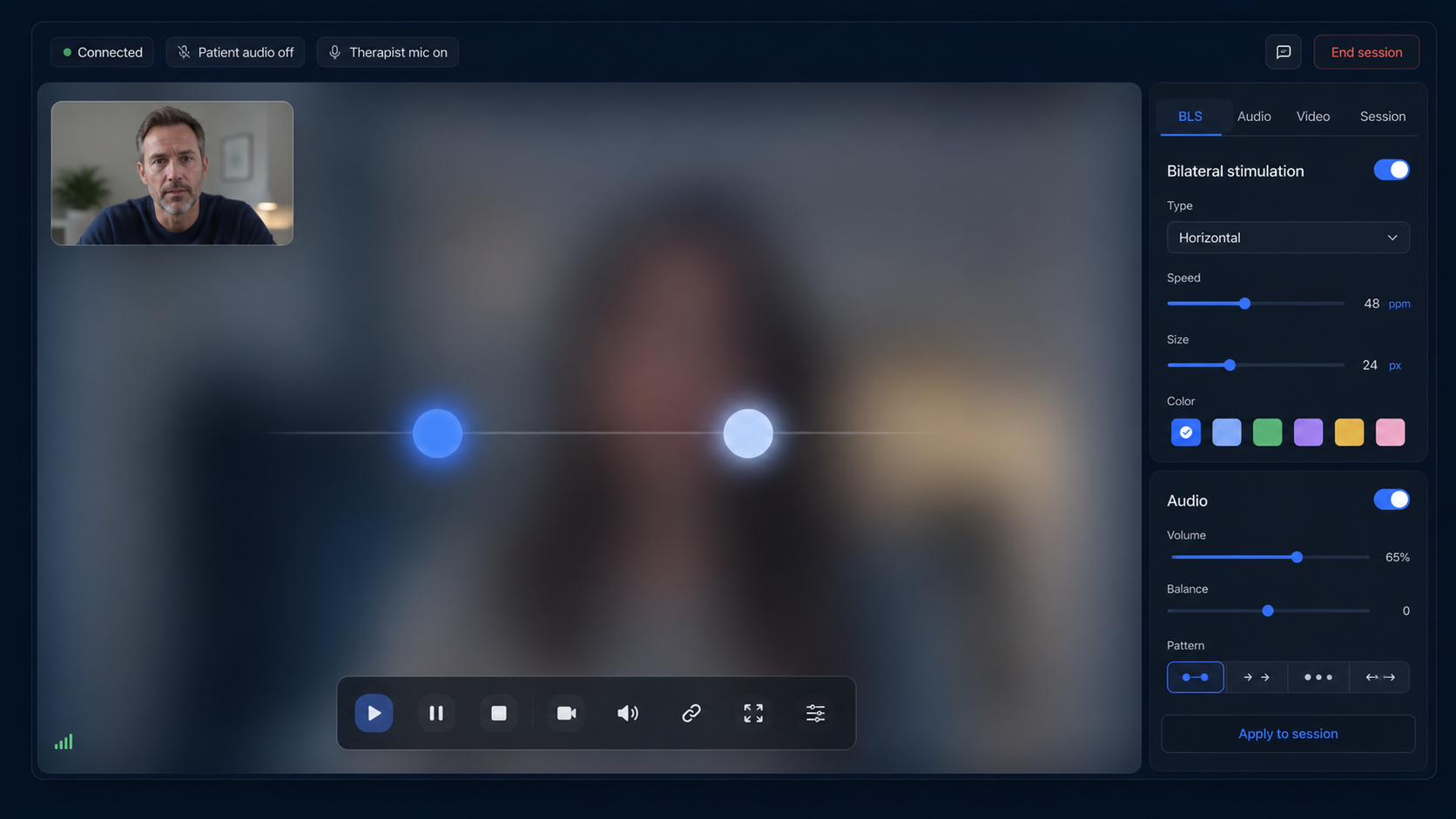
A dedicated online BLS room can draw the moving target directly on the patient's screen while the therapist controls direction, speed, size, shape, color, duration, and pause. Local rendering avoids the blur and scaling that screen sharing may introduce.
The useful test is not merely whether the animation moves. Check smoothness on the patient's actual device, viewing distance, comfortable range, focus, and the patient's ability to request an immediate pause.
Auditory BLS depends on stereo setup and comfort
Alternating left-right sound requires stereo output, so headphones are normally the clearest setup. Test channel orientation, volume, sound choice, timing, and whether browser audio needs a tap or click before it can play.
EMDRSuite can synchronize bilateral audio with visual pacing. The therapist may use either modality or combine them when clinically appropriate; software should not decide that combination automatically.
Tactile BLS requires a separate delivery method
Tactile stimulation cannot be created by an ordinary browser alone. It may involve therapist-guided self-tapping or compatible external hardware, according to training, patient needs, product instructions, and local practice requirements.
EMDRSuite currently provides visual and auditory BLS, not tactile hardware control. If tactile delivery is part of the plan, test that separate method in advance and keep start, stop, reconnection, and backup communication procedures clear.
FAQ
visual auditory tactile BLS remote EMDR
Does EMDRSuite provide all three BLS modalities?
It provides therapist-controlled visual and auditory BLS. It does not currently control tactile buzzers or other tactile hardware.
Are headphones required for auditory BLS?
Stereo headphones are normally recommended so left-right alternation is distinct and private, but suitability is determined by the therapist and patient.
Can visual and auditory BLS run together?
Yes. EMDRSuite can synchronize visual movement and bilateral sound, or the therapist can use either modality independently.
Is one modality clinically better online?
Not as a universal product rule. Selection and pacing depend on clinical judgment, patient response, context, training, and the practical reliability of the setup.
References
Visual, auditory, and tactile BLS in remote EMDR
EMDRSuite
Put the guide into practice with EMDRSuite
Run remote EMDR with visual BLS, bilateral sounds, secure patient links, video-ready sessions, saved settings, and notes.
Continue with related EMDR guides