Online EMDR tool
How therapist-controlled online BLS reaches the patient
Understand how an online EMDR tool sends live visual and auditory bilateral stimulation controls from the therapist workspace to a focused patient room.
By the EMDRSuite Editorial Team
Product claims checked against the current EMDRSuite code and interface.
No independent clinical reviewer is named for this guide.
Two interfaces, one live session
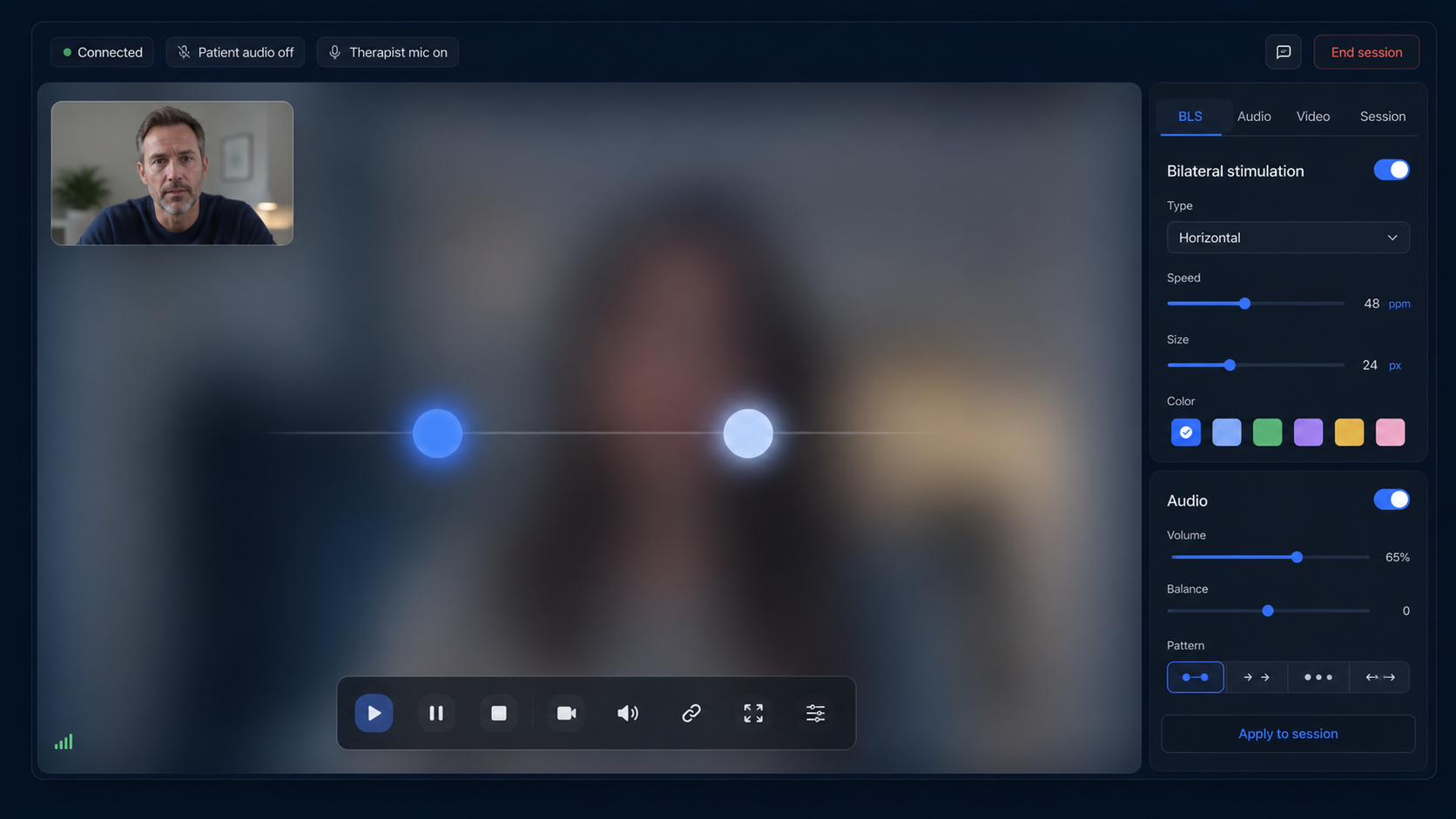
The therapist and patient do not need the same controls. The therapist room contains configuration, timing, start, pause, stop, video, and notes. The patient room prioritizes the stimulus, connection state, media controls, and an immediate pause signal.
Separating those responsibilities keeps clinical controls out of the patient's way while preserving a shared real-time session state.
The therapist configures the set
Before starting, the therapist selects direction, speed, shape, size, color, duration, repetitions, and optional left-right audio. Settings can be adjusted during preparation and reviewed for each session rather than treated as a fixed prescription.
Live commands synchronize the patient room
When the therapist starts, pauses, stops, or changes the configuration, the browser sends a session command through the protected real-time channel. The patient's browser renders the movement locally, which avoids the compression and scaling introduced by screen sharing.
The platform supports delivery; it does not decide pacing or clinical appropriateness. Those remain the responsibility of the qualified therapist.
Pause, reconnect, and close deliberately
The patient can request an immediate pause, and connection indicators help both people recognize a disruption. A reconnection mechanism is useful, but it must sit alongside an agreed backup contact method.
After a set, the therapist returns to assessment and documentation. No technical convenience removes the need for consent, observation, regulation, and a safe closure plan.
FAQ
therapist-controlled online BLS
Does online BLS require screen sharing?
No. A dedicated patient room can render the visual stimulus locally while receiving live commands from the therapist.
What can the therapist control?
EMDRSuite supports direction, speed, size, shape, color, duration, repetitions, visual movement, bilateral audio, and start, pause, or stop actions.
Can the patient stop the stimulus?
The patient room includes an immediate pause signal that alerts the therapist and stops the active set.
Is the stimulation automated therapy?
No. The software delivers controls selected by a qualified therapist and does not replace clinical judgment or treatment.
References
How therapist-controlled online BLS reaches the patient
EMDRSuite
Put the guide into practice with EMDRSuite
Run remote EMDR with visual BLS, bilateral sounds, secure patient links, video-ready sessions, saved settings, and notes.
Continue with related EMDR guides