A feared enclosed space is not automatically PTSD or panic disorder
EMDR for claustrophobia: evidence, exposure, and remote-care limits
Assess EMDR for claustrophobia using direct exposure studies, limited general EMDR phobia evidence, MRI and medical safety, and measurable avoidance.
By the EMDRSuite Editorial Team
Product claims checked against the current EMDRSuite code and interface.
No independent clinical reviewer is named for this guide.
Define the feared situation, prediction, and avoidance
Claustrophobic fear may involve elevators, trains, tunnels, aircraft, locked rooms, masks, scans, crowds, or inability to move or escape. The feared outcome may be suffocation, panic, entrapment, loss of control, humiliation, medical harm, or repetition of an earlier event.
Differentiate specific situational phobia from panic disorder, agoraphobia, PTSD, OCD, sensory or disability-related needs, respiratory or cardiac illness, and realistic hazards. For MRI or procedures, coordinate actual contraindications, sedation, communication, positioning, and facility safety rather than treating all concern as irrational.
There is no direct controlled EMDR claustrophobia trial here
The cited EMDR-specific-phobia review called the empirical support meagre. In the childhood spider-phobia comparison it summarized, EMDR improved self-reported fear but in-vivo exposure improved all outcomes and remained the treatment of choice. That finding cannot be promoted as evidence for claustrophobia.
A prior entrapment or medical event may qualify as a responsibly assessed memory target. Processing that memory does not by itself demonstrate willingness or ability to enter the enclosed situations the person needs to use.
Claustrophobia studies directly test exposure and expectancy
A randomized study of 48 participants found pure exposure superior to control across many measures, while cognitive work also reduced reported fear and panic. A later study randomized 93 participants to cognitive restructuring before or after exposure; both orders produced similarly large improvements through follow-up.
Another study gave exposure training to 45 participants before randomizing mental reinstatement versus control. Reinstatement reduced heart-rate reactivity in a mock MRI but not self-reported fear or avoidance, and groups did not differ on claustrophobia or MRI fear at one month. Physiological change alone is not functional recovery.
Remote memory work cannot substitute for real-world safety and learning
Agree whether the goal is a memory, a future image, entering a lift, completing an MRI, tolerating a mask, or broader functioning. Measure approach behavior and avoidance, preserve informed choice about exposure-based treatment, and coordinate with medical or occupational services when the feared setting has real safety rules.
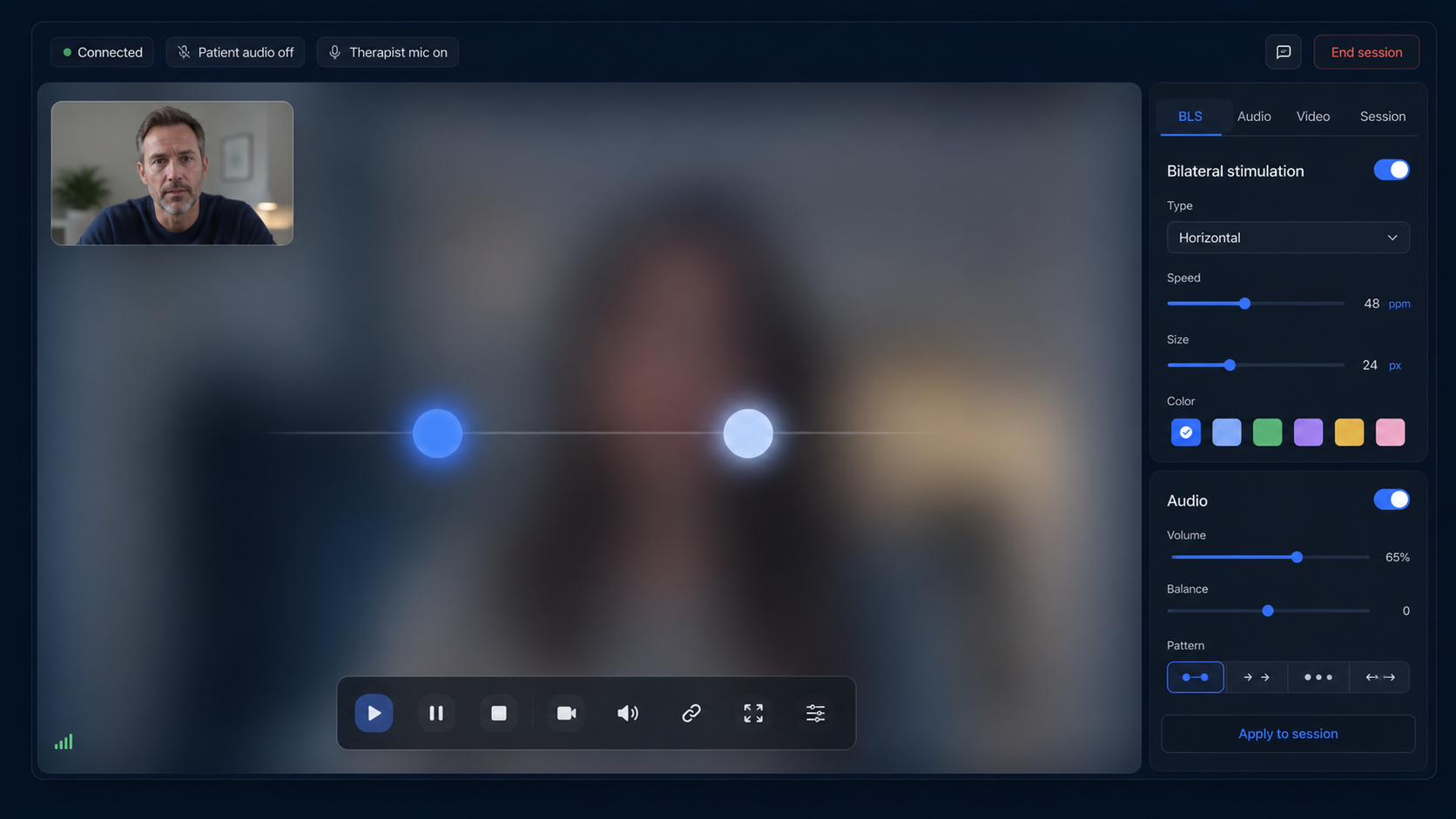
EMDRSuite does not diagnose claustrophobia, run exposure, simulate an MRI, assess sedation or medical fitness, inspect enclosed spaces, provide emergency monitoring, select targets, or guarantee procedure completion. It provides video and bilateral-stimulation controls for qualified therapists.
FAQ
EMDR for claustrophobia
Is claustrophobia always a specific phobia?
No. Panic disorder, agoraphobia, PTSD, medical issues, sensory needs, and realistic hazards may require different formulations.
Is EMDR proven specifically for claustrophobia?
The cited evidence does not include a direct controlled EMDR trial for claustrophobia.
What treatment has direct evidence?
Controlled claustrophobia studies directly support exposure and cognitive work, with behavior and avoidance measured.
Can EMDRSuite run exposure or assess MRI safety?
No. It does not run exposure or determine medical and procedural safety.
References
EMDR for claustrophobia: evidence, exposure, and remote-care limits
EMDRSuite
Put the guide into practice with EMDRSuite
Run remote EMDR with visual BLS, bilateral sounds, secure patient links, video-ready sessions, saved settings, and notes.
Continue with related EMDR guides