Krentzel and Tattersall's Distancing Technique is an OCD-focused adaptation, not generic emotional avoidance
EMDR Distancing Technique for OCD: evidence and boundaries
Review the Distancing Technique's origin, its place in the Distancing Approach for OCD, current case-level evidence, ERP boundary, training, and safety.
By the EMDRSuite Editorial Team
Product claims checked against the current EMDRSuite code and interface.
No independent clinical reviewer is named for this guide.
Krentzel created the technique in 2017
EMDRIA attributes the Distancing Technique to C. Paula Krentzel in 2017 and describes subsequent development with Jennifer Tattersall. The 2024 peer-reviewed Distancing Approach combines the technique with EMDR's Phobia Protocol, Future Rehearsal, therapeutic-relationship work, and individualized treatment for obsessive-compulsive disorder.
The named technique aims to help a client observe thoughts and sensations and develop adaptive coping statements. It is not the same as dissociative detachment, generic grounding, cognitive defusion, the Flash Technique, or avoidance of exposure to feared cues.
The 2024 publication is a model paper with a case example
The journal article provides rationale and illustrates the comprehensive approach with a case. Workshops and EMDRIA professional material establish use and training history, but they do not provide a randomized comparison or isolate Distancing from the other components.
No controlled outcome trial of the Distancing Technique or Distancing Approach was identified through 28 August 2026. Claims of effectiveness should therefore remain preliminary and should not be extrapolated from standard EMDR evidence.
ERP remains the established OCD reference treatment
NICE and the International OCD Foundation identify cognitive behavioral therapy with exposure and response prevention as a central evidence-based treatment for OCD. A novel EMDR-derived approach should not be presented as proven superior, equivalent, or a reason to remove ERP without a clinically justified plan.
Distancing should support insight and flexible responding rather than become reassurance, neutralization, thought suppression, or another compulsion. Diagnosis, severity, suicidality, comorbidity, medication, family accommodation, and access to specialist OCD care still require appropriate assessment.
Training material and product scope remain separate
This page does not reproduce the coping-statement process, eight-phase modifications, Future Rehearsal, scripts, or training handouts. It gives provenance and evidence boundaries so clinicians can locate original professional sources.
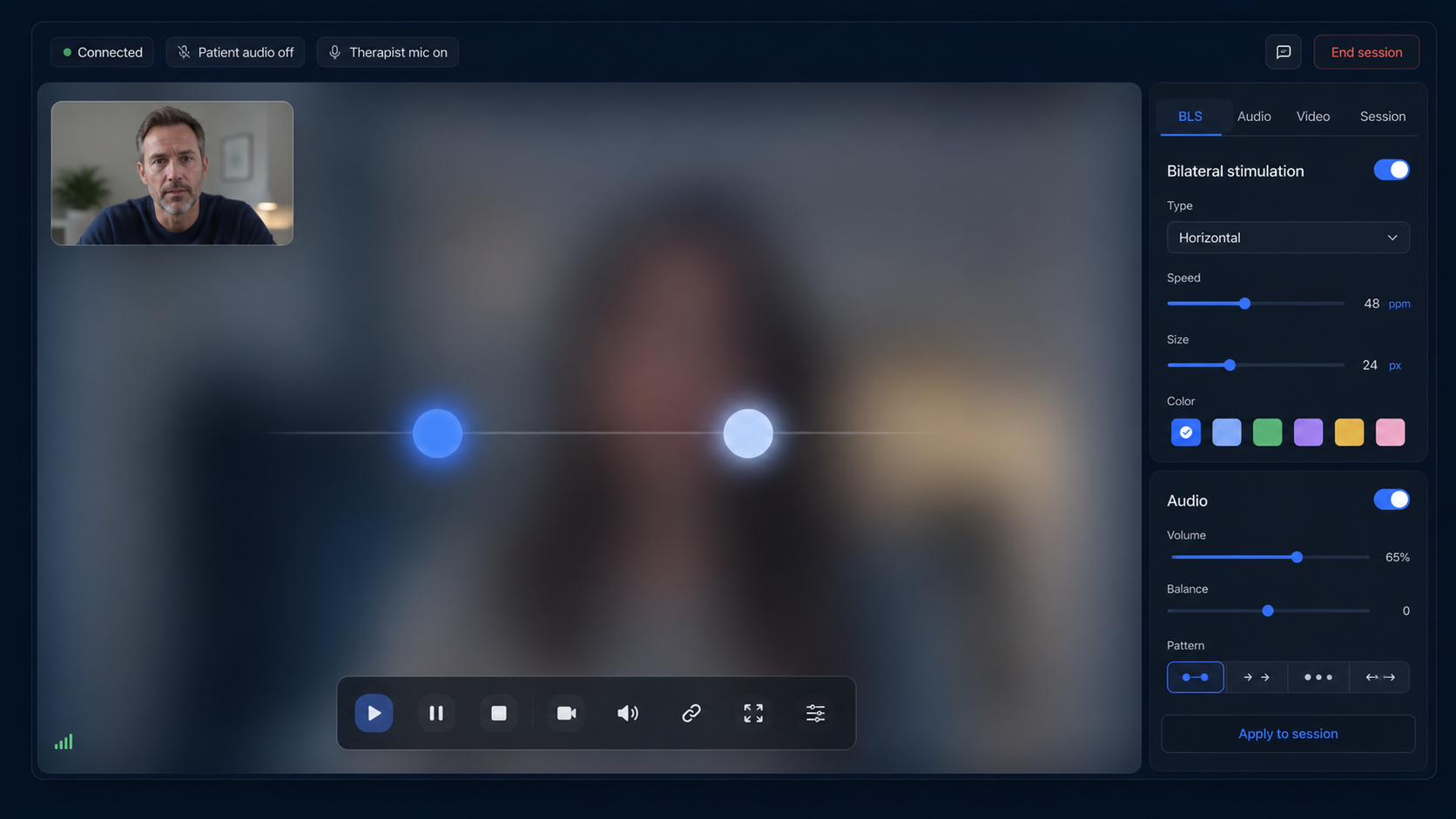
EMDRSuite offers a remote room and therapist-controlled BLS. It does not diagnose OCD, detect compulsions, create coping statements, deliver ERP, administer the Distancing Technique, or decide how a client's treatment should proceed.
FAQ
EMDR Distancing Technique
Who created the EMDR Distancing Technique?
C. Paula Krentzel developed it in 2017 and later collaborated with Jennifer Tattersall on the broader Distancing Approach.
Is it the same as the Flash Technique or grounding?
No. It is an OCD- and anxiety-focused method for observing thoughts and sensations and developing adaptive statements within a larger EMDR-derived approach.
Is it proven to treat OCD?
The 2024 paper presents rationale and a case example. No controlled outcome trial of the technique or full approach was identified through 28 August 2026.
Does it replace ERP?
Current evidence does not establish it as a replacement for ERP. ERP remains a central guideline-supported OCD treatment.
References
EMDR Distancing Technique for OCD: evidence and boundaries
EMDRSuite
Put the guide into practice with EMDRSuite
Run remote EMDR with visual BLS, bilateral sounds, secure patient links, video-ready sessions, saved settings, and notes.
Continue with related EMDR guides