R-TEP is a trained early-intervention protocol, not universal post-trauma prevention
EMDR R-TEP: recent traumatic episode protocol evidence and limits
Review R-TEP evidence, recent-memory rationale, randomized pilots, timing, screening, remote delivery, and training boundaries without a protocol script.
By the EMDRSuite Editorial Team
Product claims checked against the current EMDRSuite code and interface.
No independent clinical reviewer is named for this guide.
R-TEP addresses a recent episode rather than one settled memory
R-TEP was developed for a recent traumatic episode that may still be fragmented across moments and points of disturbance. It is not simply the standard protocol performed sooner, and it is different from G-TEP, psychological first aid, universal debriefing, crisis triage, and routine treatment of an older consolidated target.
Recency alone does not establish indication. Assess exposure, current safety, acute stress and PTSD symptoms, grief, pain, sleep, dissociation, cognition, substance use, suicide risk, medical care, natural recovery, preference, and whether the threat or event is still continuing.
The review found 11 randomized trials across early EMDR approaches
A 2024 systematic review found 11 randomized trials of EMDR delivered within three months of trauma. It reported short-term benefits for post-traumatic symptoms after treatment and at three months, but not consistent differences for other outcomes or later follow-up.
The review rated the evidence limited by low study quality, small samples, and few studies per outcome. It pooled different early EMDR procedures and populations, so it cannot prove that R-TEP is superior to standard EMDR, trauma-focused CBT, supportive care, or watchful monitoring for every recent event.
R-TEP trials are promising pilots, not definitive prevention evidence
A remote randomized feasibility pilot recruited 26 COVID-19 intensive-care survivors. Safety and feasibility criteria were met, with no attributable adverse events; the PTSD-score difference did not reach statistical significance. A perinatal-loss pilot randomized 40 women, while an online healthcare-worker study was also small.
Feasibility, symptom separation, or pre-post change is not proof that PTSD was prevented. R-TEP is not universal prevention and should not be imposed on everyone exposed to trauma, especially without symptom screening, consent, a qualified therapist, and an appropriate medical or safeguarding pathway.
Remote delivery needs protocol competence and a local safety route
Confirm location, privacy, technology, support, emergency contacts, connection-loss steps, medical limitations, and how to stop. A recent event can include unstable housing, ongoing violence, bereavement, litigation, intensive care, injury, or altered cognition that a video platform cannot resolve.
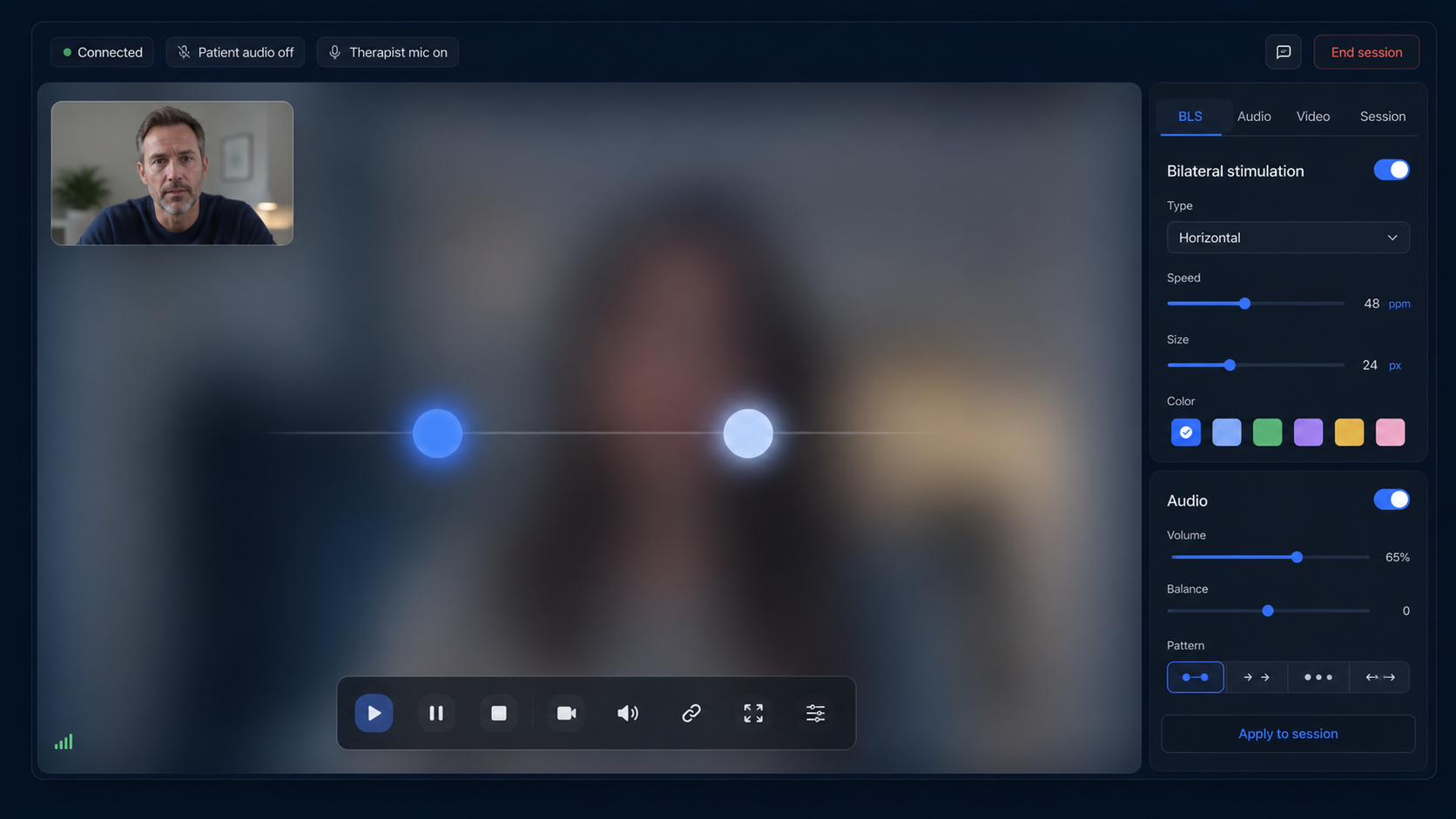
EMDRSuite can support an individual therapist-led remote session, BLS controls, secure patient access, and documentation. It does not provide R-TEP training or scripts, select points of disturbance, diagnose acute stress or PTSD, decide timing, deliver group R-TEP, monitor medical risk, or replace supervision.
FAQ
EMDR R-TEP protocol
Is R-TEP the same as standard EMDR?
No. It is a trained early-intervention protocol organized around a recent traumatic episode and its points of disturbance.
Does R-TEP prevent PTSD after every trauma?
No. Early evidence is limited, and universal intervention without symptom screening is not supported.
Can R-TEP be delivered online?
Small pilots show feasibility in selected groups, but remote safety, clinical fit, consent, and therapist competence remain essential.
Does EMDRSuite include the R-TEP protocol?
No. It supports remote workflow but does not supply scripts, training, target selection, diagnosis, or clinical decisions.
References
EMDR R-TEP: recent traumatic episode protocol evidence and limits
EMDRSuite
Put the guide into practice with EMDRSuite
Run remote EMDR with visual BLS, bilateral sounds, secure patient links, video-ready sessions, saved settings, and notes.
Continue with related EMDR guides