Flashforward, Flash Technique, and future template are three different clinical tasks
EMDR flashforward procedure vs Flash Technique and future template
Distinguish the EMDR flashforward procedure from Flash Technique and future template using evidence, target logic, current-threat checks, and training limits.
By the EMDRSuite Editorial Team
Product claims checked against the current EMDRSuite code and interface.
No independent clinical reviewer is named for this guide.
A flashforward is a feared catastrophe image, not every future worry
The flashforward procedure targets an image of a feared future catastrophe that carries disturbance and may maintain anticipatory anxiety or avoidance. Formulation must distinguish an image-based target from verbal worry, obsession, realistic planning, active danger, delusional belief, suicidal imagery, trauma memory, skill deficit, or a prediction that requires practical action.
The aim is not to prove that the feared event cannot happen, create certainty, erase prudent caution, or reconstruct a memory. Current coercion, violence, medical threat, legal deadlines, driving risk, or safeguarding concerns require real-world action alongside or before trauma-focused work.
It is not Flash Technique and it is not the future template
Flash Technique is a distinct developing intervention intended to reduce disturbance with limited sustained focus on the trauma memory. A flashforward procedure directly formulates a feared future image as a target. Similar names do not make their steps, rationale, evidence, consent, or training interchangeable.
A future template rehearses an adaptive response to a realistic anticipated situation after relevant disturbance has been addressed. It is not a feared catastrophe target. Processing a flashforward, applying Flash Technique, and installing a future template therefore answer different clinical questions.
Direct clinical evidence remains small and condition-specific
Working-memory experiments support the proposition that eye movements can reduce rated vividness or emotionality of negative future imagery under laboratory conditions. Those analogue outcomes are not a clinical effectiveness trial of the full flashforward procedure.
Clinical reports include six cancer survivors with fear of recurrence, six adolescents with social anxiety, and eight people with multiple sclerosis and anxiety. The IMPROVE panic-disorder study is a randomized trial protocol, not outcome evidence. Small uncontrolled series cannot establish comparative efficacy, durability, or who benefits.
Remote practice must preserve assessment, monitoring, and authorship
Agree target language, stop signal, privacy, dissociation and risk checks, connection-loss response, between-session monitoring, and what outcome will be measured. Avoid scripts copied from search results, suggestive certainty, unnecessary intimate imagery in notes, or presenting SUD change as proof of external safety.
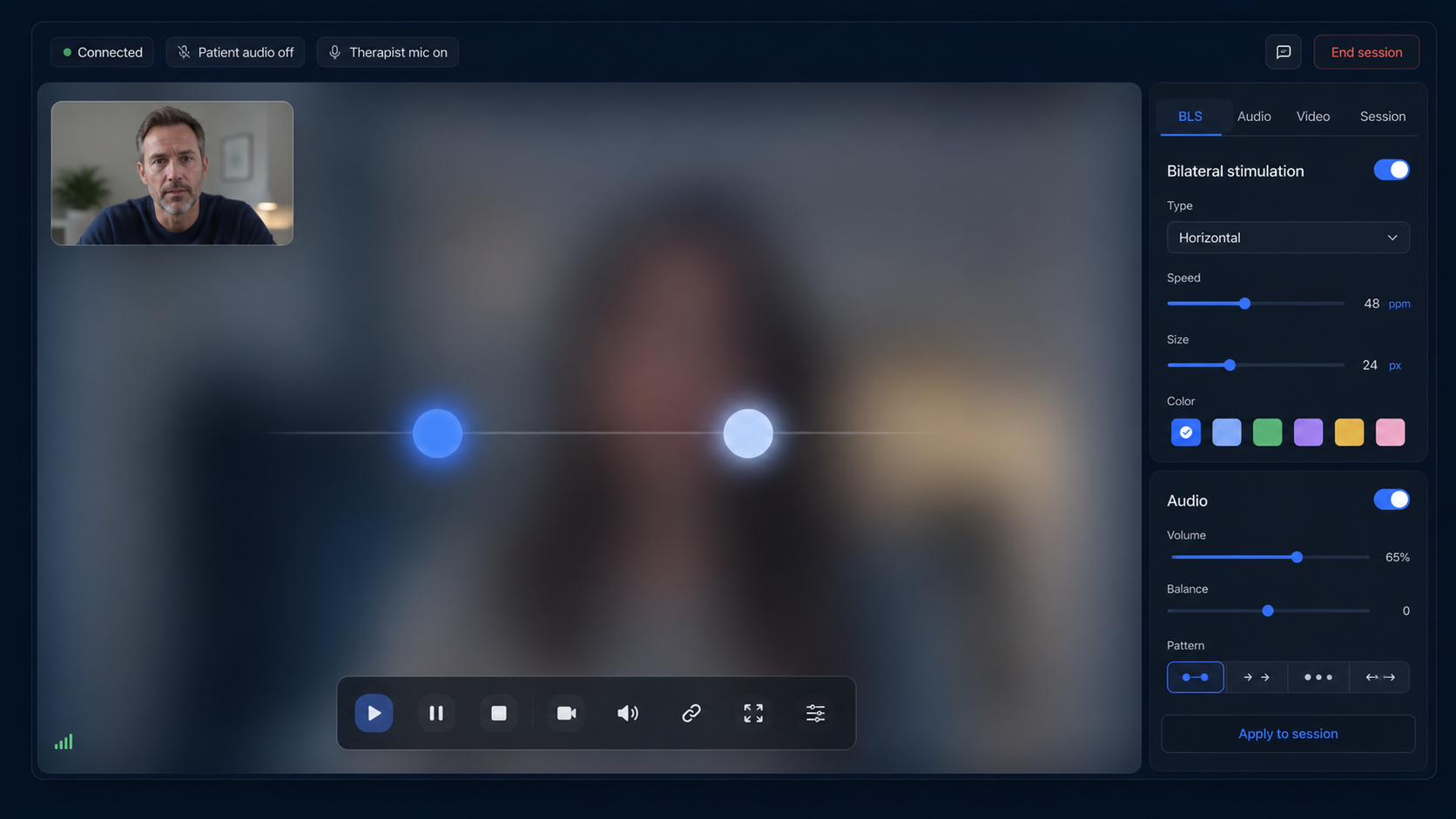
EMDRSuite can organize therapist-entered targets and support BLS in an individual remote session. It does not decide whether imagery is a flashforward, Flash Technique, future template, obsession, or real threat; it does not provide protected scripts, assess risk, interpret change, or replace training and consultation.
FAQ
EMDR flashforward procedure
Is flashforward the same as Flash Technique?
No. Flashforward targets a feared future catastrophe image; Flash Technique is a different developing intervention.
Is flashforward the same as a future template?
No. A future template rehearses an adaptive response, while a flashforward is a disturbing feared outcome that may be targeted.
How strong is the evidence?
Laboratory studies and small clinical series are informative, but direct comparative clinical evidence remains limited.
Does EMDRSuite choose or script a flashforward target?
No. It supports workflow and BLS but does not formulate targets, provide scripts, assess risk, or make clinical decisions.
References
EMDR flashforward procedure vs Flash Technique and future template
EMDRSuite
Put the guide into practice with EMDRSuite
Run remote EMDR with visual BLS, bilateral sounds, secure patient links, video-ready sessions, saved settings, and notes.
Continue with related EMDR guides