Self-help tools are not a substitute for a full psychotherapy
Can you do EMDR yourself? Evidence and safety of self-administered EMDR
What self-administered EMDR means, what evidence exists, how bilateral exercises differ from therapy, and why assessment, support, and crisis planning matter.
By the EMDRSuite Editorial Team
Product claims checked against the current EMDRSuite code and interface.
No independent clinical reviewer is named for this guide.
A moving dot or alternating sound is not the whole EMDR therapy
EMDR is a phased psychotherapy that includes history, formulation, preparation, target assessment, reprocessing, closure, and reevaluation. Bilateral stimulation is one component. Playing tones, following a light, or tapping while recalling trauma does not provide diagnosis, readiness assessment, pacing, informed consent, monitoring, or follow-up.
NICE recommends manual-based EMDR delivered in phases by trained practitioners with ongoing supervision. It separately describes supported computerized trauma-focused CBT, which still includes practitioner guidance and progress review. That distinction matters: digital delivery does not automatically mean unsupported treatment.
Evidence for self-administered EMDR is too limited for confident claims
A 2020 peer-reviewed evidence search found only one small primary study of self-administered EMDR. Symptoms improved and no serious adverse events were reported, but the authors identified substantial methodological problems and concluded that more robust research was needed.
This does not prove that every self-help exercise is harmful, and it does not establish that unsupervised trauma processing is effective or safe. EMDRIA's virtual guidance excludes self-therapy without live clinician guidance and its organizational policy prohibits self-administration. That is a professional association position, not a universal law, but it is relevant context.
Between-session skills are different from processing alone
A therapist may teach grounding, orientation, self-calming, or limited bilateral exercises for a defined purpose between appointments. Those instructions can include when to use the skill, when to stop, what not to target, and how to contact the clinician. They should not be silently relabeled as complete self-administered EMDR.
Extra caution is warranted with current danger, suicidal risk, severe dissociation, psychosis, mania, intoxication or withdrawal, unstable medical problems, or an inability to regain present orientation. A qualified professional must assess the person and local care options. A website cannot screen these factors reliably.
Use technology to support clinician-led care, not replace it
Remote EMDR can still be live, relational, and therapist-led. Before processing, test privacy, location, camera and audio, the stop signal, reconnection, emergency contacts, and what happens if either person loses communication. The clinician remains responsible for assessment, consent, pacing, closure, records, and local duties.
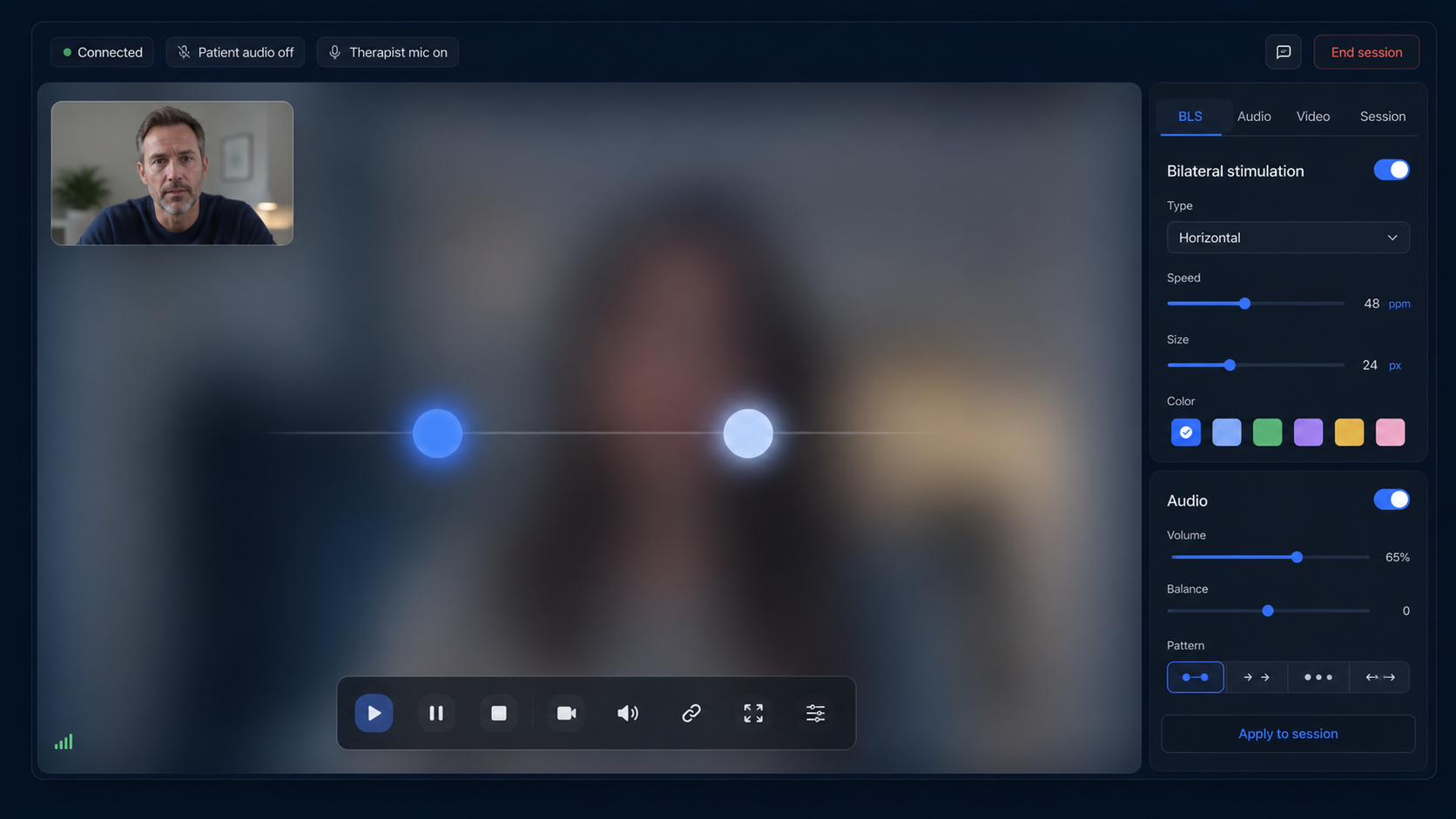
EMDRSuite provides a private room, video, and therapist-controlled visual or auditory stimulation. It does not offer self-treatment, select memories, diagnose readiness, detect dissociation, monitor risk, or provide emergency help. Never enter real patient data merely to test the platform; an ephemeral technical rehearsal is sufficient.
FAQ
can you do EMDR yourself
Can bilateral stimulation calm me without being EMDR?
It may be used as a coping exercise, but a response to tapping, sound, or light does not make the exercise a complete EMDR treatment.
Is self-administered EMDR proven safe?
No. Published evidence is very limited and cannot establish broad safety or effectiveness.
Can my therapist assign an EMDR exercise at home?
A therapist may assign a bounded skill with instructions and follow-up; clarify its purpose and stop conditions.
Does EMDRSuite provide self-EMDR?
No. It is a clinician-controlled session tool and does not conduct treatment or assess risk.
References
Can you do EMDR yourself? Evidence and safety of self-administered EMDR
EMDRSuite
Put the guide into practice with EMDRSuite
Run remote EMDR with visual BLS, bilateral sounds, secure patient links, video-ready sessions, saved settings, and notes.
Continue with related EMDR guides