Treatment formats and evidence
Group EMDR: evidence, participant screening, privacy, and clinical boundaries
A professional review of group EMDR and G-TEP evidence that separates promising outcomes from equivalence claims and covers screening, consent, privacy and crisis planning.
By the EMDRSuite Editorial Team
Product claims checked against the current EMDRSuite code and interface.
No independent clinical reviewer is named for this guide.
Group EMDR is not individual EMDR multiplied
Group protocols such as G-TEP and EMDR-IGTP use structured worksheets, self-administered bilateral stimulation and limited disclosure in ways that differ from an individual eight-phase session. Group composition, shared event, developmental level, language and setting can materially affect fit.
A group may increase reach and peer context after collective trauma, but it also changes privacy, observation, pacing, individual formulation, crisis response and the therapist's ability to notice dissociation or deterioration. Consent must explain those differences rather than imply individual equivalence.
The review evidence is promising and methodologically limited
A 2021 systematic review included 22 studies and 1,739 participants across several group EMDR protocols. Twelve were one-arm studies and ten used two arms. The review reported improvements across PTSD, depression and anxiety but emphasized methodological challenges.
A later G-TEP meta-analysis pooled 12 studies and reported a large within-study symptom effect. Heterogeneous populations, protocols, comparators and study quality mean that a large pooled change cannot by itself establish superiority, equivalence to individual EMDR or suitability for routine use in every service.
Small trials provide context, not a universal answer
A randomized study in a Syrian refugee camp included 47 adults, with 18 assigned to G-TEP and 29 to control. Two sessions over three days were followed for four weeks and produced promising PTSD and depression results.
The sample, unequal groups, short follow-up, camp context and specific protocol limit generalization. NICE recommends individual manual-based EMDR for indicated adult PTSD; its guideline does not establish group EMDR as an interchangeable first-line format.
Screening and group governance are core treatment components
Assess diagnosis, current threat, dissociation, psychosis, substance use, suicide risk, interpersonal conflict, cognitive or sensory needs, language, confidentiality expectations and whether participants know one another. Define facilitator roles, private check-in, withdrawal, follow-up and individual escalation.
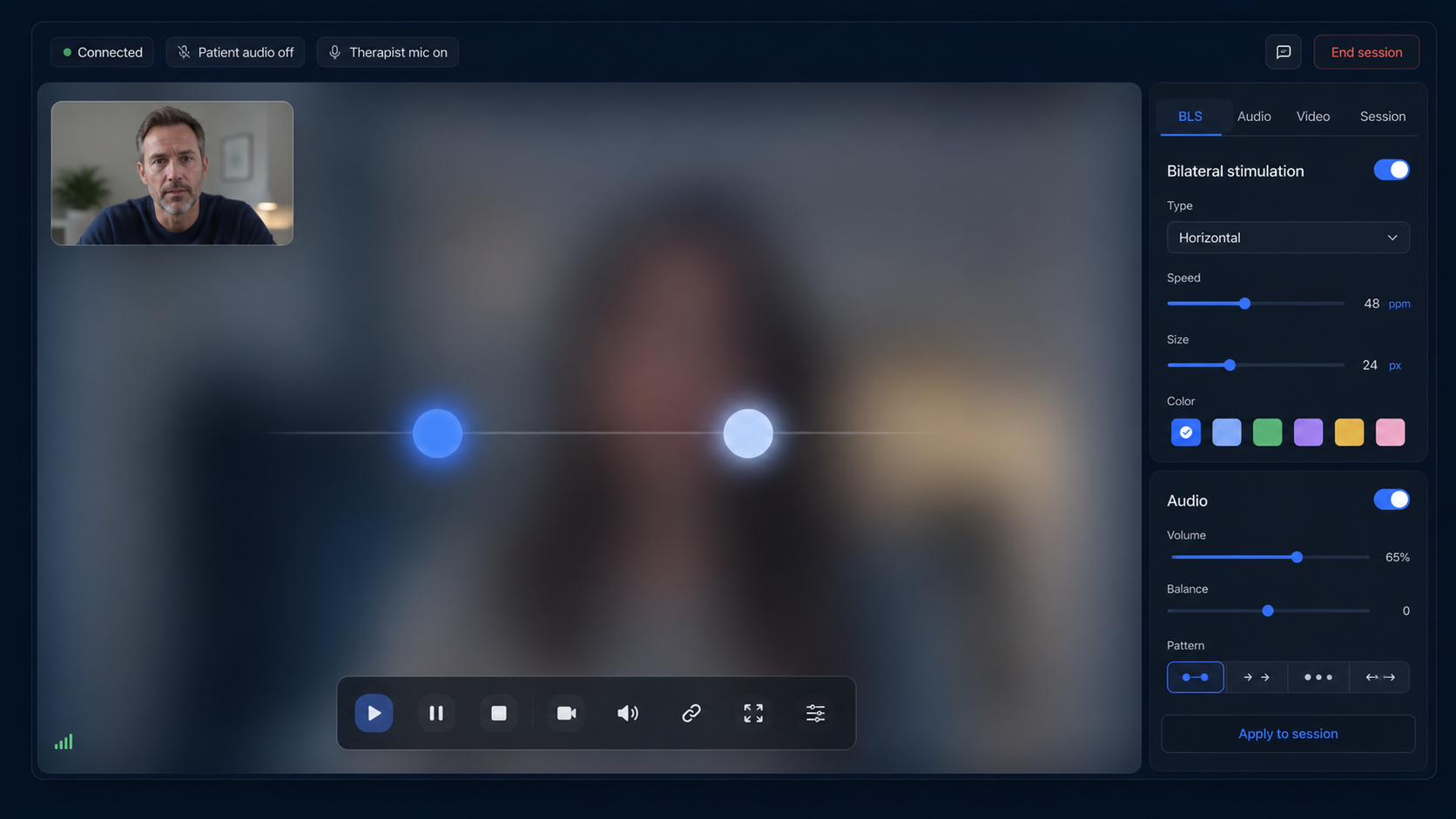
For remote groups, add identity, location, headphones, private space, recording prohibition, chat, late entry, breakout and disconnection rules. EMDRSuite is designed for one therapist-patient session and does not provide group governance, participant screening, confidentiality enforcement or multi-person crisis management.
FAQ
group EMDR evidence
Is group EMDR equivalent to individual EMDR?
No. Group protocols and evidence differ, and current research does not establish universal equivalence or interchangeability.
How strong is the group EMDR evidence?
Systematic reviews report promising symptom changes, but many studies are uncontrolled or methodologically limited and populations are heterogeneous.
What must be screened before a group?
Risk, diagnosis, ongoing threat, dissociation, privacy, group fit, language, support, ability to use the protocol and access to individual escalation.
Can EMDRSuite run group EMDR?
EMDRSuite is designed for a therapist and one patient; it is not a group-treatment, attendance or multi-person crisis-management platform.
References
Group EMDR: evidence, participant screening, privacy, and clinical boundaries
EMDRSuite
Put the guide into practice with EMDRSuite
Run remote EMDR with visual BLS, bilateral sounds, secure patient links, video-ready sessions, saved settings, and notes.
Continue with related EMDR guides