The standard protocol is an eight-phase, three-pronged framework, not a downloadable worksheet
EMDR Standard Protocol: eight phases, three prongs, and limits
Understand the EMDR Standard Protocol, eight phases, past-present-future framework, fidelity, adaptations, evidence transfer, training, and PDF limits.
By the EMDRSuite Editorial Team
Product claims checked against the current EMDRSuite code and interface.
No independent clinical reviewer is named for this guide.
Standard Protocol names both eight phases and three prongs
EMDRIA defines the Standard Protocol as a past, present, and future approach embedded in the full eight-phase treatment framework. The phases organize history and planning, preparation, target assessment, desensitization, installation, body scan, closure, and reevaluation; the three prongs organize comprehensive target planning across time.
A target worksheet, a sequence of bilateral-stimulation sets, or phases three to seven alone is not the whole Standard Protocol. Case formulation, readiness, consent, reevaluation, and the treatment course remain part of the model even when a search result focuses on one reprocessing session.
Standardized does not mean identical in every session
EMDRIA notes that time spent in each phase varies greatly. A session may revisit preparation, stop before a target is complete, or defer another prong, while a treatment course can still be reviewed for adherence to the model actually named.
Clinical judgment and responsive adaptation are not permission to omit or relabel core functions silently. Fidelity, competence, indication, timing, accessibility, and outcome answer different questions and require training, documentation, consultation, and patient-level review.
PTSD evidence does not transfer automatically to every adaptation
Guideline support and controlled trials primarily establish EMDR therapy for PTSD under defined conditions. They do not prove that every disorder-specific script, derived technique, shortened sequence, self-administered exercise, or software workflow has the same evidence as standard EMDR for PTSD.
Search demand for a Standard Protocol PDF, script, worksheet, or template is professional information intent, not permission to republish copyrighted manuals or substitute a web page for accredited training. This guide explains structure and boundaries without procedural instructions.
Software can support delivery without administering the protocol
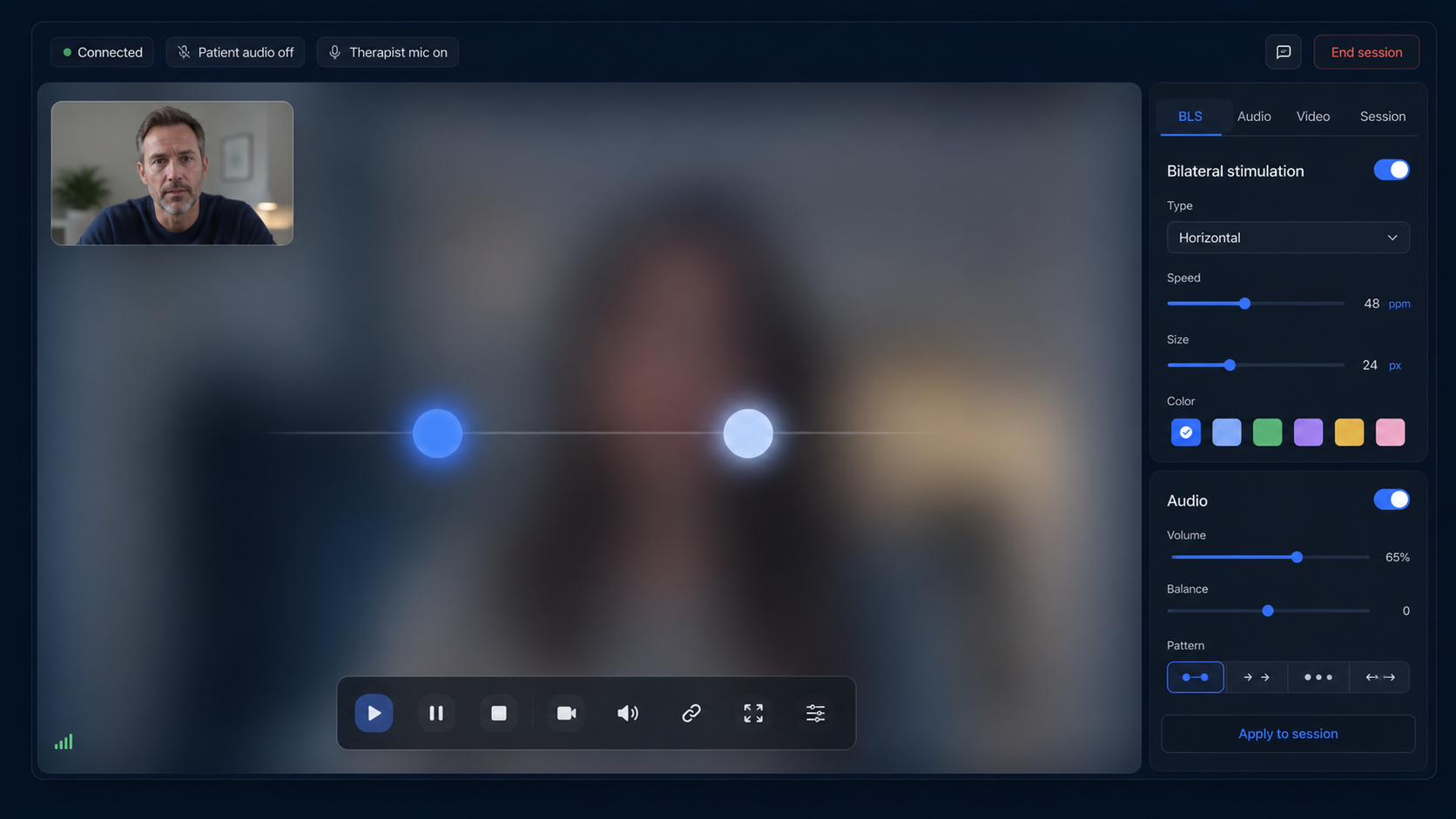
EMDRSuite provides live video, private patient access, therapist-controlled visual and auditory BLS, immediate pause behavior, saved settings, and therapist-authored notes. These functions can reduce technical switching during a remote session.
It does not select targets, run the Standard Protocol, decide phase transitions, assess readiness, generate scripts, certify fidelity, supervise practice, or infer that an eight-phase label was clinically appropriate. Those decisions remain with the trained therapist and applicable professional framework.
FAQ
EMDR standard protocol
What is the EMDR Standard Protocol?
It is the eight-phase EMDR therapy framework used with a three-pronged past, present, and future approach, not one worksheet or BLS sequence.
Must all eight phases happen in one session?
No. Phases can span and recur across sessions; fidelity should be considered across the relevant treatment course and protocol.
Can I download the Standard Protocol script here?
No. This page provides a sourced overview without reproducing scripts, worksheets, manuals, or decision rules.
Does EMDRSuite administer the Standard Protocol?
No. It supports the remote technical workflow but does not make clinical or fidelity decisions.
References
EMDR Standard Protocol: eight phases, three prongs, and limits
EMDRSuite
Put the guide into practice with EMDRSuite
Run remote EMDR with visual BLS, bilateral sounds, secure patient links, video-ready sessions, saved settings, and notes.
Continue with related EMDR guides