A stop signal preserves choice during a session; it is not a readiness or safety guarantee
EMDR stop signal: pause control, safety, and remote sessions
Review the EMDR stop signal in Phase 2, consent, freeze or dissociation limits, patient pause controls, remote contingency planning, testing, and documentation.
By the EMDRSuite Editorial Team
Product claims checked against the current EMDRSuite code and interface.
No independent clinical reviewer is named for this guide.
The stop signal is a collaborative Phase 2 agreement
EMDRIA explains that the client may use a hand stop gesture at any time, and its eight-phase case form places the stop signal among Phase 2 logistical preparations. The signal operationalizes the right to pause, ask a question, change modality, reorient, or withdraw consent.
Agree on a visible, audible, tactile, or digital option that fits mobility, language, culture, camera framing, sensory access, and the setting. Rehearse what the therapist will do rather than merely asking whether the client understands.
A rehearsed gesture is not a readiness test
The ability to demonstrate a signal in preparation does not prove that someone will use it during activation. Freeze, tonic immobility, appeasement, dissociation, shame, delayed awareness, motor limits, speech loss, or a technical failure can interfere.
Therapists still monitor contact, orientation, consent, state change, distress, and the wider formulation. Absence of a stop signal is not consent to continue, and a signal cannot create environmental safety or replace risk assessment and clinical observation.
Remote work needs an independent technical pause
For online EMDR, test the patient-side control in the actual room and device before clinical use. Confirm that an active set stops, the therapist receives the alert, video and audio remain usable, and reconnection does not restart stimulation unexpectedly.
Also agree on a backup call, current location, local support or emergency route, and what both people do if contact disappears. A digital button cannot help after total connectivity loss, so immediate patient pause and the contingency plan solve different problems.
Document function without claiming guaranteed safety
Record the agreed signal, accessibility adaptation, rehearsal result, patient preference, response, remote fallback, and any change needed. Do not interpret failure to signal as compliance, resistance, readiness, or proof that no adverse event occurred.
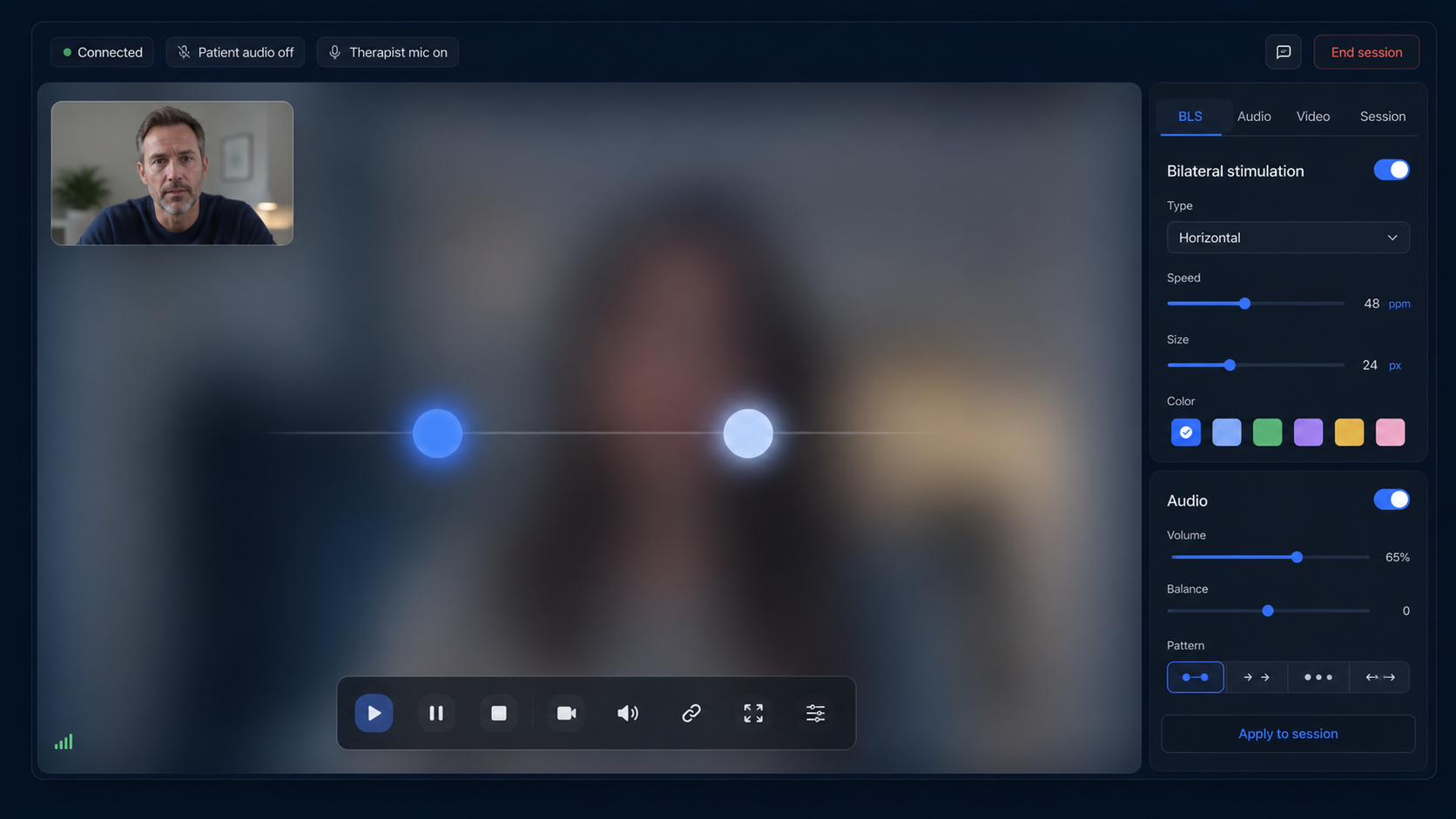
EMDRSuite provides an immediate patient pause that stops the active set and alerts the therapist, plus therapist stop controls and reconnection state. It does not detect freezing or dissociation, interpret consent, assess danger, contact emergency services, or guarantee that a session is clinically safe.
FAQ
EMDR stop signal
Why use a stop signal in EMDR?
It gives the client a clear way to pause stimulation or the process and supports ongoing consent and collaboration.
Does using the signal prove readiness for reprocessing?
No. It is one practical agreement, not a validated readiness test or safety guarantee.
What if the client freezes and cannot signal?
The therapist must continue observing contact and state; absence of a signal is not permission to continue.
Can the patient pause EMDRSuite directly?
Yes. The patient room has an immediate pause control, but it does not replace clinical monitoring or a connection-failure plan.
References
EMDR stop signal: pause control, safety, and remote sessions
EMDRSuite
Put the guide into practice with EMDRSuite
Run remote EMDR with visual BLS, bilateral sounds, secure patient links, video-ready sessions, saved settings, and notes.
Continue with related EMDR guides