Compare named protocols, not two vague labels
EMDR vs CBT: differences, evidence, and treatment choice
Compare EMDR with CBT without treating CBT as one protocol: mechanisms, PTSD evidence, session demands, preference, competence, and outcome monitoring.
By the EMDRSuite Editorial Team
Product claims checked against the current EMDRSuite code and interface.
No independent clinical reviewer is named for this guide.
CBT is a family; EMDR is a specific structured therapy
CBT can mean a broad therapeutic family or a named protocol such as cognitive processing therapy, cognitive therapy, or prolonged exposure. EMDR uses an eight-phase framework, a selected target memory, dual attention, and bilateral stimulation. A useful comparison names the diagnosis, protocol, dose, clinician competence, and outcome rather than asking which three-letter acronym is universally better.
For PTSD, both may be trauma focused, but session tasks differ. CBT protocols may emphasize exposure, appraisals, behavioral experiments, or homework. EMDR does not normally require a detailed verbal account, extended exposure, belief-challenging homework, or daily exposure assignments, although it still requires contact with distressing material and active clinical monitoring.
Guidelines support both for PTSD, not every condition
NICE offers trauma-focused CBT and EMDR for adult PTSD under specified timing and delivery conditions. The APA guideline distinguishes named CBT variants and EMDR. These recommendations concern PTSD; they do not prove that EMDR and every form of CBT are interchangeable for depression, OCD, insomnia, psychosis, or another presenting problem.
A 2024 individual-participant meta-analysis found no significant overall difference between EMDR and other psychological treatments across the included adult PTSD trials. Earlier head-to-head studies and meta-analyses have produced varying short-term patterns. Do not turn one pooled estimate into a universal ranking or assume equal evidence outside PTSD.
Choose through formulation, preference, feasibility, and measurement
Consider the primary disorder and target, contraindications or immediate priorities, prior treatment, dissociation, risk, willingness to describe details, homework feasibility, accessibility, cultural meaning, and the therapist's actual training. Preference can matter, but informed preference requires an accurate explanation of both options and realistic alternatives.
Record baseline severity and functioning, define expected change, monitor adverse effects and engagement, and review progress at a planned point. Switching or combining should follow a revised formulation, not a belief that stalled processing proves resistance or that adding techniques automatically improves treatment.
A software feature cannot choose or deliver CBT
Remote delivery adds privacy, location, emergency, camera, audio, connection, and reconnection requirements regardless of modality. EMDR also requires reliable therapist control of bilateral stimulation when that modality is used.
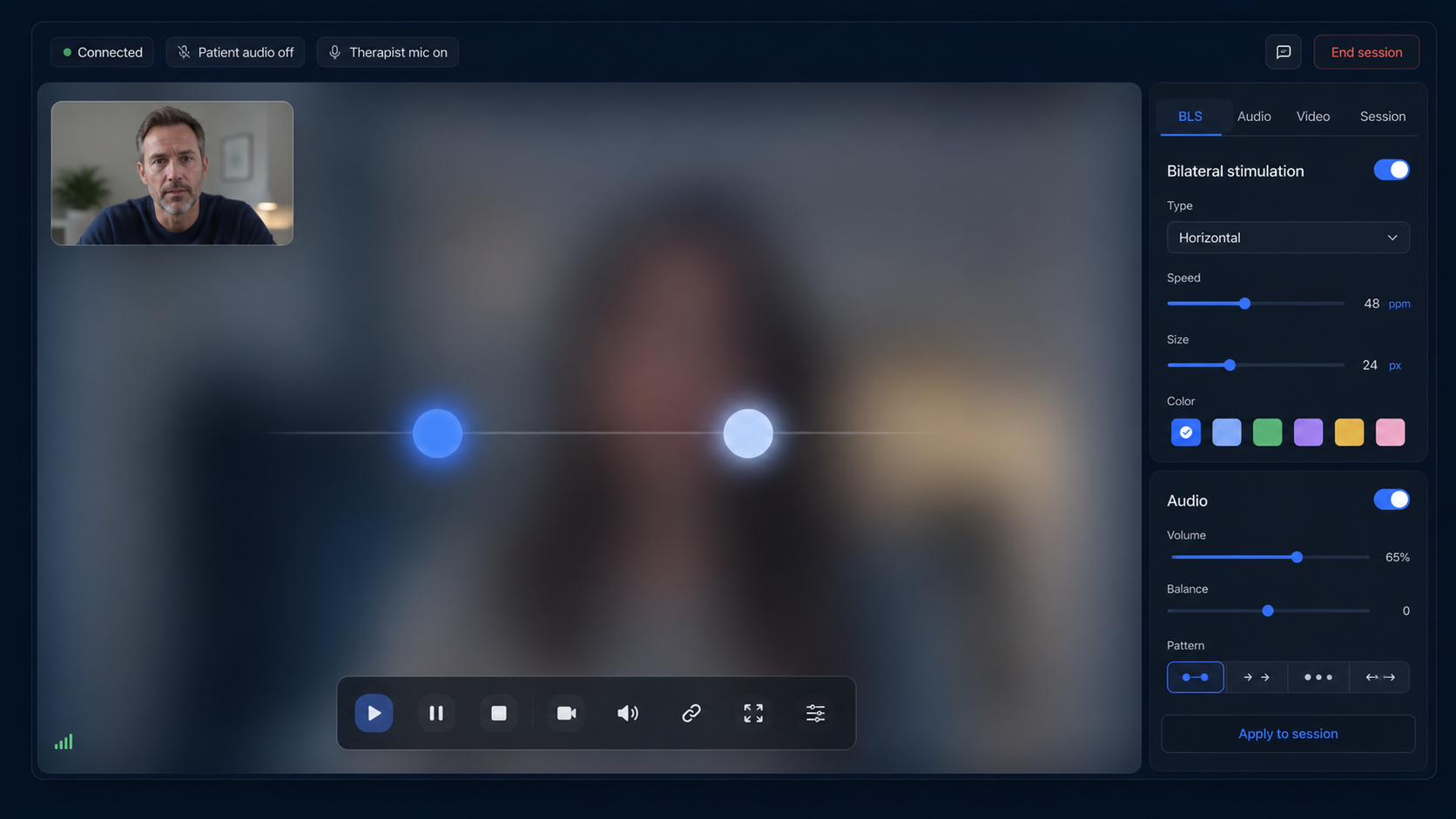
EMDRSuite provides live video and therapist-controlled visual or auditory stimulation. It does not diagnose PTSD, select between EMDR and CBT, deliver a CBT protocol, assign homework, score outcomes, or establish clinician competence. Those decisions remain within qualified care.
FAQ
EMDR vs CBT
Is EMDR a type of CBT?
EMDR and CBT are usually classified as distinct therapy approaches, although both can be trauma focused and share some clinical principles.
Is EMDR better than CBT for PTSD?
Guidelines support both named approaches, and comparative evidence does not justify a universal winner for every patient.
Does EMDR require less talking?
It usually does not require a detailed narrative, but the patient still communicates enough for assessment, consent, monitoring, and treatment decisions.
Can EMDRSuite provide CBT?
No. It supports remote EMDR session technology and does not deliver CBT or choose a treatment.
References
EMDR vs CBT: differences, evidence, and treatment choice
EMDRSuite
Put the guide into practice with EMDRSuite
Run remote EMDR with visual BLS, bilateral sounds, secure patient links, video-ready sessions, saved settings, and notes.
Continue with related EMDR guides