Focused attention can look similar while the procedures remain distinct
Is EMDR hypnosis? Differences, similarities, consent, and evidence
Compare EMDR and hypnosis: induction, suggestion, dual attention, awareness, agency, imagery, intentional integration, PTSD evidence, and software boundaries.
By the EMDRSuite Editorial Team
Product claims checked against the current EMDRSuite code and interface.
No independent clinical reviewer is named for this guide.
Standard EMDR and hypnosis use different procedures
The APA describes hypnosis as focused attention with reduced peripheral awareness and an enhanced capacity to respond to suggestion. Clinical hypnosis commonly uses an induction followed by therapeutic suggestions. Standard EMDR instead uses an eight-phase protocol, target assessment, dual attention to memory and present safety, bilateral stimulation, closure, and reevaluation.
EMDR does not ordinarily depend on a hypnotic induction or suggestions that a symptom, perception, or behavior will change. The client remains awake, can speak, stop, change the stimulation, and orient to the room. Hypnosis also is not mind control: response to suggestion varies and consent remains necessary.
Some experiences overlap without making the methods identical
Both approaches can involve focused attention, imagery, body awareness, emotional material, altered subjective intensity, and a therapeutic relationship. A person may describe absorption, distance from a memory, or a dreamlike feeling in either context. Subjective similarity does not determine which procedure was delivered.
Likewise, ordinary relaxation, absorption, or reduced awareness of the room does not by itself prove a trance. The clinician should explain the intended method, check the person's understanding, use agreed stop signals, and document any deliberate departure from standard practice.
Clinicians can intentionally integrate hypnosis, but must name it
Peer-reviewed literature has discussed similarities and the rationale for combining EMDR with hypnosis. That possibility is why an absolute claim of zero overlap would be misleading. Intentional integration should be explicit, clinically justified, within competence, and covered by informed consent rather than presented as invisible standard EMDR.
Evidence for hypnosis-based PTSD interventions is heterogeneous, and direct robust trials comparing hypnosis with standard EMDR are lacking. Case reports or theoretical comparisons cannot establish that one is superior, faster, safer, or appropriate for every person.
The software does not induce or detect a hypnotic state
A moving visual stimulus or alternating audio does not itself establish hypnosis. The purpose, instructions, interaction, attention, and clinical context matter. Therapists should not market bilateral stimulation as a covert induction or promise that a device accesses the unconscious.
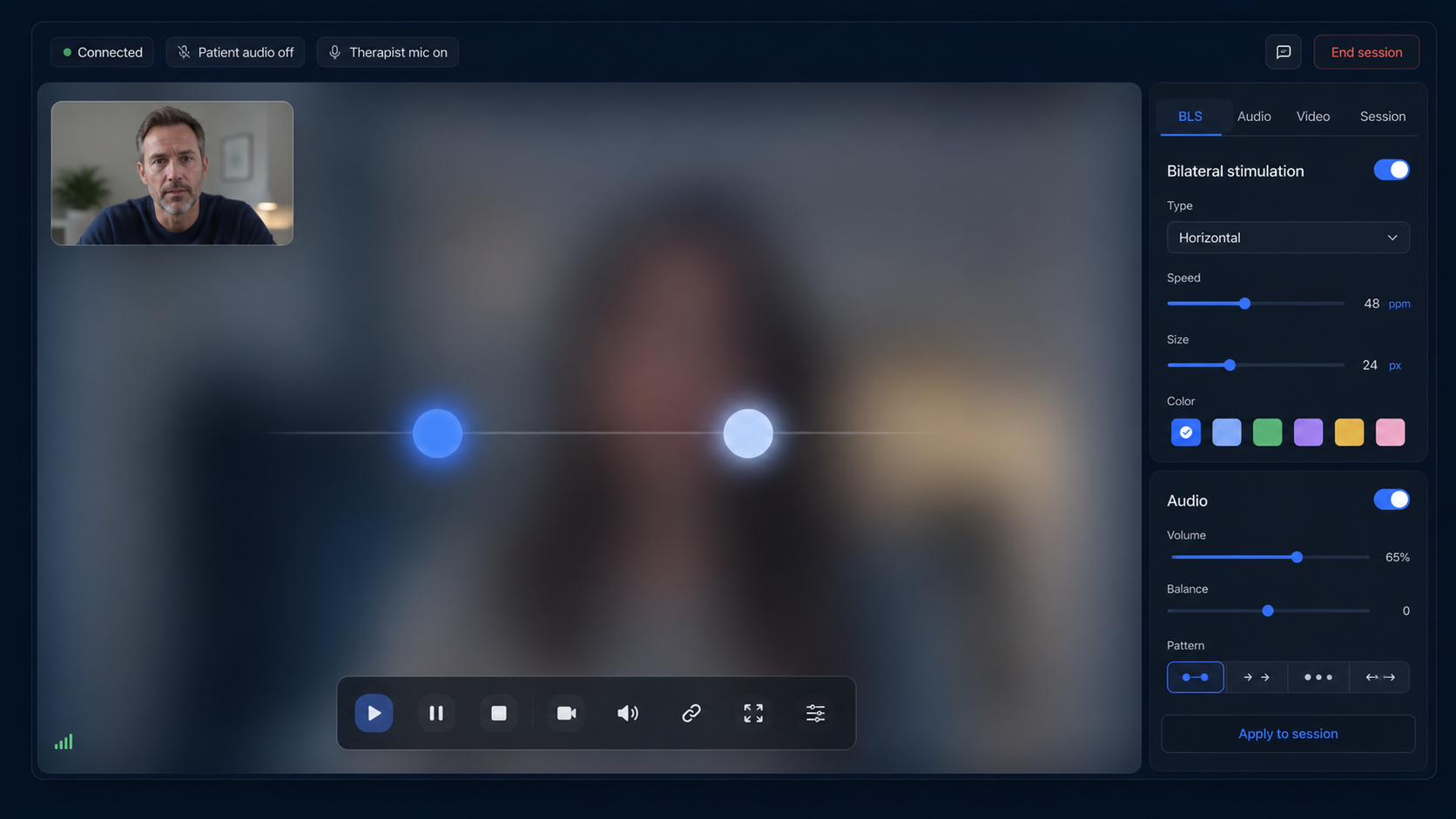
EMDRSuite displays therapist-controlled visual or auditory stimulation and supports live video. It does not deliver hypnotic suggestions, induce trance, measure suggestibility, detect consciousness, or provide hypnotherapy. If a clinician combines methods, responsibility for competence, explanation, consent, monitoring, and documentation remains entirely clinical.
FAQ
is EMDR hypnosis
Does EMDR put you in a trance?
Standard EMDR does not ordinarily use hypnotic induction; focused absorption can feel unusual, but that feeling alone does not establish hypnosis.
Can I lose control during EMDR?
You should remain able to communicate and stop. Agree on a stop signal and tell the therapist about disorientation or loss of control.
Can hypnosis and EMDR be combined?
They can be intentionally integrated by a suitably trained clinician, but this should be explained, consented to, and documented.
Does the EMDRSuite light induce hypnosis?
No. A visual stimulus is not a hypnotic induction, and the platform does not deliver suggestions or detect trance.
References
Is EMDR hypnosis? Differences, similarities, consent, and evidence
EMDRSuite
Put the guide into practice with EMDRSuite
Run remote EMDR with visual BLS, bilateral sounds, secure patient links, video-ready sessions, saved settings, and notes.
Continue with related EMDR guides