Visual focus does not make two therapies equivalent
EMDR vs Brainspotting: procedure, evidence, and clinical claims
Compare EMDR and Brainspotting by procedure, theory, training, guideline status, and research quality without overstating visual-position mechanisms.
By the EMDRSuite Editorial Team
Product claims checked against the current EMDRSuite code and interface.
No independent clinical reviewer is named for this guide.
They use visual attention differently
EMDR is an eight-phase psychotherapy in which a client attends to selected memory material while receiving sets of bilateral stimulation, followed by brief reports and reassessment. Brainspotting is described by its developer as maintaining gaze at a visual position associated with activation while the therapist provides relational attunement and the client observes internal processing.
Eye position, a pointer, bilateral audio, body awareness, and therapist attunement can appear in one or both practices, but shared ingredients do not make their protocols, proposed mechanisms, training pathways, or evidence bases interchangeable. A clinician should describe the procedure actually offered rather than call every gaze-based intervention EMDR.
The evidence bases are not at the same stage
EMDR appears in major PTSD guidelines and has multiple randomized trials and meta-analyses. Brainspotting's theoretical paper presents testable hypotheses rather than confirmed neurobiological mechanisms. Claims that a gaze point locates where trauma is stored in the brain go beyond the available evidence.
A frequently cited preliminary study analyzed 22 clients before and after three Brainspotting sessions using client and therapist reports. It had no randomized active comparator and included the method's developer as an author. That can support further research, but it cannot establish equivalence or superiority to EMDR, rule out expectancy and therapist effects, or generalize across diagnoses.
Use guideline status and uncertainty in consent
For an adult with PTSD, discuss treatments supported by current guidelines before presenting an emerging method as an equivalent alternative. Absence from a guideline is not proof that a therapy never helps; it means the evidence has not met that guideline's recommendation threshold or scope.
If Brainspotting is offered, clarify its evidence level, clinician credentials, theoretical uncertainty, alternatives, fees, monitoring, and how lack of progress or deterioration will be handled. Do not imply that reflexes reveal hidden memories or that bodily activation verifies historical truth.
EMDRSuite is not a Brainspotting system
A remote visual stimulus must remain under informed therapist control, with accessibility, stop, privacy, emergency, and reconnection procedures. A moving dot or fixed screen position is not by itself a psychotherapy protocol.
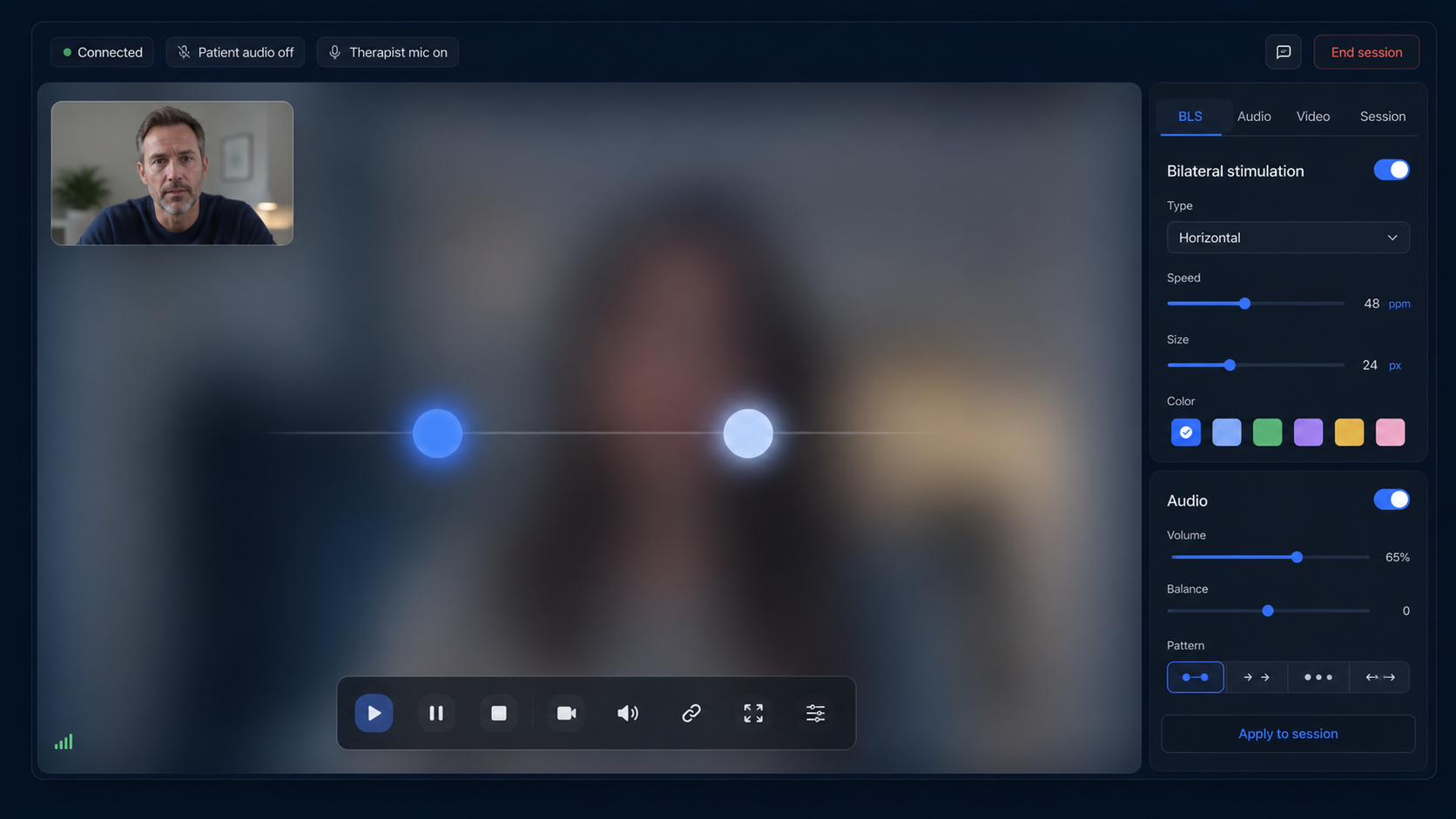
EMDRSuite supports therapist-controlled visual and auditory bilateral stimulation for remote EMDR. It does not identify brainspots, interpret eye or body reflexes, locate trauma in the brain, deliver Brainspotting, certify practitioners, or compare treatment outcomes.
FAQ
EMDR vs Brainspotting
Is Brainspotting the same as EMDR?
No. They may share visual attention and trauma-processing features, but their procedures, theories, training, and evidence differ.
Is Brainspotting proven better than EMDR?
No robust comparative evidence establishes superiority or equivalence.
Do eye positions show where trauma is stored?
That proposed mechanism has not been established as a clinical fact and should not be used to validate memories.
Can EMDRSuite be used as Brainspotting software?
No. Its stimulus controls do not identify brainspots or implement a Brainspotting protocol.
References
EMDR vs Brainspotting: procedure, evidence, and clinical claims
EMDRSuite
Put the guide into practice with EMDRSuite
Run remote EMDR with visual BLS, bilateral sounds, secure patient links, video-ready sessions, saved settings, and notes.
Continue with related EMDR guides