Treatment formats and evidence
Online versus in-person EMDR: evidence, suitability, and clinical differences
A source-led comparison of remote and in-person EMDR that separates feasibility from equivalence and covers suitability, risk, privacy, technology and continuity.
By the EMDRSuite Editorial Team
Product claims checked against the current EMDRSuite code and interface.
No independent clinical reviewer is named for this guide.
Delivery format is one part of treatment suitability
Online and in-person EMDR can use the same broad therapeutic framework, but the settings are not operationally identical. Remote work changes observation, privacy, emergency response, control of the environment, device dependence, sensory delivery and what happens when contact is interrupted.
The decision therefore starts with diagnosis, treatment target, consent, risk, dissociation, medical or cognitive needs, digital access, privacy, support and jurisdiction. Preference and accessibility matter, but neither convenience nor a good internet connection establishes clinical suitability.
The remote evidence is promising but heterogeneous
A 2024 systematic review included 16 articles and 1,231 participants. It found promising outcomes, but combined therapist-led individual work, group delivery and self-administered computerized protocols across ages and problems. Small samples, absent control groups and self-report outcomes limited the conclusions.
A 2020 review had found only one uncontrolled online EMDR trial. The later evidence base is larger, yet it still does not provide a robust universal head-to-head demonstration that every online EMDR pathway is equivalent to well-delivered in-person care for every patient, target or risk profile.
Guidelines support EMDR, not an automatic remote equivalence claim
NICE NG116 recommends manual-based EMDR for indicated adult PTSD, delivered by trained practitioners with supervision and phased components. Its explicit digital recommendation concerns supported computerized trauma-focused CBT for selected adults, not a blanket endorsement of online EMDR.
Telepsychology guidance adds competence, informed consent, identity and location checks, privacy, data handling, emergency planning and interjurisdictional duties. A therapist must apply those requirements to the actual service and patient rather than infer safety from the treatment name or platform alone.
A remote plan needs observable controls and a fallback
Test the exact patient device, browser, camera, microphone, headphones, visual stimulus, bilateral audio, pause control and reconnection. Confirm the current location, backup channel, local emergency resources, who may be nearby and what will happen if video or audio fails during activation.
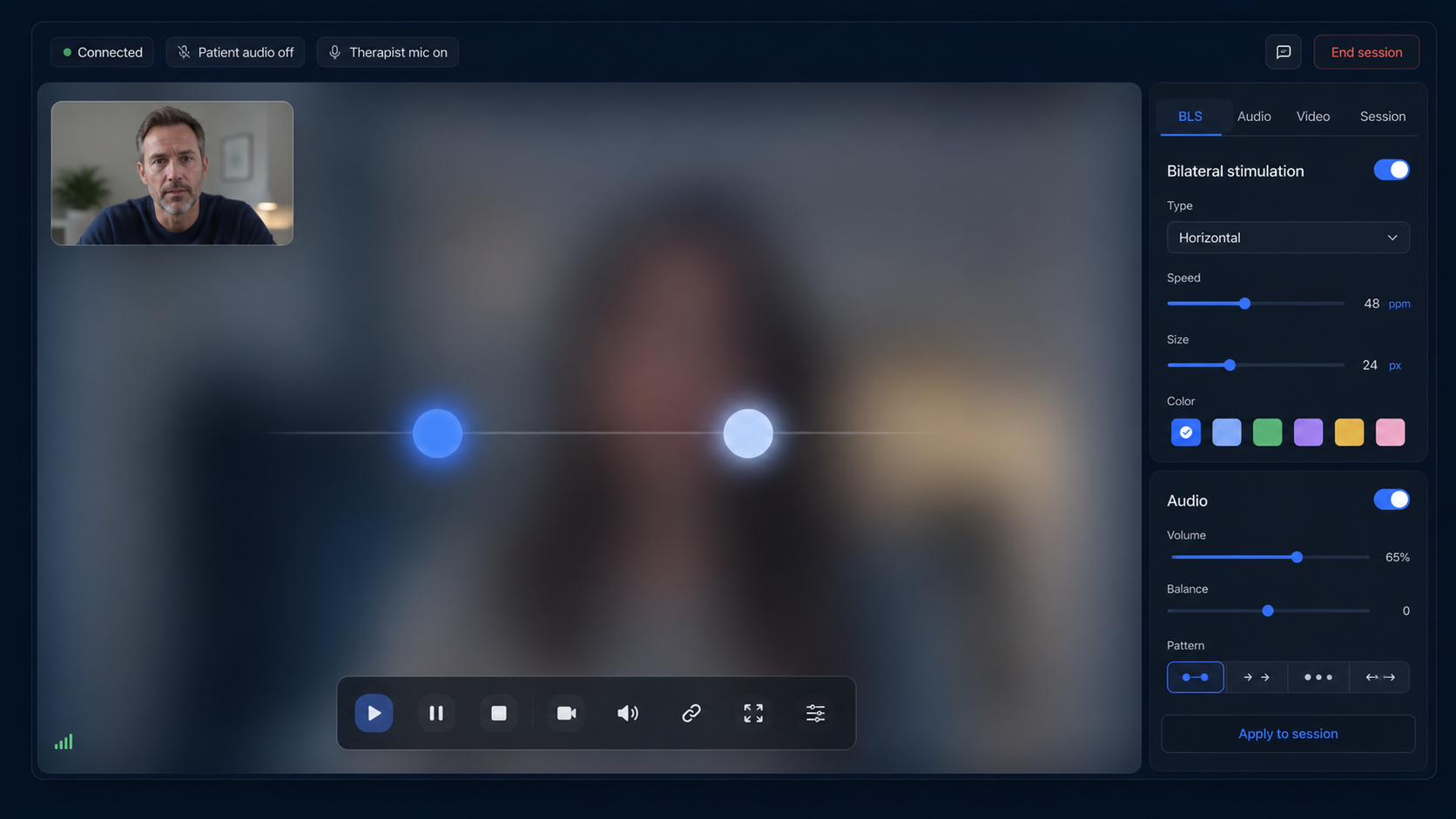
Record format choice, alternatives, patient preference, risk reasoning, contingency plan and review point. EMDRSuite can support integrated video, therapist-controlled BLS and private links, but it cannot decide suitability, observe the physical room, verify legal authority or replace emergency and clinical judgment.
FAQ
online vs in-person EMDR
Is online EMDR proven equivalent to in-person EMDR?
No universal equivalence claim is justified. Evidence is promising but heterogeneous, and suitability depends on patient, target, risk, setting and delivery quality.
Does NICE specifically recommend online EMDR?
NICE recommends EMDR for indicated PTSD, but its explicit digital recommendation is for supported computerized trauma-focused CBT in selected adults.
What must be tested before remote EMDR?
The actual device, privacy, video, microphone, BLS display or audio, pause, reconnection, location, backup contact and emergency plan.
Can EMDRSuite determine whether remote care is appropriate?
No. It supports delivery controls; the qualified therapist remains responsible for assessment, consent, risk, jurisdiction and format choice.
References
Online versus in-person EMDR: evidence, suitability, and clinical differences
EMDRSuite
Put the guide into practice with EMDRSuite
Run remote EMDR with visual BLS, bilateral sounds, secure patient links, video-ready sessions, saved settings, and notes.
Continue with related EMDR guides