Separate treatment outcomes, components, mechanisms, scope, and reporting
Why is EMDR controversial? What the evidence debate actually covers
A balanced map of EMDR controversy: PTSD outcomes, eye movements, proposed mechanisms, evidence certainty, uses beyond PTSD, safety reporting, and marketing claims.
By the EMDRSuite Editorial Team
Product claims checked against the current EMDRSuite code and interface.
No independent clinical reviewer is named for this guide.
The controversy is several questions, not one verdict
Debate about EMDR often mixes five separate questions: whether the full treatment helps PTSD, whether eye movements add benefit, which mechanism explains change, how far evidence extends beyond PTSD, and how adverse effects and commercial claims are reported. Evidence for one question does not settle the others.
Major guidelines recommend EMDR for PTSD, so describing the entire treatment as simply unsupported ignores those evaluations. Guideline inclusion also does not prove every theoretical explanation, every protocol adaptation, or every use for anxiety, pain, addiction, or another condition.
The eye-movement debate changed as component evidence accumulated
A critical 1999 review concluded that convincing evidence for an additional eye-movement effect was lacking at that time. A 2013 meta-analysis of 15 clinical and 11 laboratory trials, involving 849 participants, later reported an additive effect for eye movements, with treatment fidelity among the moderators.
That later result makes the historical dispute more nuanced, not closed. Component studies vary in task, comparison, sample, fidelity, and outcome. An average incremental effect does not show that eye movements are the only active element, that every bilateral modality is equivalent, or that one precise biological story has been proved.
Efficacy and mechanism certainty can move independently
A 2018 systematic review of 87 mechanism studies found reasonable support for working-memory and physiological accounts while describing mechanism research as still early. Adaptive Information Processing is a clinical model; it should not be presented as a directly observed brain process or settled neuroscientific fact.
A 2026 review of 12 randomized trials and 690 adults found possible PTSD benefit versus waiting list, but rated certainty low to very low and found long-term effects unclear. Waiting-list comparisons, active-treatment comparisons, component experiments, and guideline judgments answer different questions and should not be collapsed into one slogan.
Responsible communication states both support and limits
A rigorous summary says EMDR is a guideline-recommended trauma-focused psychotherapy for PTSD while comparative effects, exact mechanisms, broader indications, and long-term outcomes require condition-specific interpretation. It also notes that a review of 51 randomized EMDR trials found sparse adverse-effect reporting, rather than claiming that missing reports prove no harm.
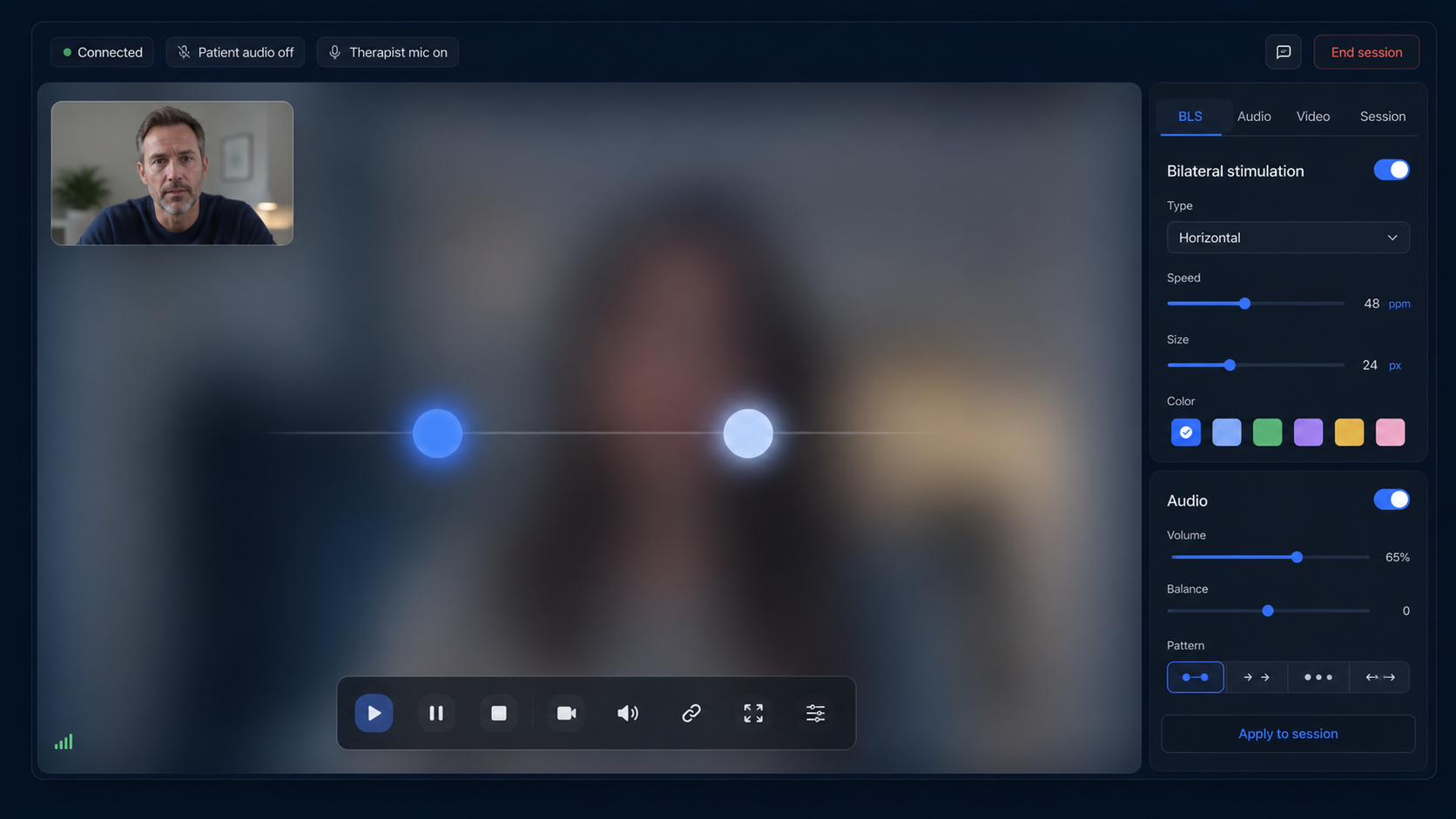
EMDRSuite supports therapist-led remote sessions and bilateral stimulation. It does not validate a mechanism, certify treatment fidelity, prove efficacy for an individual, or turn a nonstandard intervention into EMDR. Product claims must remain narrower than the clinical evidence.
FAQ
why is EMDR controversial
Is EMDR pseudoscience?
A blanket label obscures the evidence: EMDR is guideline-recommended for PTSD, while mechanisms, components, broader uses, and evidence certainty remain debated.
Are eye movements necessary?
Meta-analytic component evidence suggests an average additive effect, but it does not settle every modality, mechanism, or individual case.
Do guidelines prove how EMDR works?
No. Recommendations concern benefits, harms, evidence, and implementation; they do not certify one mechanism.
Does EMDRSuite prove EMDR works?
No. Software operation is not clinical evidence and cannot establish an individual's outcome.
References
Why is EMDR controversial? What the evidence debate actually covers
EMDRSuite
Put the guide into practice with EMDRSuite
Run remote EMDR with visual BLS, bilateral sounds, secure patient links, video-ready sessions, saved settings, and notes.
Continue with related EMDR guides