Bilateral stimulation and modality choice
EMDR eye movements, tapping, or tones: what evidence can and cannot decide
A therapist guide to visual, tactile, and auditory bilateral stimulation, direct and laboratory evidence, accessibility, remote delivery, preference, and monitoring.
By the EMDRSuite Editorial Team
Product claims checked against the current EMDRSuite code and interface.
No independent clinical reviewer is named for this guide.
Guidelines permit alternatives without declaring them equivalent
NICE says adult EMDR normally uses eye movements, while taps or tones can be used when preferred or more appropriate, including for visual impairment. That recommendation supports accessibility and clinical choice; it does not establish that every modality has identical effects for every person, target or outcome.
Choice starts with the treatment manual, therapist competence, consent, sensory and motor access, comfort, attention, fatigue, equipment and the person's response. A modality is part of a structured psychotherapy, not a standalone treatment or a consumer stimulus selected by popularity.
Component evidence answers narrower questions
A randomized clinical trial with 139 patients compared eye movements, visual fixation and exposure-only conditions within an otherwise standard EMDR procedure. A meta-analysis of 53 laboratory studies found that dual tasks reduced vividness and emotionality of recalled images, while emphasizing debate and variation across tasks and conditions.
Laboratory memory change is not the same endpoint as PTSD remission, durable functioning or comparative safety. Component studies can inform mechanisms and hypotheses but cannot by themselves rank visual, tactile and auditory delivery as complete therapies.
Direct modality comparisons remain limited
A small within-session study of 12 patients found eye movements outperformed alternating tones for immediate vividness and emotionality, with uncertainty about whether tones added to recall alone. This is not enough to ban tones, prove universal visual superiority or generalize to tapping and full treatment outcomes.
Online experience research found therapists and clients used several modalities and switched between them, often for practical or preference reasons. Feasibility and acceptability are useful observations, not randomized evidence that one remote modality produces better clinical outcomes.
Test delivery and monitor the person, not the animation
For remote work, test the actual screen, tracking range, frame smoothness, stereo channel, volume, headphones, tactile instructions, stop signal, latency and backup. Reassess if discomfort, dizziness, sensory overload, dissociation, loss of dual attention or technical failure appears.
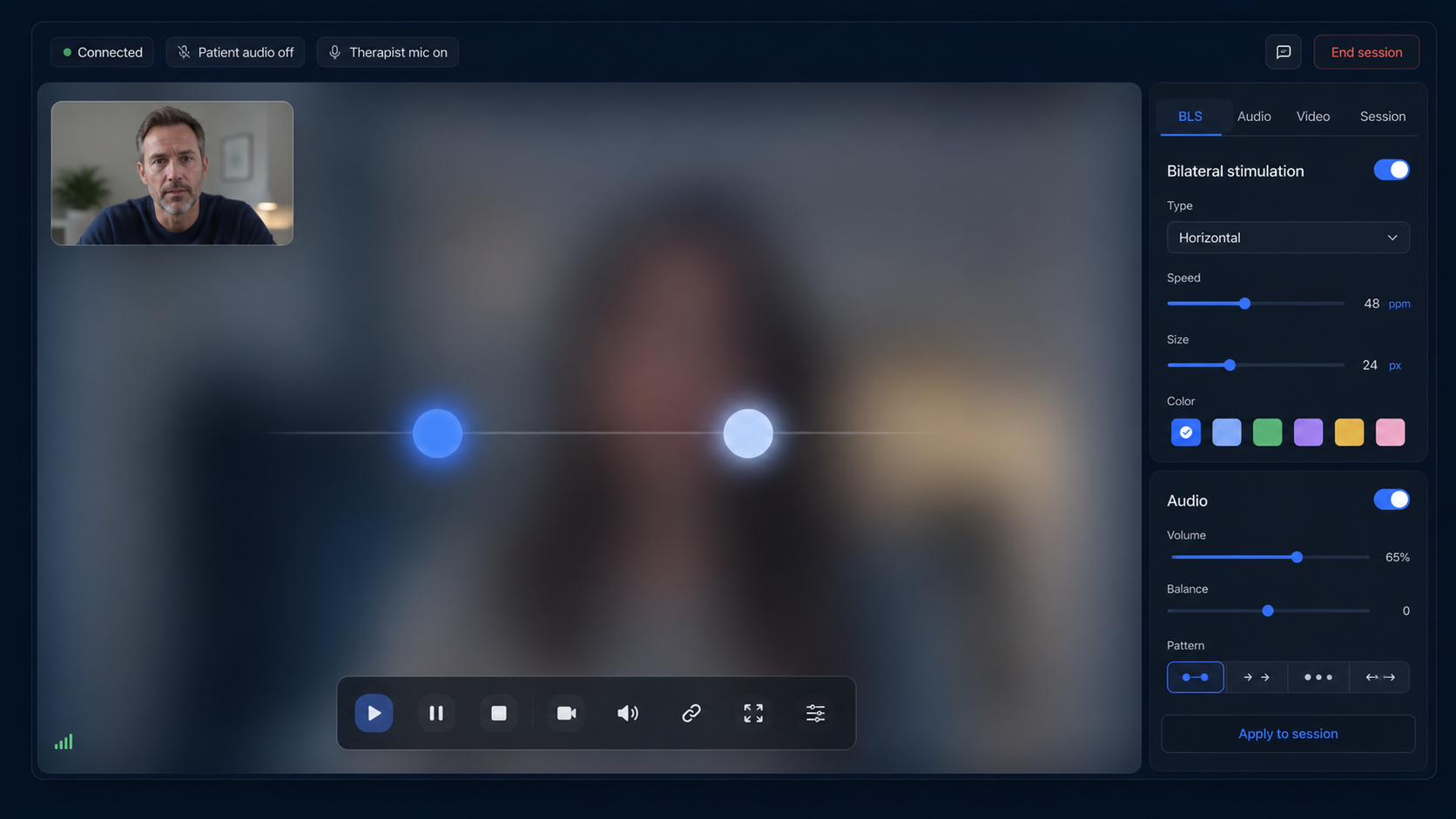
EMDRSuite provides therapist-controlled visual and auditory BLS with adjustable settings. It does not claim modality equivalence, choose tapping or tones, measure working-memory load, infer effectiveness or replace trained observation and a documented clinical rationale.
FAQ
EMDR eye movements vs tapping
Are tapping and tones proven identical to eye movements?
No. Guidelines allow alternatives, but direct comparative clinical evidence is limited and does not prove universal equivalence.
Do laboratory dual-task studies prove treatment success?
No. They study narrower memory outcomes and cannot establish full-course clinical effectiveness.
Can preference influence modality choice?
Yes, alongside accessibility, competence, protocol, comfort, response and technical reliability.
Does EMDRSuite choose the best BLS modality?
No. It supplies controls; modality selection and monitoring remain with the therapist.
References
EMDR eye movements, tapping, or tones: what evidence can and cannot decide
EMDRSuite
Put the guide into practice with EMDRSuite
Run remote EMDR with visual BLS, bilateral sounds, secure patient links, video-ready sessions, saved settings, and notes.
Continue with related EMDR guides