Pregnancy changes coordination needs, not the requirement for evidence
EMDR during pregnancy: safety, evidence, and clinical planning
Review EMDR during pregnancy for PTSD or fear of childbirth: safety data, evidence limits, maternity coordination, informed consent, pacing, and remote-session planning.
By the EMDRSuite Editorial Team
Product claims checked against the current EMDRSuite code and interface.
No independent clinical reviewer is named for this guide.
Define the treatment question and the stage of care
Treatment during pregnancy is not the same search intent as early postpartum intervention or therapy for a birth that has already occurred. Clarify whether the target is PTSD from an earlier event, fear of childbirth, a previous traumatic birth, pregnancy loss, current medical trauma, or another condition, and whether immediate danger or obstetric complications change priorities.
NICE recognizes PTSD and severe fear of childbirth in the perinatal period and recommends coordinated mental-health and maternity care. Its guideline supports trauma-focused CBT or EMDR for PTSD following traumatic birth, miscarriage, stillbirth, or neonatal death; it does not make every pregnancy-related fear an automatic indication for EMDR.
Available safety findings are reassuring but not definitive
A systematic review found 13 studies of trauma-focused therapy during pregnancy across eight intervention types. Symptoms improved in most studies and five reported no serious adverse events, but obstetric outcomes were incompletely reported and methods were generally weak. The review could not isolate the effects of EMDR or prove broad maternal-fetal safety.
A randomized trial assigned 141 pregnant women with fear of childbirth to EMDR or usual care. Safety outcomes did not differ, and both groups improved, but EMDR was not significantly better than usual care. The authors did not support adding EMDR routinely in that setting. Reassurance should therefore remain proportionate to these limits.
Plan with the patient and relevant maternity professionals
Use shared decision-making about expected benefit, alternatives, uncertainty, timing, symptom monitoring, physical comfort, breaks, and coordination with the obstetric or maternity team when clinically indicated. Review acute medical symptoms, medication, sleep, suicidality, dissociation, domestic safety, and access to urgent local care within professional scope.
Pregnancy alone should not be described as a universal contraindication, and online articles should not declare an individual safe to process. Avoid attributing ordinary fetal movement, contractions, pain, dizziness, bleeding, or other medical symptoms to therapy; follow local obstetric advice and emergency pathways.
Remote sessions require clinical and technical contingencies
Confirm the patient's exact location, privacy, emergency contacts, local services, physical positioning, camera and audio, stop signal, closure time, and reconnection plan. Decide in advance what requires pausing the session or seeking medical assessment.
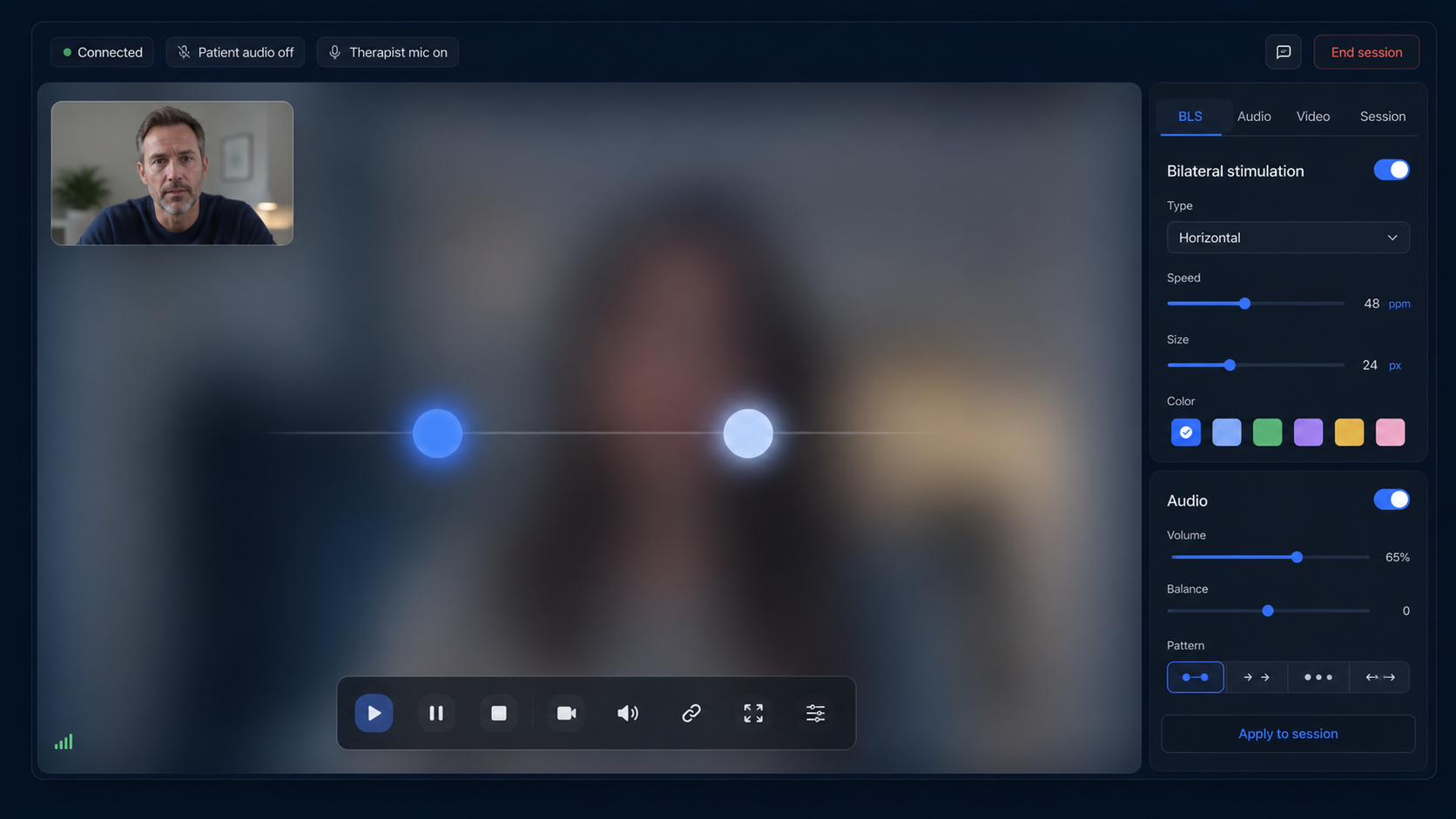
EMDRSuite provides therapist-controlled bilateral stimulation and live video. It does not monitor pregnancy, fetal wellbeing, contractions, vital signs, distress, or medical emergencies, and it cannot determine whether EMDR is appropriate. A technical test should use no real patient data.
FAQ
EMDR during pregnancy
Is EMDR proven safe during pregnancy?
Current findings are reassuring but limited; they do not prove universal maternal-fetal safety or suitability for an individual.
Does EMDR work for fear of childbirth?
One randomized trial found improvement in both groups but no significant advantage over usual care, so routine additional use was not justified.
Is pregnancy a contraindication to EMDR?
Not universally, but indication, timing, medical context, consent, risk, and coordination require individual professional assessment.
Can EMDRSuite monitor a pregnant patient?
No. It provides communication and stimulation controls, not medical or fetal monitoring.
References
EMDR during pregnancy: safety, evidence, and clinical planning
EMDRSuite
Put the guide into practice with EMDRSuite
Run remote EMDR with visual BLS, bilateral sounds, secure patient links, video-ready sessions, saved settings, and notes.
Continue with related EMDR guides