EMDR populations and accessibility
EMDR with autistic and neurodivergent clients: evidence and individualized adaptations
A therapist guide to limited EMDR evidence in autism, diagnostic overshadowing, clear communication, sensory access, pacing, consent, and individualized adaptation.
By the EMDRSuite Editorial Team
Product claims checked against the current EMDRSuite code and interface.
No independent clinical reviewer is named for this guide.
Autism is not the treatment target
EMDR is considered for an assessed trauma-related problem, not as a treatment for autism or neurodivergence. Autistic people are heterogeneous, and communication, sensory processing, interoception, attention, memory, movement, language, support, and preferences cannot be inferred from a diagnosis. Ask the person what is accessible and meaningful rather than applying a standard autism profile.
Diagnostic overshadowing can work in both directions: trauma responses may be misread as autistic traits, while familiar autistic behavior may be pathologized as trauma. Formulation should distinguish baseline patterns, change from baseline, current danger, PTSD criteria, dissociation, anxiety, depression, physical health, medication, sleep, and contextual stress without requiring neurotypical presentation.
The evidence is promising and still small
A feasibility study of autistic adults exposed to adverse events reported symptom reductions after EMDR added to usual care, but it was small and did not establish universal efficacy. A Delphi study gathered consensus from EMDR therapists about barriers and adaptations; professional consensus describes practice, not comparative treatment effect.
Reviews repeatedly describe a limited evidence base. Avoid claiming a special autism protocol, assuming EMDR is superior to another trauma-focused therapy, or treating lists of adaptations as mandatory. Explain uncertainty, alternatives, therapist competence in both autism and trauma, and the role of autism-informed consultation.
Adapt function, language, sensory load, and predictability
Possible accommodations include clear literal language, written or visual information, explicit session structure, more processing time, fewer open-ended questions, predictable transitions, attention to masking and fatigue, flexible breaks, and checking understanding without demanding eye contact or rapid emotion labels. Support persons require role clarity and consent.
Assess visual motion, sound, headphones, tactile options, light, camera, screen size, latency, and body-focused prompts individually. Some people prefer eye movements; others do not. A shorter set or different modality is a clinical adaptation only when it preserves purpose and is monitored, not an automatic setting selected from a diagnostic label.
Record preferences and response, not a deficit checklist
Document the person's language and identity preference, access needs, communication plan, relevant baseline, chosen accommodations, consent, observed or reported response, overload signals, stop method, support roles, consultation, and review date. Revisit these because capacity and sensory tolerance can vary by context and day.
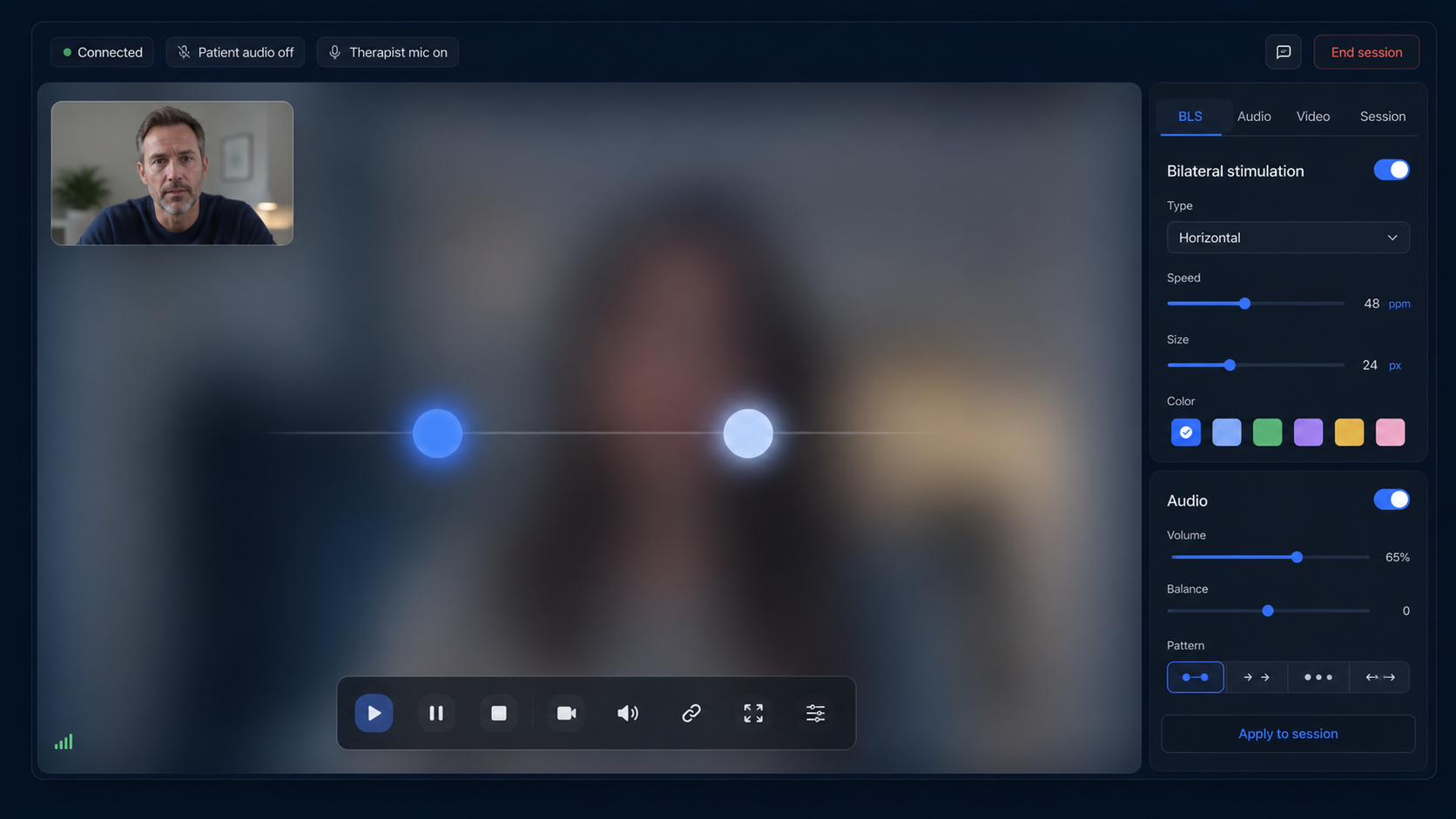
EMDRSuite lets the therapist adjust visual and auditory stimulation and maintain therapist-entered notes. It does not diagnose autism or PTSD, infer sensory needs, provide an autism protocol, choose BLS, judge readiness, replace tactile accommodations, or substitute for accessible care, specialist competence, and shared clinical decisions.
FAQ
EMDR for autistic clients
Is EMDR an autism treatment?
No. It may be considered for an assessed trauma-related problem in an autistic person; it does not treat autism itself.
Is there a standard autism EMDR protocol?
The research supports individualized accessibility and formulation, not one mandatory protocol for every autistic or neurodivergent person.
Must eye movements be used?
No universal modality fits everyone. The trained therapist and client consider purpose, preference, sensory access, response, and available alternatives.
Does EMDRSuite select autism adaptations?
No. It provides adjustable controls; assessment, accommodations, consent, and monitoring remain clinician-led.
References
EMDR with autistic and neurodivergent clients: evidence and individualized adaptations
EMDRSuite
Put the guide into practice with EMDRSuite
Run remote EMDR with visual BLS, bilateral sounds, secure patient links, video-ready sessions, saved settings, and notes.
Continue with related EMDR guides