Do not turn a workplace problem into an individual defect
EMDR for burnout: work stress, trauma, and evidence limits
Separate burnout from PTSD and depression when considering EMDR, with WHO guidance, workplace causes, emerging studies, and responsible care boundaries.
By the EMDRSuite Editorial Team
Product claims checked against the current EMDRSuite code and interface.
No independent clinical reviewer is named for this guide.
Burnout is occupational, not a catch-all medical diagnosis
WHO defines burnout as an occupational phenomenon arising from chronic workplace stress that has not been successfully managed, with exhaustion, distance or cynicism, and reduced professional efficacy. It is not classified as a medical condition and should not describe distress in every area of life.
Assess workload, control, hours, staffing, bullying, discrimination, moral injury, role conflict, support, sleep, physical health, depression, anxiety, PTSD, substance use, and risk. A trauma history does not remove the employer's or system's responsibilities.
The main EMDR burnout trial is still a protocol
The HARD publication describes a planned cohort of 3,000 healthcare workers and an embedded open-label trial of 900 people receiving usual care or usual care plus 12 EMDR sessions. Its paper reports design, not treatment results.
Small online studies in pandemic-exposed healthcare workers mostly recruited people with PTSD or traumatic stress and measured trauma, anxiety, depression, or emotional exhaustion. They cannot establish EMDR as a general burnout treatment for other occupations or ordinary chronic workload.
Individual therapy cannot substitute for safer work
WHO guidance covers organizational interventions, manager and worker training, individual support, return to work, and inclusion. An umbrella review found signals for mindfulness, CBT, ACT, and related approaches, while emphasizing limited research and the need to attend to professional context.
A meta-analysis of randomized physician studies found statistically small changes in some burnout dimensions that were unlikely to be clinically meaningful. Treatment planning should therefore include workload and organizational change where possible, not only personal coping or memory processing.
Name the target and protect recovery
EMDR may be relevant when a qualified assessment identifies PTSD, a distressing workplace event, moral injury, or another formulated memory target. Measure that target separately from exhaustion, work participation, sleep, depression, safety, and actual workplace conditions.
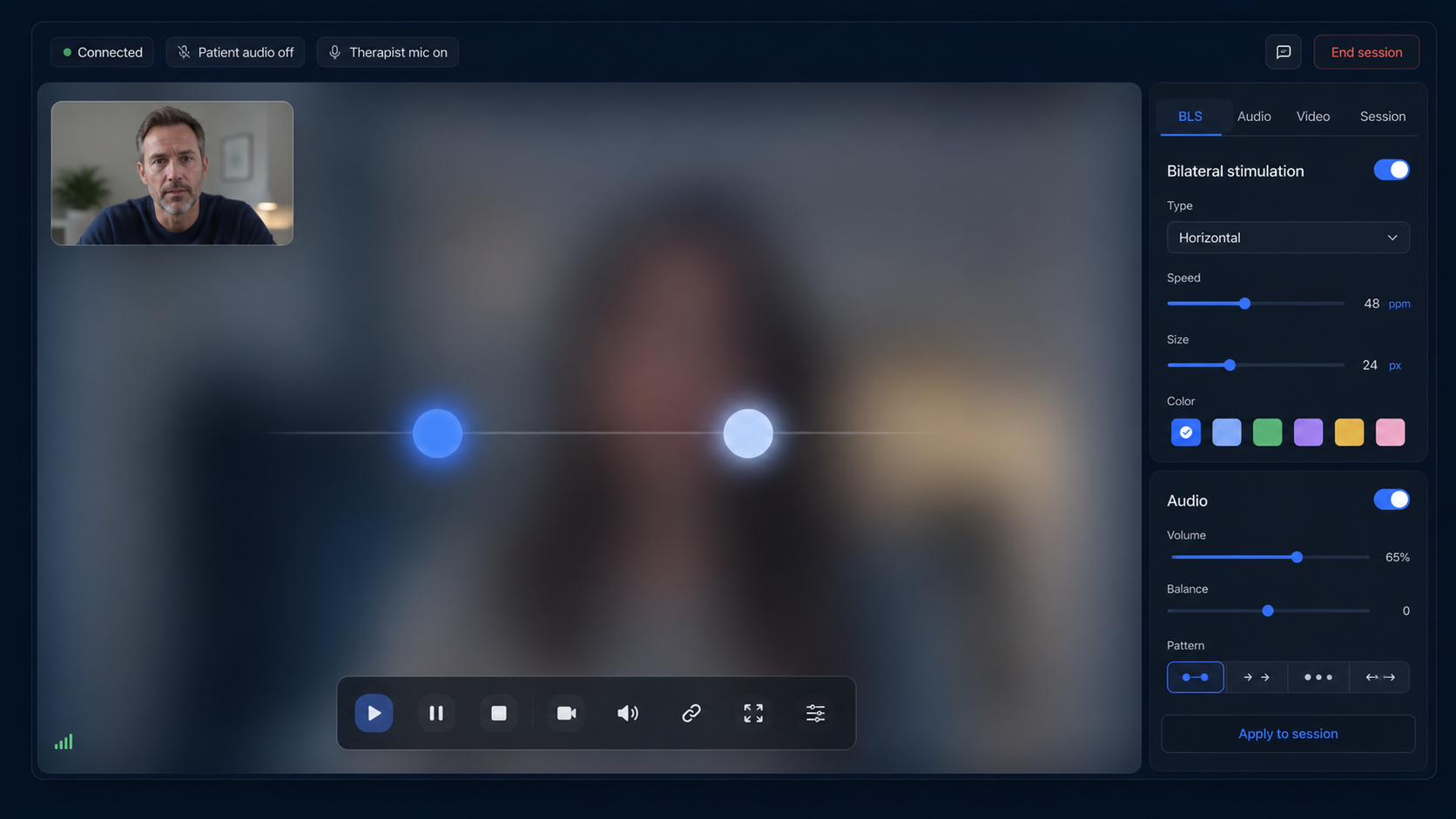
EMDRSuite supports remote video and therapist-controlled bilateral stimulation. It does not diagnose burnout, measure workload, change employment conditions, certify sick leave or return to work, provide occupational health care, assess suicide risk, or replace organizational action.
FAQ
EMDR for burnout
Is burnout a medical diagnosis?
WHO classifies it as an occupational phenomenon, not a medical condition.
Has EMDR been proven for burnout?
Direct evidence remains emerging; the largest cited study is a protocol rather than published outcome data.
Can therapy solve unsafe working conditions?
No. Individual care may help distress, but organizational causes require organizational action.
Does EMDRSuite assess burnout?
No. It provides remote-session technology only.
References
EMDR for burnout: work stress, trauma, and evidence limits
EMDRSuite
Put the guide into practice with EMDRSuite
Run remote EMDR with visual BLS, bilateral sounds, secure patient links, video-ready sessions, saved settings, and notes.
Continue with related EMDR guides