Butterfly Hug is self-administered tactile BLS, not self-directed EMDR therapy
EMDR Butterfly Hug: origin, evidence, safety, and clinical limits
Review the Butterfly Hug's origin, tactile BLS evidence, group-protocol context, self-use limits, and remote-session safeguards.
By the EMDRSuite Editorial Team
Product claims checked against the current EMDRSuite code and interface.
No independent clinical reviewer is named for this guide.
The method began in disaster work and later entered several protocols
Jarero and Artigas report that Lucina Artigas originated the Butterfly Hug while working with Hurricane Pauline survivors in Acapulco in 1998. Crossing the arms and alternating tactile stimulation lets the person administer BLS without a therapist touching them.
It has since appeared within IGTP, IGTP-OTS, PRECI, ASSYST, remote work, and other settings. Use inside a multicomponent protocol does not make Butterfly Hug the protocol, prove every use, or turn bilateral tapping into complete EMDR therapy.
Direct standalone evidence remains limited
Group and remote studies that use Butterfly Hug also include assessment, psychoeducation, imagery, drawings, therapist contact, other protocol steps, or repeated sessions. Their outcomes cannot isolate the effect of tapping from the rest of the intervention.
A ClinicalTrials.gov record updated in 2026 describes a completed 46-participant randomized Butterfly Tapping study focused on emotional reactivity and EEG outcomes. A registry entry is not a peer-reviewed clinical-effectiveness result, and it does not establish treatment of PTSD or another disorder.
Self-administered BLS is not automatically safe or regulating
Some people may find crossing the arms, chest contact, rhythm, inward attention, or trauma-linked imagery uncomfortable, inaccessible, culturally unsuitable, or activating. Consent includes offering alternatives and stopping when orientation, agency, or tolerance decreases.
Between-session use needs an agreed purpose, boundaries, warning signs, crisis routes, and clarity about whether the person is grounding, strengthening a resource, or activating disturbing material. A lower distress rating in one moment is not diagnosis, memory processing, or proof of durable benefit.
Remote technology must preserve choice rather than automate the method
In remote care, check camera framing only when clinically necessary, privacy, headphones, stop signals, reconnection, physical comfort, and an alternative modality. Do not record or score body movements to infer compliance or response.
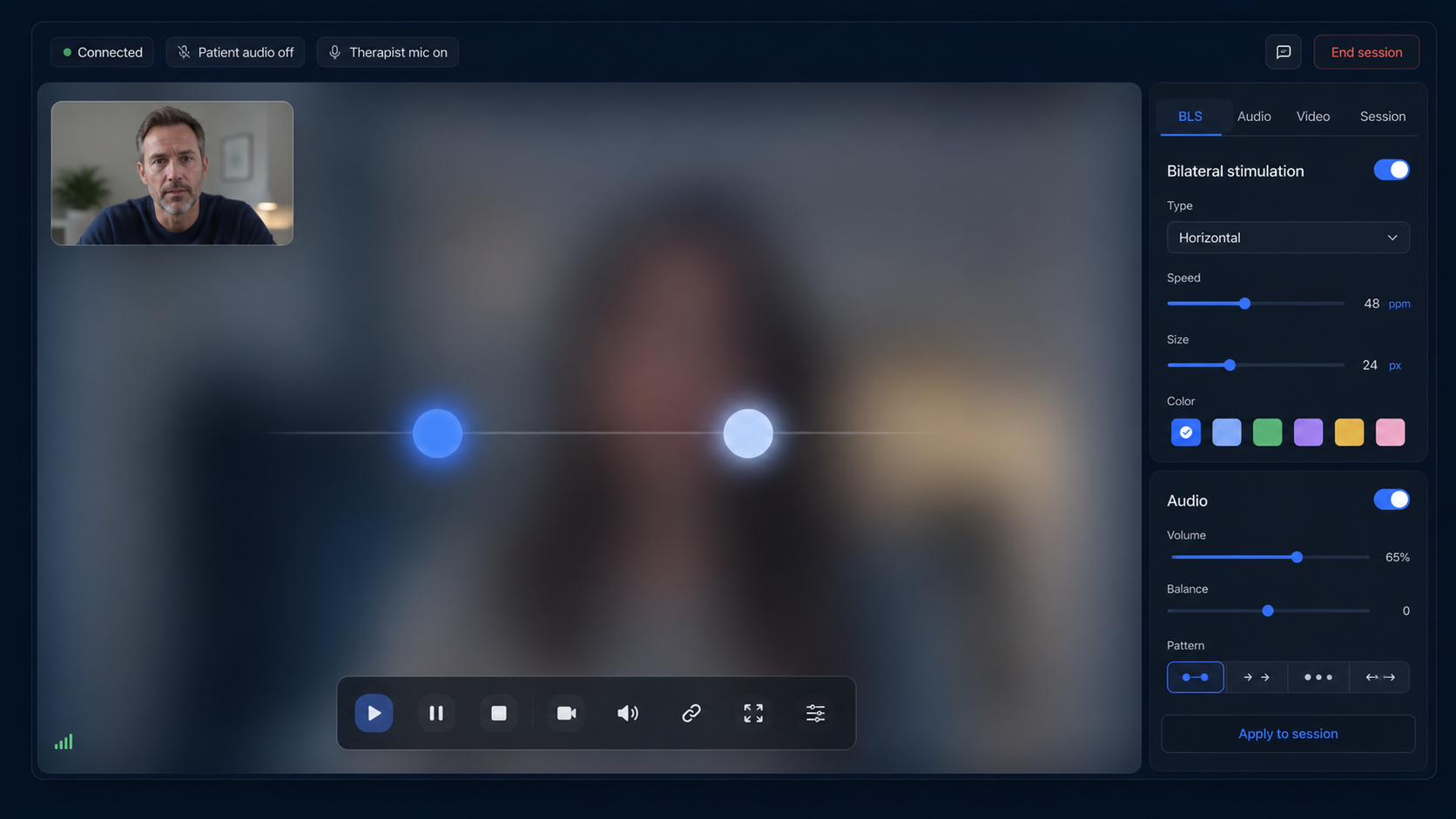
EMDRSuite provides therapist-controlled visual and auditory BLS, video, and session controls. It does not teach Butterfly Hug, prescribe self-tapping, monitor touch, deliver IGTP or ASSYST, or replace EMDR training and clinical judgment.
FAQ
EMDR Butterfly Hug
Who developed the Butterfly Hug?
Lucina Artigas originated it in 1998 during disaster work in Acapulco; Ignacio Jarero and Artigas documented the method.
Is Butterfly Hug the same as EMDR therapy?
No. It is a tactile BLS method used in some EMDR procedures, not the full eight-phase therapy.
Has Butterfly Hug alone been proven to treat PTSD?
No. Most outcome studies combine it with other components, and a recent registered experiment does not establish clinical effectiveness.
Does EMDRSuite automate Butterfly Hug?
No. It supports therapist-led remote sessions but does not teach, prescribe, watch, or score self-tapping.
References
EMDR Butterfly Hug: origin, evidence, safety, and clinical limits
EMDRSuite
Put the guide into practice with EMDRSuite
Run remote EMDR with visual BLS, bilateral sounds, secure patient links, video-ready sessions, saved settings, and notes.
Continue with related EMDR guides