Four Elements is a stress-management resource, not a trauma-processing protocol
EMDR Four Elements exercise: origin, evidence, and clinical limits
Understand Earth, Air, Water, and Fire in the Four Elements exercise, its intended stress-management role, evidence limits, and remote use.
By the EMDRSuite Editorial Team
Product claims checked against the current EMDRSuite code and interface.
No independent clinical reviewer is named for this guide.
Earth, Air, Water, and Fire organize four brief resource tasks
Elan Shapiro published the Four Elements exercise in a 2007 clinical Q&A. The sequence links present grounding, breathing, saliva or mouth awareness, and adaptive imagery; its stated modest aim was a small reduction in current stress and repeated practice, not complete trauma resolution.
The original description places it in preparation and stabilization, including emergencies and difficulty accessing safe-place imagery. Later books and G-TEP-related training include it, but Four Elements is not G-TEP, R-TEP, standard EMDR, a diagnostic scale, or an emergency service.
Published provenance is stronger than component-specific outcome evidence
The original article is a clinical rationale and set of directions rather than a controlled trial. A randomized STEP study with 34 EMDR-trained clinicians included Four Elements videos inside a larger computerized self-care protocol, so it cannot estimate the exercise's independent contribution.
Broader group-protocol and trauma-treatment evidence also bundles multiple procedures. No controlled clinical trial isolating Four Elements as treatment for PTSD, anxiety, or another diagnosis was identified in the sources reviewed through 28 August 2026.
A mnemonic does not replace individualized preparation
Grounding can be unsuitable when the current environment is actually dangerous; breathing focus may intensify panic; mouth sensations may be difficult with medication or medical conditions; and safe imagery can fail or activate loss. Adapt language, sequence, sensory demands, and expectations rather than blaming the patient.
Track current stress only for the agreed clinical purpose. A one- or two-point change is not a validated outcome, readiness certificate, or reason to delay indicated trauma-focused treatment indefinitely.
Remote delivery still requires containment and scope
Confirm location, privacy, accessibility, stop and pause signals, emergency contacts, session time, follow-up, and what happens if distress rises. Do not send copied scripts or worksheets when use rights, monitoring, and context are unclear.
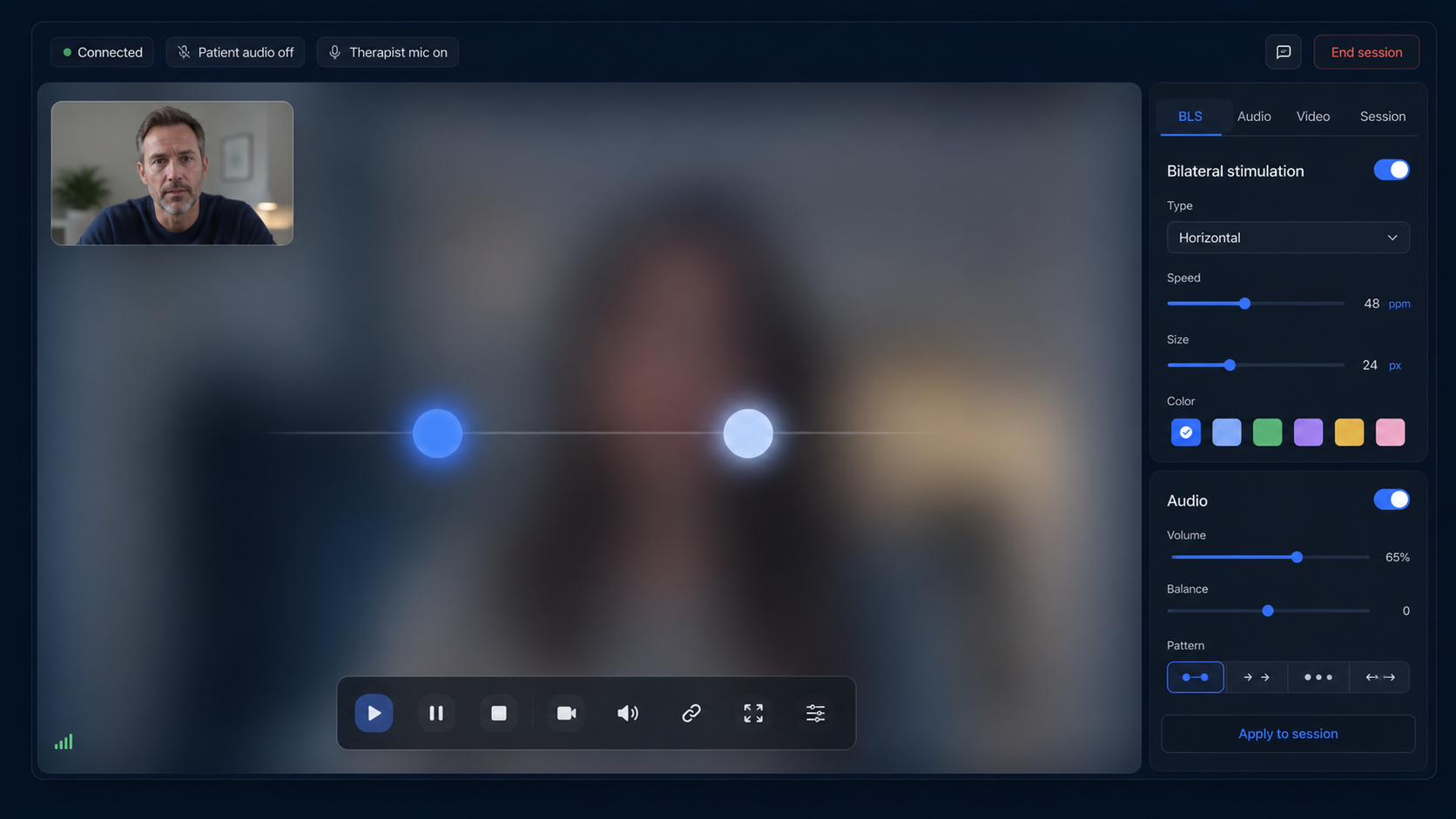
EMDRSuite can support a qualified therapist's video session and BLS controls. It does not include a Four Elements script, bracelet reminder, stress algorithm, group room, crisis response, or automatic decision about preparation or processing.
FAQ
EMDR Four Elements exercise
Who created the Four Elements exercise?
Elan Shapiro published it as a stress-management resource in 2007.
What are the four elements?
Earth, Air, Water, and Fire organize grounding, breathing, mouth awareness, and adaptive imagery.
Is Four Elements independently proven to treat PTSD?
No controlled clinical trial isolating it as a PTSD treatment was identified; studies usually bundle it with other procedures.
Does EMDRSuite provide the Four Elements script?
No. It provides remote-session technology, not protected scripts, stress scoring, or clinical decisions.
References
EMDR Four Elements exercise: origin, evidence, and clinical limits
EMDRSuite
Put the guide into practice with EMDRSuite
Run remote EMDR with visual BLS, bilateral sounds, secure patient links, video-ready sessions, saved settings, and notes.
Continue with related EMDR guides