Phase 2 resources, mechanism questions, and evidence limits
EMDR Resource Development and Installation: RDI evidence and clinical boundaries
A therapist guide to EMDR Resource Development and Installation, its Phase 2 role, two-case evidence, component research, current uncertainty, consent, and monitoring.
By the EMDRSuite Editorial Team
Product claims checked against the current EMDRSuite code and interface.
No independent clinical reviewer is named for this guide.
RDI is a resource procedure, not the whole of EMDR therapy
Resource Development and Installation is used to identify and strengthen access to adaptive qualities, experiences, relationships, or symbolic resources. It is often located in preparation and may be revisited when a formulation indicates a specific capacity needs support.
RDI should not be presented as synonymous with the standard protocol, proof of readiness, or a universal prerequisite measured by a fixed number of sessions. Resourcing can support treatment, but indefinite preparation can also postpone an indicated trauma-focused intervention without evidence that more installation will solve the barrier.
The foundational clinical evidence consists of two cases
The 2002 publication introduced RDI for complex PTSD or DESNOS and reported descriptive psychometric and behavioral outcomes from two single-case studies. The authors themselves called the evidence preliminary and recommended future outcome research.
Two cases cannot estimate comparative effectiveness, adverse-event rates, who benefits, or whether bilateral stimulation adds value beyond imagery, therapeutic relationship, rehearsal, expectancy, and other components. Clinical popularity is not the same as replicated efficacy.
A component experiment challenged a core mechanism assumption
In 53 undergraduate participants, horizontal and vertical eye movements during positive memories reduced vividness, pleasantness, and experienced strength compared with recall alone. Those findings followed working-memory predictions and did not support the claim that eye movements necessarily intensify positive resource memories.
This laboratory study did not test the full RDI procedure in patients, so it neither proves RDI ineffective nor validates it. A 2026 registered single-arm pilot shows that research is continuing, but registration is not a result and cannot support effectiveness claims.
Tie every resource intervention to a formulation and observable purpose
Define the capacity being supported, how access will be assessed, what would indicate benefit or interference, and how the work connects to the broader treatment plan. Obtain consent that distinguishes established EMDR evidence from the much thinner evidence for RDI as a standalone intervention.
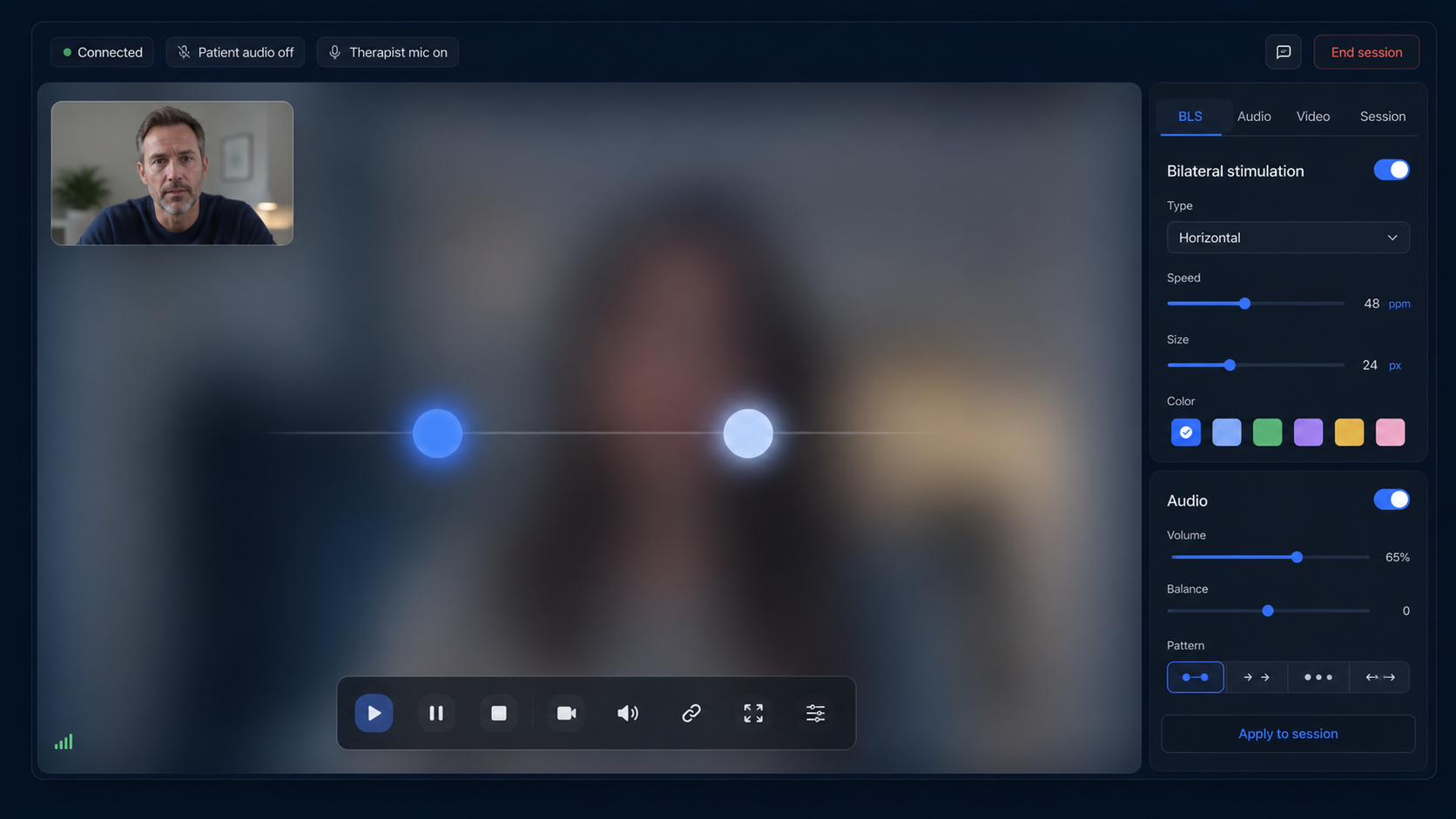
EMDRSuite can deliver adjustable bilateral stimulation and retain clinician-entered notes. It does not identify resources, measure stabilization, install a capacity, validate an imagery exercise, determine readiness, or replace accredited training and consultation.
FAQ
EMDR Resource Development and Installation
Is RDI required before every EMDR case?
No. Preparation is individualized, and no fixed RDI requirement is established for every client.
How strong is direct RDI evidence?
Weak and preliminary: the foundational clinical report contained two cases, and rigorous outcome research remains sparse.
Do eye movements reliably strengthen positive memories?
That mechanism is not established; one component experiment found reductions rather than increases in positive-memory qualities.
Can EMDRSuite determine whether a client is resourced?
No. Readiness and capacity require clinical assessment, not a software score.
References
EMDR Resource Development and Installation: RDI evidence and clinical boundaries
EMDRSuite
Put the guide into practice with EMDRSuite
Run remote EMDR with visual BLS, bilateral sounds, secure patient links, video-ready sessions, saved settings, and notes.
Continue with related EMDR guides