Assessment and safety
EMDR and dissociation: assessment, dual attention, and readiness questions
A source-led guide to dissociation in PTSD and complex PTSD, what screening can and cannot show, and why session-state monitoring matters before and during EMDR.
By the EMDRSuite Editorial Team
Product claims checked against the current EMDRSuite code and interface.
No independent clinical reviewer is named for this guide.
Dissociation is not one symptom or one treatment verdict
Dissociation may involve depersonalization, derealization, memory disruption, reduced awareness, detachment, or other experiences. It can occur within PTSD, the DSM-5 dissociative subtype, complex PTSD, dissociative disorders, and other clinical contexts. A single score cannot resolve that differential picture.
Research finds a moderate-to-strong association between dissociative symptoms and ICD-11 complex PTSD, while also showing inconsistent measurement. The practical implication is careful assessment and formulation, not an automatic conclusion that EMDR is either required or contraindicated.
Screening supports assessment; it does not replace it
Validated questionnaires can identify experiences that warrant further inquiry and provide a baseline for monitoring. Results depend on the instrument, timeframe, language, setting, current state, and the person's understanding of each item. They are not stand-alone diagnoses or automated readiness tests.
Assessment should consider current safety, memory gaps, depersonalization, derealization, identity disruption, substance effects, psychosis-related experiences, medical factors, functional impact, and the clinician's competence. Complex or unclear findings may indicate consultation or referral within applicable professional standards.
Dual attention is observable and can change during a session
EMDR asks the person to contact target material while remaining oriented enough to the present therapeutic context. Apparent calm is not sufficient evidence of dual attention: reduced responsiveness, time loss, confusion, abrupt state shifts, or marked detachment may require the therapist to reassess what is happening.
Remote work adds visibility, audio, connection, privacy, location, and emergency-response considerations. A technical interruption can resemble disengagement, while dissociation can be mistaken for a frozen connection. The contingency plan should help distinguish and respond to both without allowing software to make the clinical interpretation.
Evidence supports nuance rather than exclusion
Systematic reviews suggest that people with dissociative symptoms can benefit from trauma-focused treatment, but highly dissociative populations remain underrepresented and dissociation is often only a secondary outcome. A recent meta-analysis found a small overall reduction in dissociation across psychological interventions and called for more explicit attention to it.
Track state changes, functioning, adverse effects, recovery after sessions, and the person's account, not only target SUD. Pause, return to assessment or preparation, adapt, consult, or refer when clinically indicated. The rationale and review point should be visible in the record.
FAQ
EMDR and dissociation
Does dissociation automatically rule out EMDR?
No. Dissociation requires careful assessment and may alter planning, pacing, monitoring, competence needs, or referral decisions; it is not one automatic verdict.
Can a dissociation questionnaire diagnose a dissociative disorder?
No. Screening can flag experiences for fuller assessment but does not establish diagnosis or readiness by itself.
Why does dual attention matter in EMDR?
It describes contact with target material while retaining sufficient orientation to the present context; this can change during a session.
Can video software detect dissociation?
No. Connection data and visible behaviour may inform observation, but clinical interpretation belongs to the therapist.
References
EMDR and dissociation: assessment, dual attention, and readiness questions
EMDRSuite
Put the guide into practice with EMDRSuite
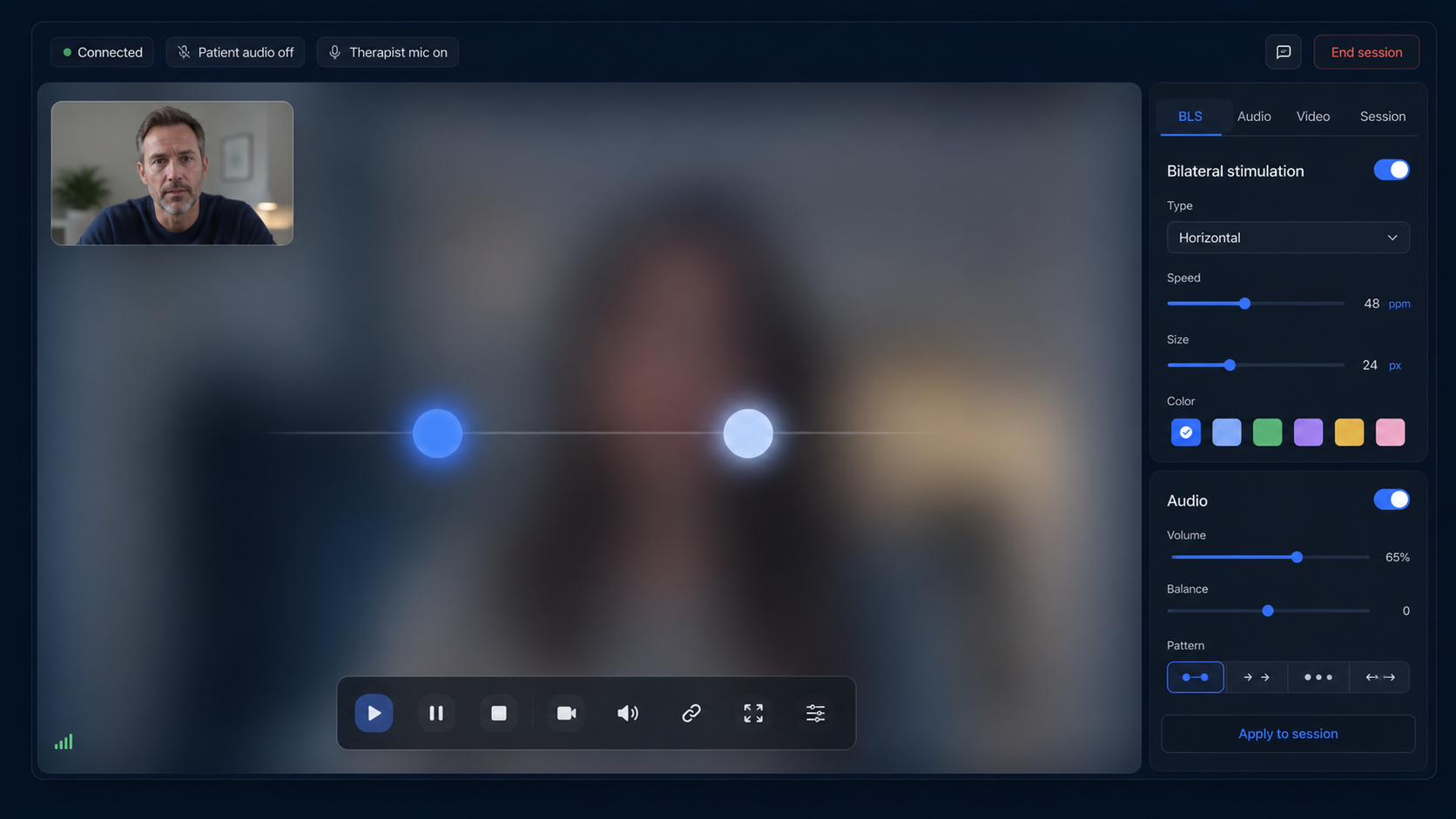
Run remote EMDR with visual BLS, bilateral sounds, secure patient links, video-ready sessions, saved settings, and notes.
Continue with related EMDR guides