Derived technique, preliminary evidence, and informed choice
EMDR Flash Technique: evidence, differences, and training boundaries
A therapist guide to the Flash Technique, how it differs from standard EMDR, clinical and experimental findings, evidence limits, training, consent, and remote use.
By the EMDRSuite Editorial Team
Product claims checked against the current EMDRSuite code and interface.
No independent clinical reviewer is named for this guide.
Flash Technique is not another name for standard EMDR
EMDRIA describes EMDR psychotherapy as an eight-phase, three-pronged treatment and distinguishes it from EMDR-derived techniques. Its continuing-education listing explicitly classifies the Flash Technique as a deviation from the EMDRIA definition of EMDR.
That distinction matters for explanation, consent, documentation, training, fidelity, and claims. A positive engaging focus with brief contact with a disturbing memory is not interchangeable with the standard assessment and open reprocessing sequence, even when both may use eye movements, blinking, or bilateral stimulation.
The first clinical randomized trial was small and condition-specific
A 2022 randomized study involved 39 people after traffic accidents and compared Flash Technique with a WHO stress-management module. Some anxiety, intrusion, avoidance, total traumatic-stress, and psychological quality-of-life outcomes favored Flash at one month, while depression, stress, hyperarousal, and several quality-of-life domains did not differ.
This is a promising first clinical test, not proof across PTSD diagnoses, complex presentations, children, remote care, or every version of Flash. The comparator was not full standard EMDR or another established trauma-focused psychotherapy.
Experimental findings do not establish clinical equivalence
A separate experiment randomized 60 non-clinical participants with aversive autobiographical memories to Flash or abbreviated EMDR. Memory emotionality and vividness decreased without a between-group difference, and participants rated Flash as more pleasant.
A non-clinical memory experiment cannot demonstrate equivalent PTSD remission, durability, safety, dropout, or functioning. The ENHANCE protocol was designed to compare trained delivery of standard EMDR, EMDR 2.0, and Flash; a study protocol describes intended methods, not treatment results.
Use requires competence, transparent naming, and outcome monitoring
Clarify whether Flash is preparation, an adjunct, or the principal intervention; identify the indication; explain alternatives and uncertainty; document the version and training used; assess dissociation and risk; and monitor target symptoms, function, adverse changes, acceptability, and what happens next.
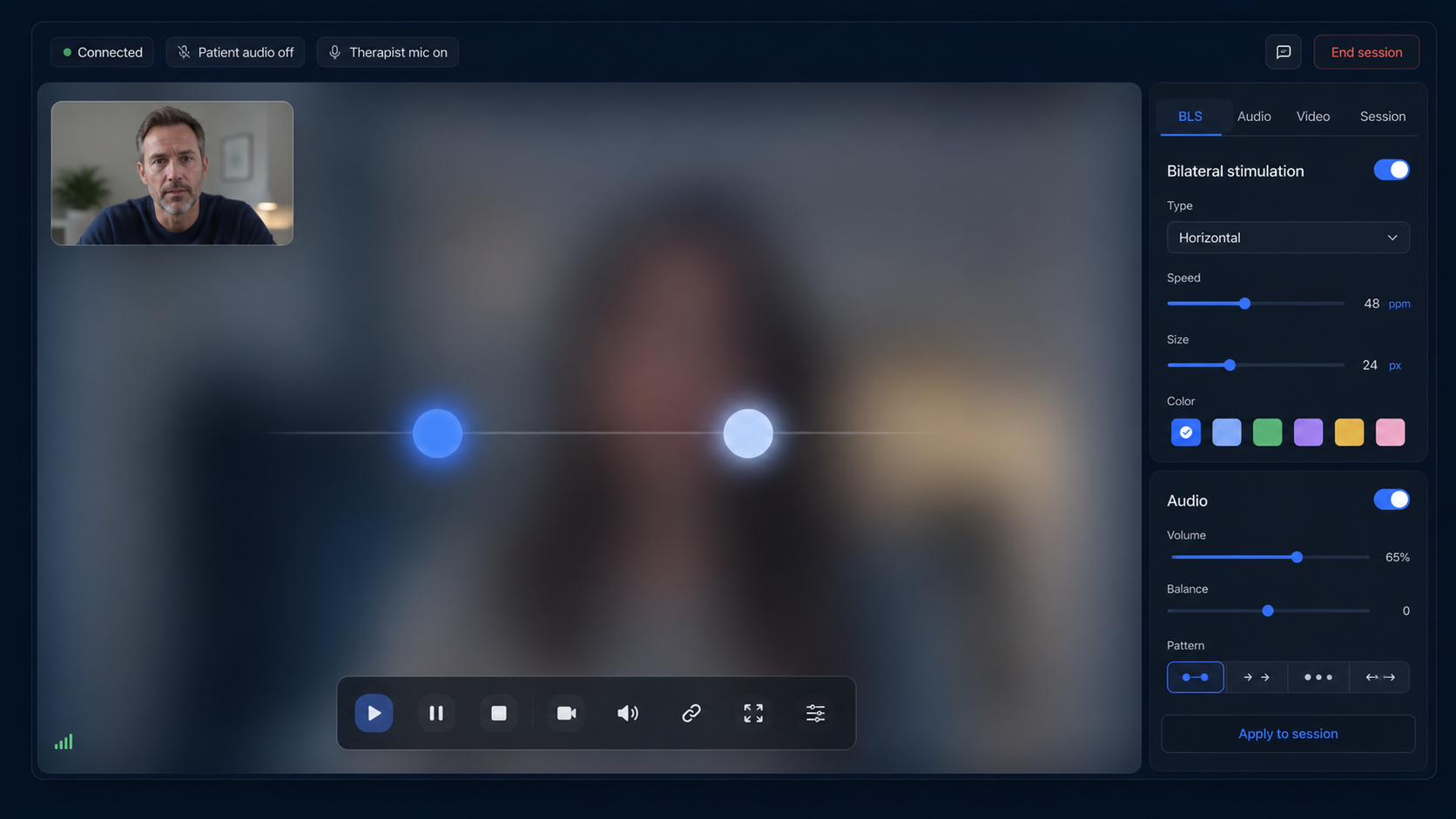
EMDRSuite can support therapist-controlled visual or auditory stimulation during a remote appointment. It does not teach or certify Flash, reproduce a proprietary protocol, select a technique, verify fidelity, assess readiness, or turn a derived technique into standard EMDR.
FAQ
EMDR Flash Technique evidence
Is Flash Technique the same as EMDR?
No. It is commonly described as an EMDR-derived technique and EMDRIA lists its course as a deviation from the EMDR definition.
Is Flash better than standard EMDR?
That is not established. Early studies are promising, but direct clinical comparative evidence remains limited.
Does Flash avoid all distress or trauma contact?
No such guarantee is supported; explanation should not promise painless treatment or zero activation.
Does EMDRSuite include Flash training?
No. The software provides session controls, not protocol training, certification, or clinical decisions.
References
EMDR Flash Technique: evidence, differences, and training boundaries
EMDRSuite
Put the guide into practice with EMDRSuite
Run remote EMDR with visual BLS, bilateral sounds, secure patient links, video-ready sessions, saved settings, and notes.
Continue with related EMDR guides