G-TEP is a trained group protocol, not a worksheet to use without screening
EMDR G-TEP: group traumatic episode protocol evidence and limits
Review G-TEP studies, group screening, remote delivery, privacy, worksheet and training limits without reproducing the protocol.
By the EMDRSuite Editorial Team
Product claims checked against the current EMDRSuite code and interface.
No independent clinical reviewer is named for this guide.
G-TEP structures group processing of a traumatic episode
G-TEP is a trained Group Traumatic Episode Protocol that uses a structured worksheet and self-administered bilateral stimulation within a therapist-led group. It is not R-TEP delivered to several people, standard individual EMDR, IGTP, psychological first aid, universal debriefing, or a printable worksheet that establishes competence.
Before grouping, assess event fit, current danger, diagnosis, dissociation, psychosis, substance use, suicide risk, medical needs, developmental and accessibility needs, privacy, language, group cohesion, and whether individual care or another treatment is more appropriate.
Randomized findings are promising but based on small samples
A refugee-camp trial randomized 47 adults, with 18 assigned to G-TEP and 29 to control, and reported lower PTSD and depression symptoms after two sessions. A later outpatient study randomized 44 heterogeneous patients to immediate or delayed G-TEP and separately examined implementation in 23 hospital patients.
Remote frontline-worker and online childhood-sexual-abuse studies add feasibility signals, but the latter included only 19 women across G-TEP and trauma-focused CBT. Small groups, waitlist comparators, short follow-up, self-report, and different populations prevent a claim that G-TEP is superior or prevents chronic PTSD.
The group EMDR review does not make protocols interchangeable
A systematic review included 22 studies and 1,739 participants: 13 examined IGTP, four G-TEP, four IGTP-OTS, and one a child group protocol. Twelve were one-arm studies and ten had two arms; the authors highlighted methodological limitations.
Results pooled across protocol families cannot validate every G-TEP worksheet, dose, remote format, population, or trainer. A registered birth-trauma feasibility study is ongoing evidence collection, not a result. Protocol fidelity and independent replication remain important.
Remote groups require more than video and bilateral stimulation
Establish identity, location, private space, headphones, support, emergency routes, co-facilitation, inclusion and exclusion criteria, observation limits, stop procedures, reconnection, breakout policy, record minimization, and follow-up. Group confidentiality can be requested but not guaranteed by the therapist or platform.
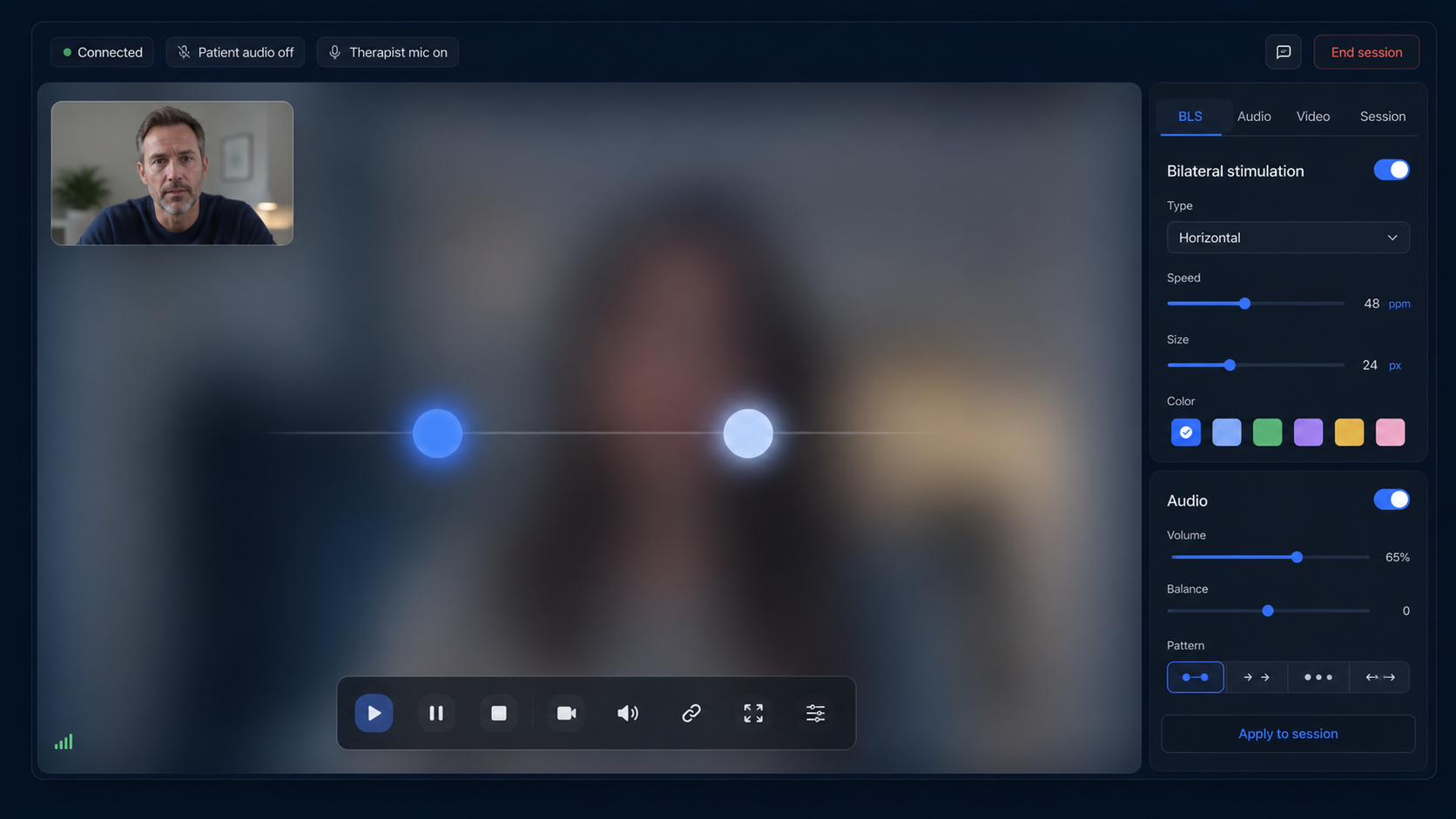
EMDRSuite supports one therapist and one patient per session room. It does not provide G-TEP group rooms, worksheets, scripts, screening, co-facilitator controls, training, certification, or group-risk management; it should not be presented as implementing G-TEP.
FAQ
EMDR G-TEP protocol
Is G-TEP the same as R-TEP?
No. G-TEP is a structured group protocol; R-TEP is an individual recent-traumatic-episode protocol.
Does the evidence prove that G-TEP prevents PTSD?
No. Small trials report symptom change, but prevention and comparative superiority remain unproven.
Can a therapist download a worksheet and run G-TEP?
A worksheet is not training, competence, screening, supervision, or authorization to reproduce protected materials.
Does EMDRSuite provide G-TEP groups?
No. EMDRSuite session rooms are therapist-patient, not group-protocol rooms.
References
EMDR G-TEP: group traumatic episode protocol evidence and limits
EMDRSuite
Put the guide into practice with EMDRSuite
Run remote EMDR with visual BLS, bilateral sounds, secure patient links, video-ready sessions, saved settings, and notes.
Continue with related EMDR guides