FND is a real neurological disorder diagnosed by positive clinical signs
EMDR for functional neurological disorder: evidence and care limits
Evaluate EMDR for FND using the MODIFI feasibility trial, neurological diagnosis, rehabilitation evidence, trauma assumptions, and remote-care limits.
By the EMDRSuite Editorial Team
Product claims checked against the current EMDRSuite code and interface.
No independent clinical reviewer is named for this guide.
FND symptoms are real, involuntary, and neurologically assessed
Functional neurological disorder can involve functional seizures, weakness, tremor, gait, movement, sensory, speech, or cognitive symptoms. A responsible diagnosis uses positive neurological features and a compatible clinical picture; it is not merely a normal scan, unexplained symptoms, assumed trauma, or evidence that the person is fabricating illness.
New facial droop, weakness, seizure-like events, loss of consciousness, severe headache, injury, or other acute change requires the appropriate emergency and neurological pathway. Assess comorbid neurological disease, medications, sleep, pain, PTSD, mood, dissociation, function, and rehabilitation needs without requiring a trauma history.
MODIFI established feasibility, not efficacy
The MODIFI randomized feasibility study enrolled 50 people and compared EMDR plus standard neuropsychiatric care with standard care. Treatment adherence was 88% and questionnaire completion at nine months was 76%, with promising clinical signals.
The authors designed the study to test feasibility and acceptability before a definitive trial. Its size and purpose do not prove that EMDR treats FND, establish superiority, identify responders, or justify calling it a first-line neurological treatment.
Rehabilitation and formulation remain multidisciplinary
A 2025 umbrella review found CBT and physiotherapy foundational while rating review quality no better than moderate. Broader outcome reviews indicate benefit from psychological and physical rehabilitation, including in persistent FND, but report heterogeneous studies and limited certainty.
Explain the diagnosis constructively and coordinate neurology, physiotherapy, occupational or speech therapy, psychology, and medical care according to symptoms. If EMDR targets PTSD or a medical memory, measure those outcomes separately from seizures, mobility, falls, daily activity, and participation.
Remote session software cannot monitor neurological events
Before remote processing, plan what the patient and clinician will do if awareness changes, a functional seizure occurs, connection is lost, mobility becomes unsafe, or a new symptom appears. Do not ask the patient to prove that symptoms are psychological or continue stimulation through uncertainty.
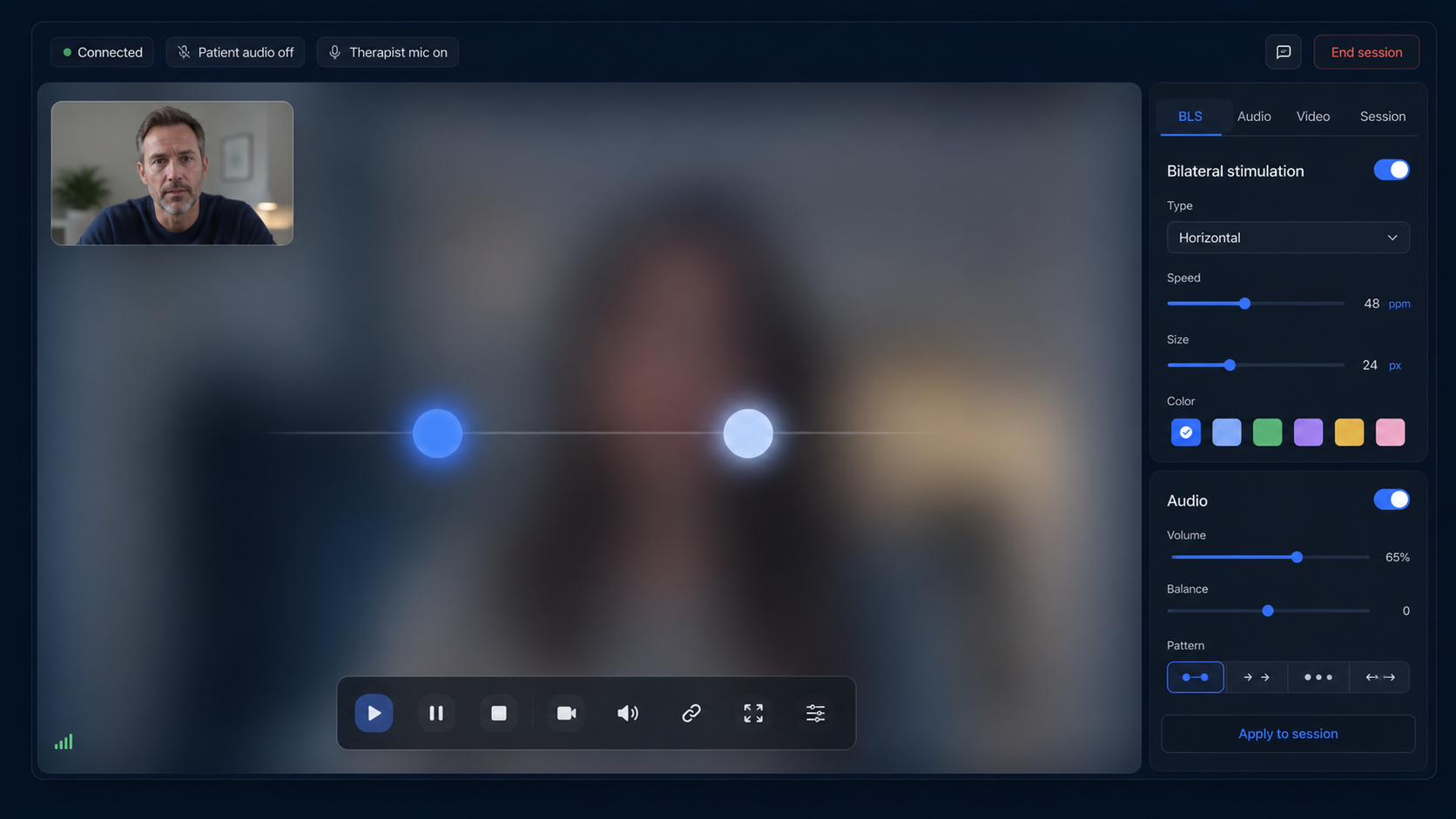
EMDRSuite does not diagnose FND or stroke, distinguish epileptic from functional seizures, monitor consciousness or falls, provide physiotherapy, inspect the environment, contact emergency services, select targets, or replace neurology and multidisciplinary rehabilitation.
FAQ
EMDR for functional neurological disorder
Is FND imaginary or voluntary?
No. Symptoms are real and involuntary; diagnosis should be based on positive clinical features.
Did MODIFI prove EMDR works for FND?
No. Its 50-person design tested feasibility and acceptability, not definitive efficacy.
Must someone have trauma to be diagnosed with FND?
No. Trauma is neither required nor sufficient for diagnosis.
Can EMDRSuite monitor a seizure or neurological emergency?
No. It cannot classify events, monitor consciousness, or replace emergency and neurological care.
References
EMDR for functional neurological disorder: evidence and care limits
EMDRSuite
Put the guide into practice with EMDRSuite
Run remote EMDR with visual BLS, bilateral sounds, secure patient links, video-ready sessions, saved settings, and notes.
Continue with related EMDR guides