Two-Hand Interweave is Robin Shapiro's discernment procedure, not a decision test
EMDR Two-Hand Interweave: origin, evidence, and training
Review Robin Shapiro's Two-Hand Interweave, its preparation and processing contexts, evidence limits, protected instructions, and remote safeguards.
By the EMDRSuite Editorial Team
Product claims checked against the current EMDRSuite code and interface.
No independent clinical reviewer is named for this guide.
Robin Shapiro published the named procedure in 2005
The Legacy Library and EMDRIA book record attribute the Two-Hand Interweave to Robin Shapiro's chapter in EMDR Solutions: Pathways to Healing. It is described as an exercise of discernment that may be used in preparation, during processing, or in other clinician-led contexts.
EMDRIA education describes applications involving comparisons, choices, danger, past-versus-present capacities, and collaboration between internal networks. That lineage distinguishes the named procedure from cognitive interweaves generally and from standard eight-phase EMDR as a complete treatment.
Clinical popularity is not isolated efficacy
A peer-reviewed addictions practice article includes the Two-Hand Interweave among possible pre-EMDR interventions for ambivalence. Books, workshops, and clinician reports provide rationale and examples, but they do not isolate the procedure's contribution to outcomes.
No controlled trial isolating the Two-Hand Interweave was identified through 28 August 2026. The Legacy Library description's approximately 95% clinician-experience claim is not a trial result, diagnostic-accuracy estimate, or success rate that can be generalized to patients.
It cannot decide what is true or what a client should choose
The procedure may support noticing differences, but it is not a validated decision aid, lie detector, capacity test, parts diagnosis, or method for establishing risk. The therapist should preserve client agency, uncertainty, cultural context, consent, and the possibility that ambivalence carries adaptive information.
Remote use requires reliable communication, clear stop controls, observation of activation and orientation, and a contingency plan. A named interweave should not replace assessment of current danger, dissociation, coercion, suicidality, substance effects, or other reasons for hesitation.
Training and copyright remain separate from this overview
This page does not reproduce the Two-Hand Interweave instructions, sequence, scripts, demonstrations, or protected chapter. Clinicians should consult the original publication and authorized professional education rather than an unofficial PDF.
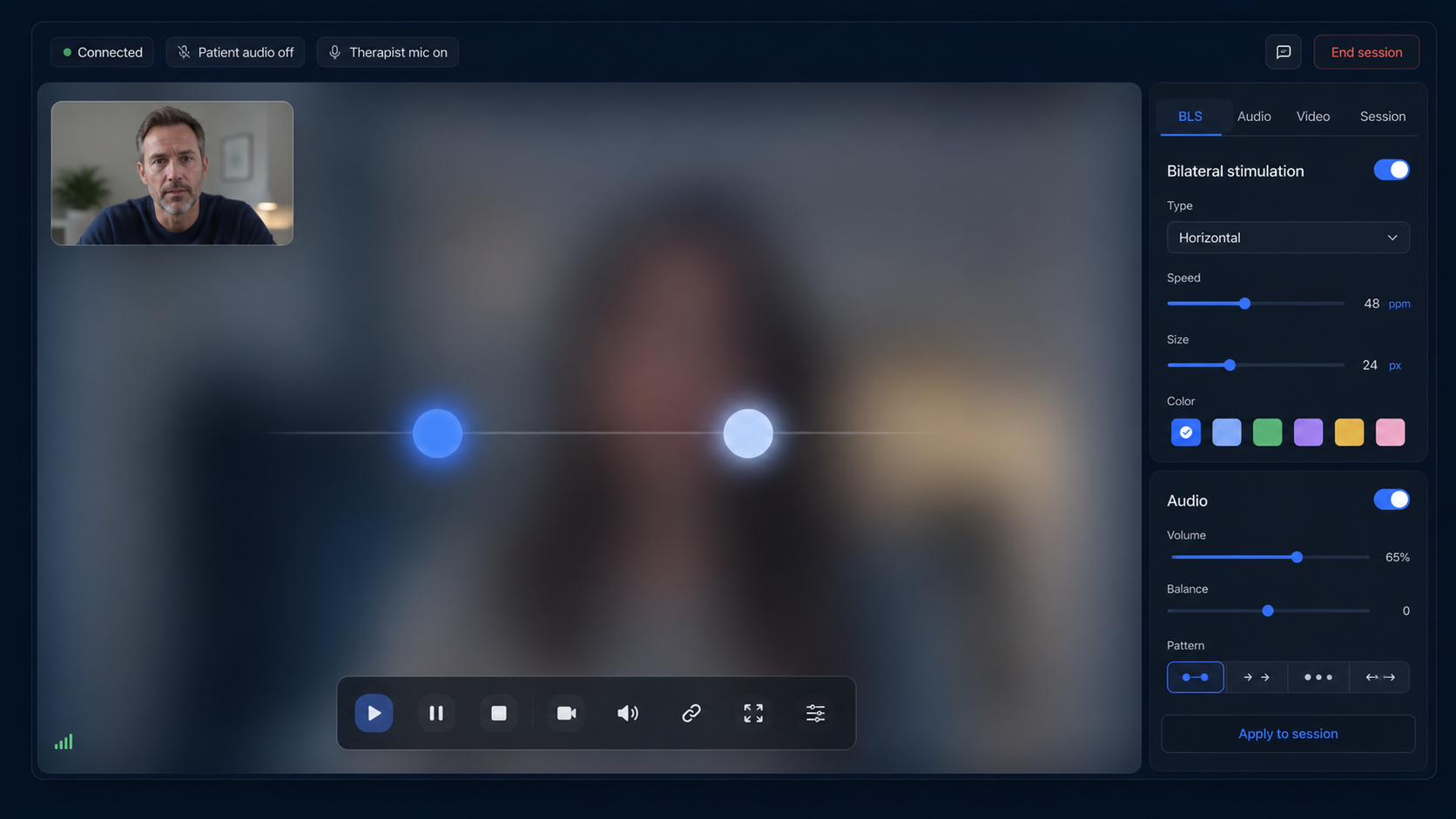
EMDRSuite supplies the video room and therapist-controlled bilateral stimulation. It does not generate contrasts, interpret what each hand means, recommend an interweave, or decide when processing should continue.
FAQ
EMDR Two-Hand Interweave
Who developed the Two-Hand Interweave?
Robin Shapiro published the named procedure in the 2005 book EMDR Solutions: Pathways to Healing.
Is it a cognitive interweave?
It can function as an interweave, but the named procedure also appears in preparation and discernment contexts. It should not replace the broader concept page for cognitive interweaves.
Is there controlled evidence for it?
No controlled trial isolating the Two-Hand Interweave was identified in the sources reviewed through 28 August 2026.
Does this page provide the script?
No. It provides provenance and evidence boundaries, not the protected sequence or clinical instructions. Use original sources and appropriate training.
References
EMDR Two-Hand Interweave: origin, evidence, and training
EMDRSuite
Put the guide into practice with EMDRSuite
Run remote EMDR with visual BLS, bilateral sounds, secure patient links, video-ready sessions, saved settings, and notes.
Continue with related EMDR guides