Two first-line PTSD treatments differ in session tasks, not in seriousness
EMDR vs CPT for PTSD: evidence, tasks, and treatment choice
Compare EMDR and Cognitive Processing Therapy for PTSD by protocol, cognitive work, bilateral stimulation, homework, evidence, preference, and monitoring.
By the EMDRSuite Editorial Team
Product claims checked against the current EMDRSuite code and interface.
No independent clinical reviewer is named for this guide.
CPT and EMDR use different routes through trauma-focused care
CPT focuses on trauma-related stuck points and more balanced appraisals through Socratic questioning, structured cognitive practice and worksheets. The current CPT protocol may be delivered with or without a written trauma account and often runs for about 12 sessions with flexibility based on progress.
EMDR organizes care through eight phases and selected memory networks, with brief reports during sets of bilateral stimulation. It normally does not require a detailed narrative or the same worksheet and homework sequence. Neither description makes one treatment easier for every patient.
Guidelines support both; indirect rankings do not prove a winner
The VA/DoD guideline identifies CPT, EMDR and prolonged exposure as the three most strongly recommended individual trauma-focused psychotherapies for PTSD. A network meta-analysis included 98 randomized trials and 5,567 participants and found significant benefits for both CPT and EMDR, with certainty and follow-up patterns varying by comparison.
The 2024 individual-participant analysis found no significant overall difference between EMDR and the psychological comparators available to it, but it was not a dedicated head-to-head CPT trial. Cross-trial rankings cannot tell a clinician which treatment will work best for one person.
Choose through informed preference and measurable fit
Discuss diagnosis, prior therapy, guilt and self-blame, willingness for worksheets or between-session practice, preference about detailed writing, dissociation, literacy, accessibility, culture, schedule and therapist competence. Avoid presenting CPT as merely talking or EMDR as a passive eye exercise.
Set baseline symptoms and functioning, monitor engagement and adverse effects, and agree when to review progress. Switching or combining requires a revised formulation; it should not be triggered only by brand preference or a single difficult session.
A BLS platform does not deliver CPT
Both treatments can be delivered remotely with appropriate privacy, emergency and technology planning. CPT needs secure handling of worksheets and practice; EMDR needs reliable bilateral stimulation when used online.
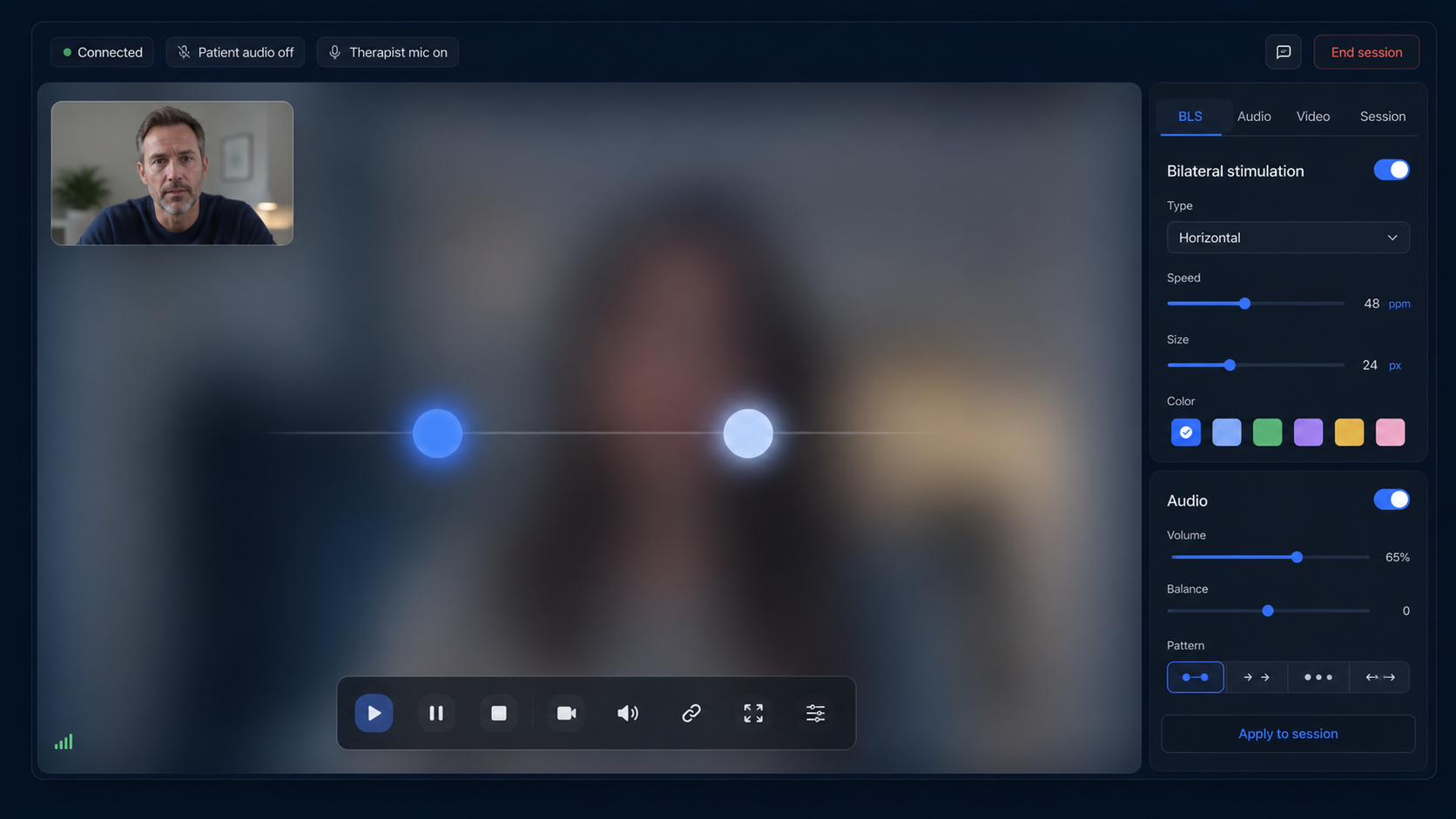
EMDRSuite supports video and therapist-controlled stimulation. It does not deliver CPT worksheets, identify stuck points, assign homework, score PTSD, choose a treatment or establish competence.
FAQ
EMDR vs CPT
Are CPT and EMDR both first-line for PTSD?
Yes. Major guidelines recommend both as named trauma-focused psychotherapies for adult PTSD.
Which is more effective?
Current evidence does not justify a universal winner; direct evidence, patient fit and clinician competence all matter.
Does CPT always require a written trauma account?
No. Current CPT can be delivered without the written account, based on the protocol and shared decision-making.
Can EMDRSuite deliver CPT?
No. It is an EMDR session platform and does not provide CPT worksheets or treatment.
References
EMDR vs CPT for PTSD: evidence, tasks, and treatment choice
EMDRSuite
Put the guide into practice with EMDRSuite
Run remote EMDR with visual BLS, bilateral sounds, secure patient links, video-ready sessions, saved settings, and notes.
Continue with related EMDR guides