Parts language and memory processing are not interchangeable protocols
EMDR vs IFS: evidence, structure, and responsible integration
Compare EMDR and Internal Family Systems by treatment structure, PTSD evidence, parts work, training, integration claims, and remote practice limits.
By the EMDRSuite Editorial Team
Product claims checked against the current EMDRSuite code and interface.
No independent clinical reviewer is named for this guide.
The models organize treatment differently
EMDR is an eight-phase psychotherapy that selects target memories, assesses associated image, cognition, emotion and sensation, and uses dual attention with bilateral stimulation. Internal Family Systems describes experience through parts and Self-led relationships, while PARTS is a specific group-and-individual IFS program studied for PTSD.
Using words such as part, protector, exile or Self during an EMDR session does not automatically create a validated combined protocol. The clinician must name which model is guiding formulation, what procedure is being delivered, and which competencies and consent apply.
IFS evidence is emerging; there is no EMDR-versus-IFS trial
EMDR is recommended in major adult PTSD guidelines. A 2024 PARTS proof-of-concept study included 15 participants and supported feasibility, acceptability and further controlled research. A 2026 active-control trial randomized 60 patients; both groups improved, with no significant between-group difference in PTSD symptoms.
Those findings test an intensive 16-week online group program with individual sessions, not every form of individual IFS and not an IFS-informed EMDR adaptation. No direct randomized comparison establishes IFS as superior, equivalent or inferior to EMDR.
Integration needs a rationale, not just compatible language
Before combining, define the primary diagnosis, target, risk, dissociation, treatment phase, expected mechanism and outcome measure. Explain when standard EMDR is being adapted, how parts language changes the procedure, and what evidence is direct versus extrapolated.
Track PTSD symptoms, functioning, adverse effects, engagement and treatment burden. If protective responses intensify, that is clinical information requiring formulation and pacing; it is not proof that a hidden part or memory has been discovered.
Software cannot identify parts or select a model
Remote work requires privacy, location, emergency planning, stop signals, camera and audio contingencies regardless of the psychotherapy. A digital workspace can support communication and stimulation without interpreting inner experience.
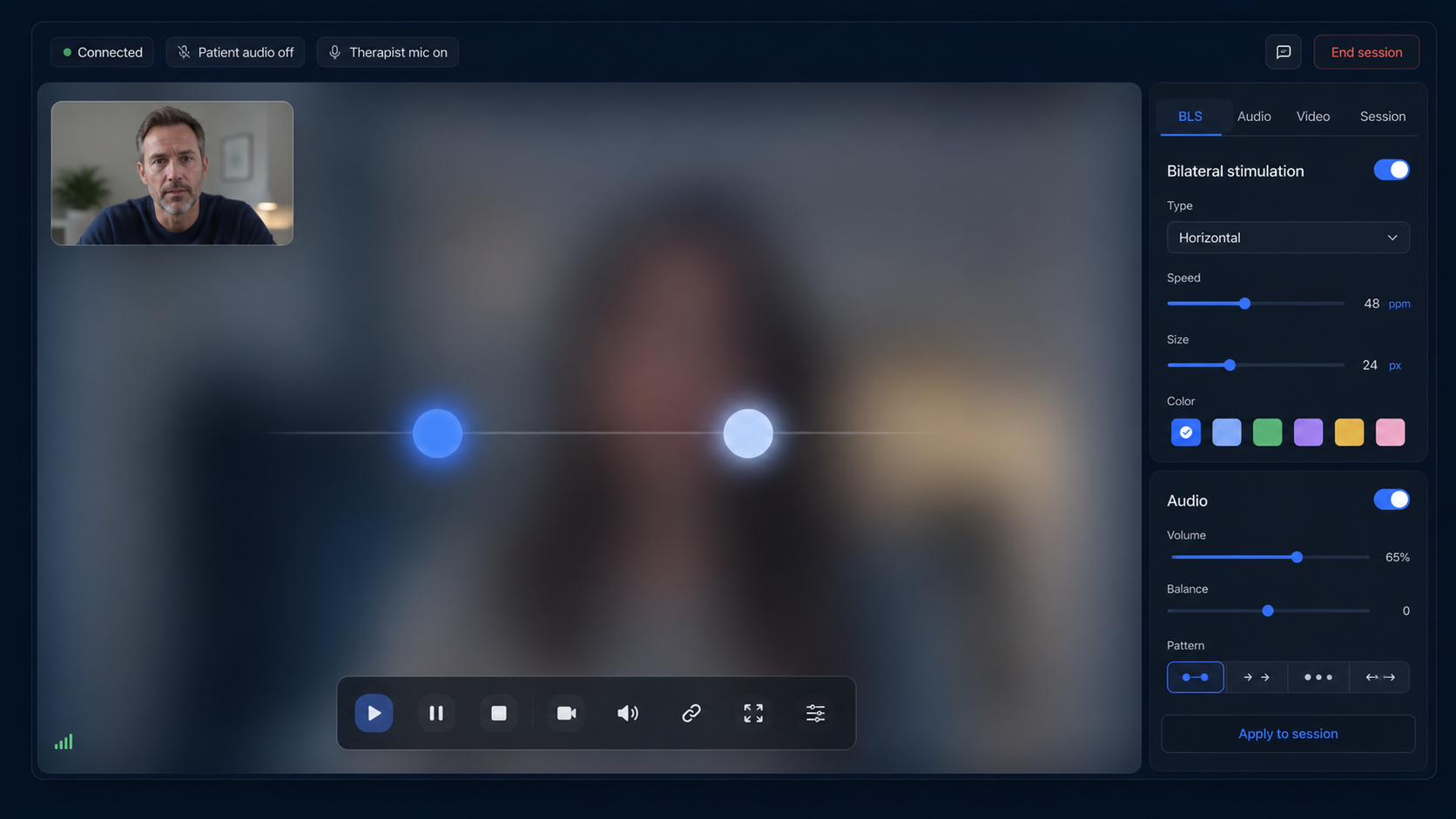
EMDRSuite provides therapist-controlled visual or auditory bilateral stimulation and video. It does not identify parts, access Self, diagnose dissociation, deliver IFS, merge protocols, recommend interventions or certify competence.
FAQ
EMDR vs IFS
Is IFS the same as EMDR?
No. They use different models, procedures and training pathways, even when both address trauma.
Is there a direct EMDR versus IFS trial?
No direct randomized comparison was identified; current IFS PTSD research evaluates the specific PARTS program.
Can therapists combine IFS and EMDR?
Qualified clinicians may integrate elements with clear rationale, consent and outcome monitoring, but the combination is not automatically evidence based.
Does EMDRSuite provide parts work?
No. It supports remote EMDR technology and does not identify or interpret parts.
References
EMDR vs IFS: evidence, structure, and responsible integration
EMDRSuite
Put the guide into practice with EMDRSuite
Run remote EMDR with visual BLS, bilateral sounds, secure patient links, video-ready sessions, saved settings, and notes.
Continue with related EMDR guides