Different primary targets can make coordination more useful than competition
EMDR vs DBT: differences, evidence, and when treatments combine
Compare EMDR and dialectical behavior therapy by targets, structure, PTSD and BPD evidence, risk management, sequencing, and concurrent treatment.
By the EMDRSuite Editorial Team
Product claims checked against the current EMDRSuite code and interface.
No independent clinical reviewer is named for this guide.
EMDR and standard DBT usually answer different questions
EMDR is a trauma-focused psychotherapy organized around memories and present triggers. Comprehensive DBT is a multi-component program designed around a hierarchy that prioritizes life-threatening behavior, therapy-interfering behavior, quality of life, and skills acquisition, typically including individual therapy, skills training, between-session coaching, and a consultation team.
DBT-PTSD and DBT Prolonged Exposure are specific trauma-treatment variants; they are not synonyms for standard DBT. Compare the exact program being offered, the primary diagnosis and outcomes, not isolated grounding skills versus eye movements.
Evidence supports neither a universal sequence nor automatic combination
NICE asks clinicians to consider comprehensive DBT when reducing recurrent self-harm is a priority for women with borderline personality disorder. EMDR has guideline support for PTSD. A 2024 meta-analysis found promising effects for PTSD-specific DBT variants, but this does not establish standard DBT alone as equivalent to EMDR for PTSD.
A 2025 trial randomized 124 patients with PTSD and at least four BPD symptoms to EMDR alone or EMDR plus concurrent DBT. Both groups improved substantially, with no significant one-year difference; the concurrent group was twice as likely to drop out of EMDR. One trial does not forbid combination, but it directly challenges the assumption that adding DBT always improves outcome.
Let risk hierarchy and formulation organize care
Assess suicidality, self-harm, substance use, dissociation, instability, environment, capacity to attend, and current supports. Some people need a comprehensive risk-focused program; others can begin trauma-focused treatment safely without completing an arbitrary stabilization period. Decisions require individual evidence, not diagnosis-based exclusion.
If treatments run concurrently, define who coordinates risk, crisis contact, records, targets, skills coaching, medication communication, and contradictory instructions. Measure PTSD, self-harm, BPD symptoms, functioning, and dropout separately. More appointments and techniques can also increase burden.
A platform cannot supply a DBT program or risk team
Remote trauma work needs exact location, privacy, emergency contacts, local crisis pathways, stop signals, closure, and reconnection. Those safeguards do not replace ongoing suicide and self-harm assessment.
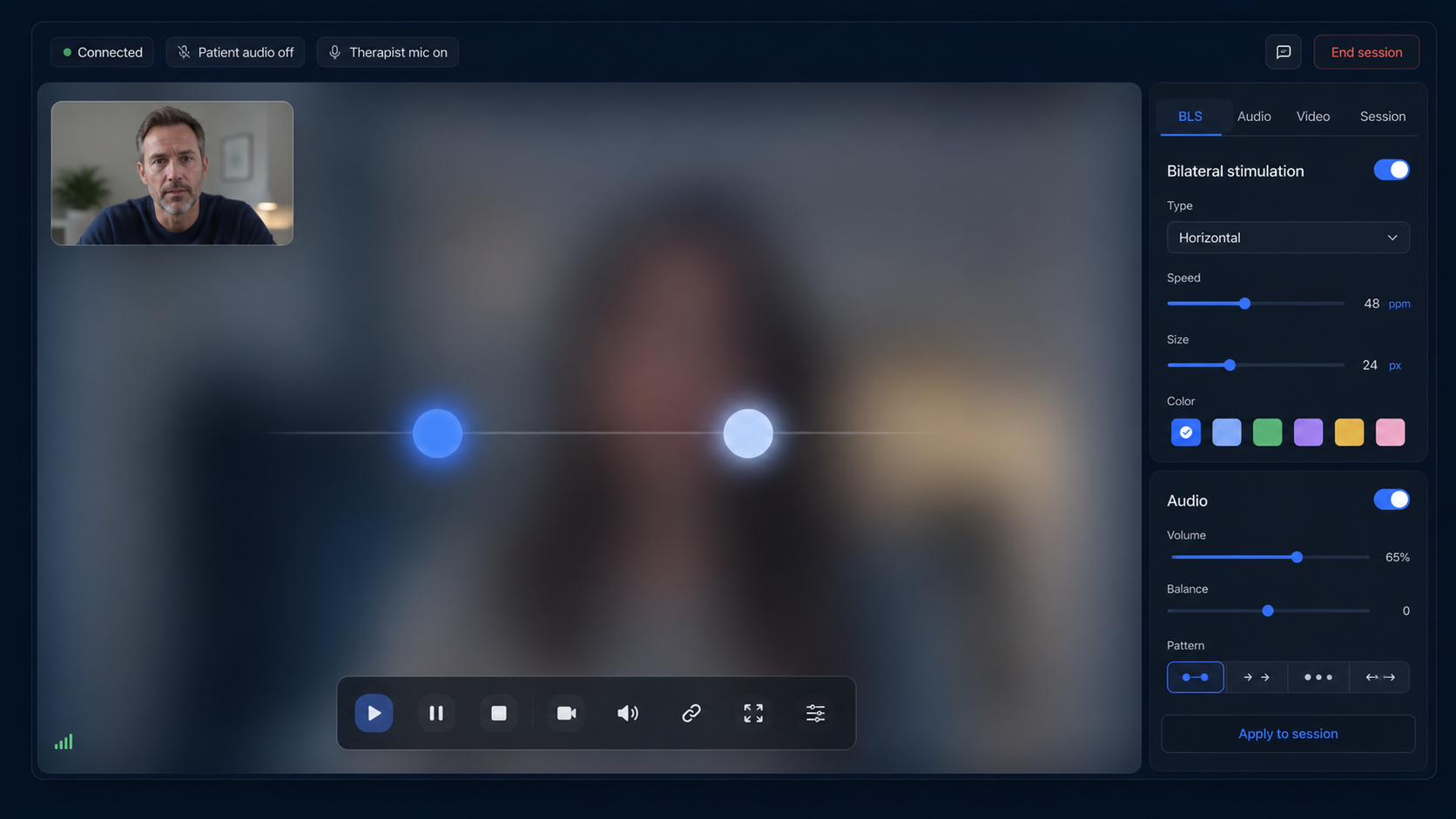
EMDRSuite provides therapist-led video and bilateral stimulation. It does not deliver DBT skills groups or coaching, monitor self-harm, triage crises, coordinate a treatment team, select sequencing, or determine readiness for trauma processing.
FAQ
EMDR vs DBT
Should DBT always come before EMDR?
No universal sequence applies. Current risk, treatment targets, functioning, preference, supports, and clinician competence should determine the plan.
Can EMDR and DBT be used together?
They can be coordinated, but a recent trial did not show better one-year outcomes from automatically adding concurrent DBT to EMDR.
Is DBT a trauma-processing therapy?
Standard DBT is not primarily a trauma-processing protocol; DBT-PTSD and DBT PE are distinct trauma-focused adaptations.
Does EMDRSuite provide crisis monitoring?
No. It is session technology and does not monitor risk, coach DBT skills, or replace emergency procedures.
References
EMDR vs DBT: differences, evidence, and when treatments combine
EMDRSuite
Put the guide into practice with EMDRSuite
Run remote EMDR with visual BLS, bilateral sounds, secure patient links, video-ready sessions, saved settings, and notes.
Continue with related EMDR guides