Talk therapy is an umbrella term, not a single comparator
EMDR vs talk therapy: what therapists and patients actually compare
Clarify EMDR versus talk therapy by structure, trauma focus, disclosure, evidence, therapeutic relationship, shared decisions, and remote delivery.
By the EMDRSuite Editorial Team
Product claims checked against the current EMDRSuite code and interface.
No independent clinical reviewer is named for this guide.
EMDR includes dialogue but is not defined by unrestricted discussion
Talk therapy can mean supportive counselling, psychodynamic therapy, CBT, brief eclectic psychotherapy or almost any psychotherapy involving conversation. EMDR also requires dialogue for history, consent, target assessment, check-ins, meaning and closure, but adds a specified eight-phase trauma-focused procedure.
The useful comparison is therefore EMDR versus a named therapy for a named problem. Describing EMDR as nonverbal or no-talking is misleading; patients may give brief reports during processing without narrating every detail.
Evidence depends on which talking therapy is meant
A network meta-analysis included 90 trials and 6,560 participants across 22 PTSD interventions and found stronger evidence for EMDR and trauma-focused CBT than for generic counselling, while confidence was moderate to low. It does not prove every conversational therapy ineffective.
A direct trial randomized 140 patients to EMDR or brief eclectic psychotherapy; both reduced PTSD symptoms, with different response patterns. The 2024 EMDR participant-level meta-analysis found no significant overall difference from available psychological comparators, which were heterogeneous and not one generic talk therapy.
Choose a defined treatment, not a stereotype
Name the diagnosis or clinical aim, the proposed model, active procedures, expected course, therapist competence, patient preference, prior response and outcome measure. For non-PTSD problems, do not transfer PTSD evidence automatically.
Therapeutic alliance, formulation, consent and safety matter in EMDR as in other psychotherapies. A structured protocol can still be relational and flexible; supportive conversation can still be purposeful without becoming EMDR.
Technology supports contact; it does not conduct psychotherapy
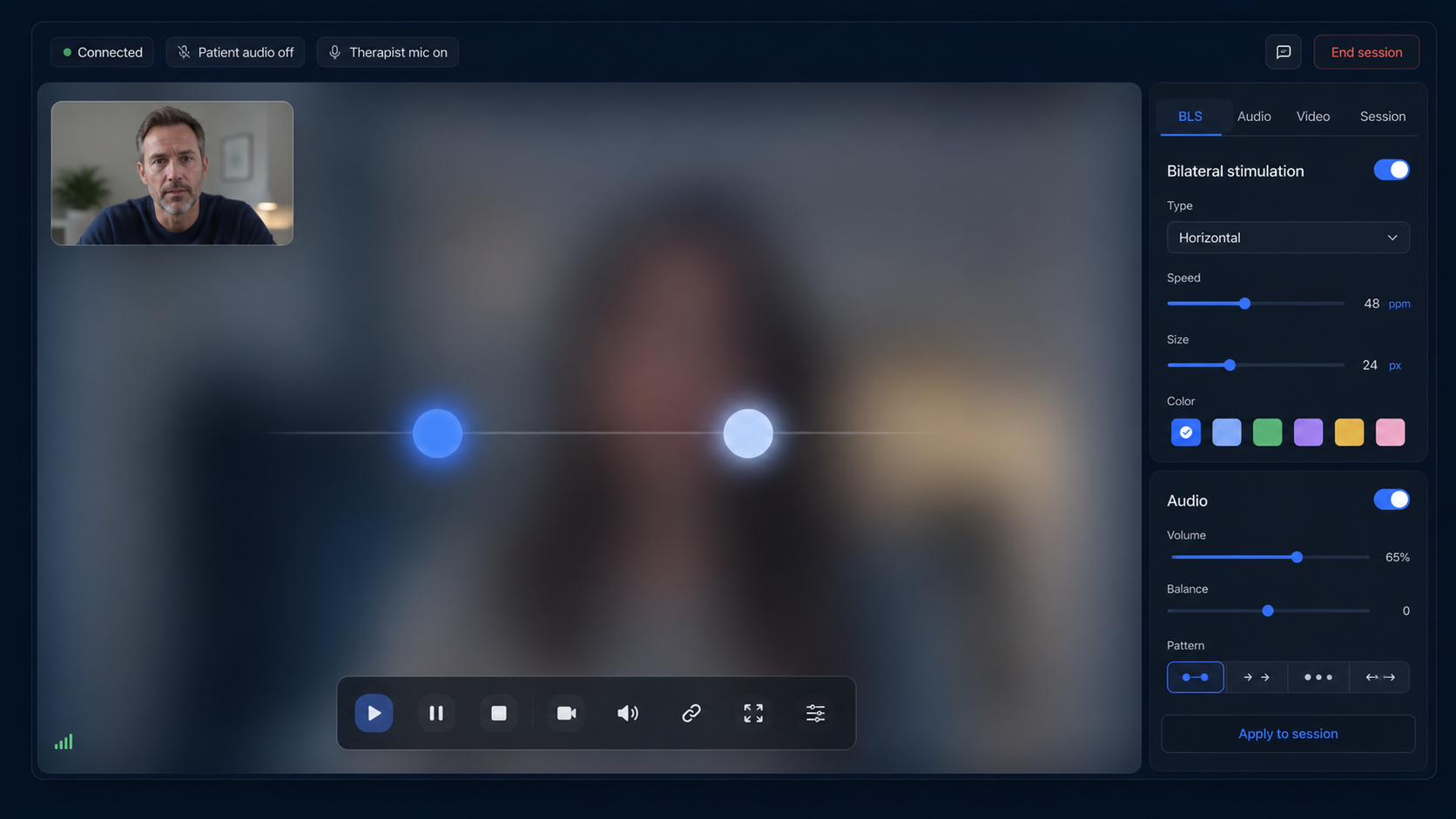
Secure video can carry many psychotherapies. EMDR additionally needs reliable therapist-controlled BLS, a stop process, visibility, privacy, emergency planning and reconnection.
EMDRSuite provides the communication and stimulation workspace. It does not replace clinical dialogue, formulate a case, choose a psychotherapy, or conduct trauma treatment.
FAQ
EMDR vs talk therapy
Is EMDR a talking therapy?
It is a psychotherapy that includes dialogue, but it is organized by an eight-phase protocol rather than conversation alone.
Do patients have to tell every trauma detail?
Not necessarily. Enough information is needed for safe assessment and treatment, while processing reports can be brief.
Is EMDR better than traditional therapy?
That question is too broad; compare EMDR with a named treatment for a defined condition and outcome.
Can EMDRSuite replace the therapist conversation?
No. It supports video and BLS while the clinician remains responsible for psychotherapy.
References
EMDR vs talk therapy: what therapists and patients actually compare
EMDRSuite
Put the guide into practice with EMDRSuite
Run remote EMDR with visual BLS, bilateral sounds, secure patient links, video-ready sessions, saved settings, and notes.
Continue with related EMDR guides