The BHS is a Knipe present-orientation procedure, not a symptom scale
EMDR Back of the Head Scale: purpose, evidence, and limits
Understand the Back of the Head Scale's origin, intended dissociation context, evidence limits, training boundaries, and remote-session safeguards.
By the EMDRSuite Editorial Team
Product claims checked against the current EMDRSuite code and interface.
No independent clinical reviewer is named for this guide.
Jim Knipe developed BHS for present orientation
The Francine Shapiro Legacy Library attributes the Back of the Head Scale, or BHS, to Jim Knipe and places it in preparation before trauma desensitization. Its intended use is to discuss how much a client feels oriented to the current room while disturbing material competes for attention.
BHS is not the Subjective Units of Disturbance scale, the Validity of Cognition scale, a dissociation diagnosis, or a universal readiness score. It is a clinician-guided, moment-specific aid within a wider formulation and therapeutic relationship.
Publication and training do not establish measurement validity
BHS appears in Knipe's publications, EMDRIA educational material, and training on dissociation and over-accessing. Those sources establish provenance and professional use, while the 2026 EMDR Toolbox Method paper says evidence for the wider framework remains primarily empirical and grounded in clinical practice.
No reliability or validity study of BHS, and no controlled trial isolating its clinical effect, was identified in the sources reviewed through 28 August 2026. It should not be described as a validated psychometric instrument or proof that processing is safe to begin.
Orientation requires broader assessment and a contingency plan
A response can change across a session and may be influenced by attention, fatigue, language, neurodivergence, medication, environment, or the way the prompt is understood. Clinicians still need appropriate dissociation assessment, consent, pacing, observation, and local emergency or interruption plans.
In remote care, confirm privacy, location and contact contingencies, stable audio/video, a way to stop stimulation, and what happens if connection or orientation deteriorates. BHS cannot replace clinical judgment or jurisdiction-specific duties.
This reference does not reproduce the protected procedure
This page explains purpose, lineage, evidence, and limits; it does not provide the anchors, wording, scoring sequence, or intervention instructions from the published chapter. Clinicians should use authorized training and original sources when considering the method.
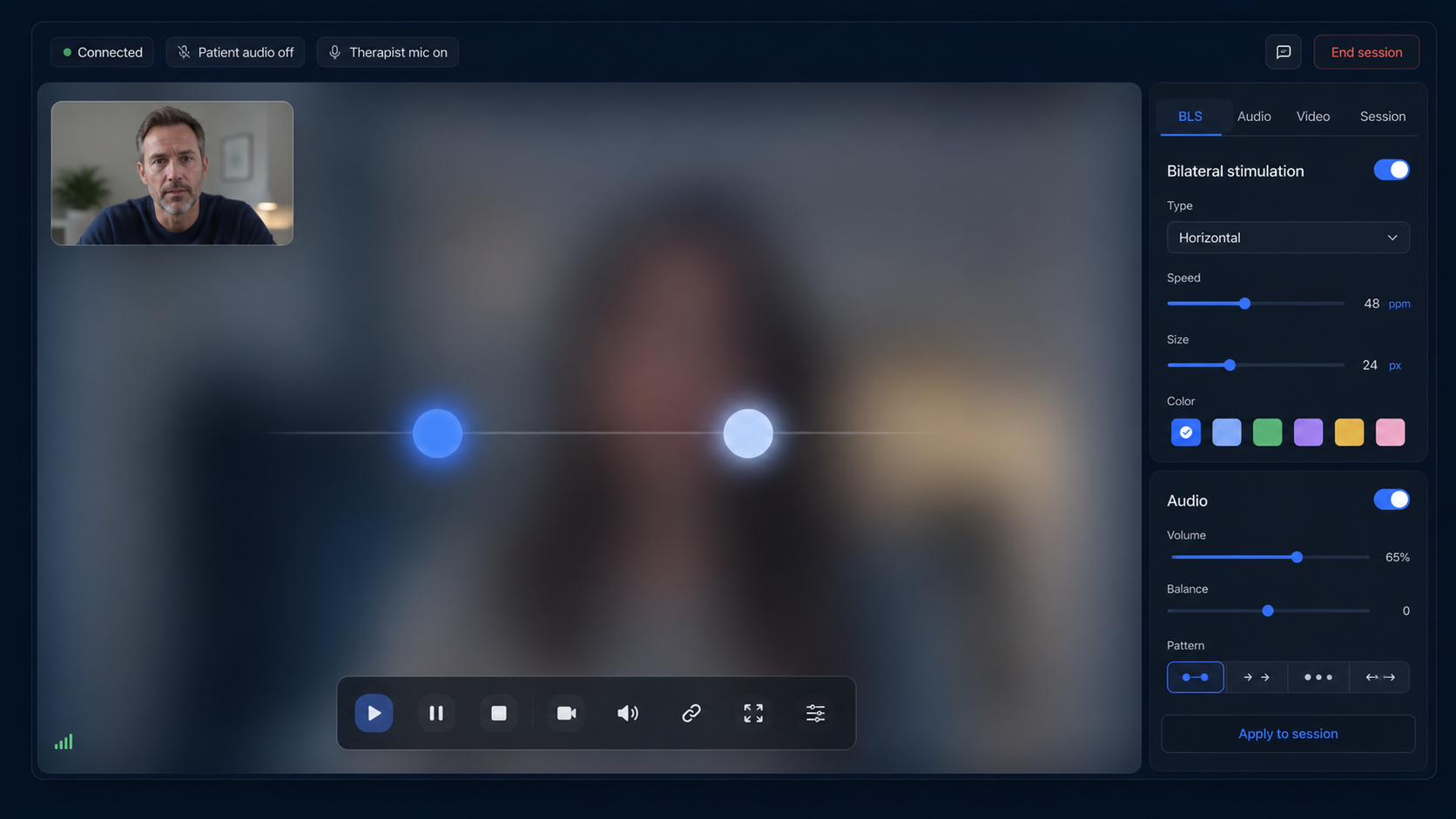
EMDRSuite provides an online room, therapist-controlled bilateral stimulation, and operational controls. It cannot score or detect present orientation, diagnose dissociation, certify readiness, or choose BHS or CIPOS for a client.
FAQ
EMDR Back of the Head Scale
Is BHS the same as SUD or VOC?
No. SUD and VOC rate different target-related experiences in standard EMDR assessment. BHS is described as a present-orientation aid in Knipe's dissociation work.
Is the Back of the Head Scale validated?
No reliability, validity, diagnostic-accuracy, or controlled component study was identified in the reviewed sources. Publication and training use are not psychometric validation.
Can BHS prove a client is ready for reprocessing?
No. A momentary response cannot certify readiness. Formulation, consent, capacity, stability, risk, pacing, and the full clinical context remain necessary.
Does EMDRSuite administer BHS?
No. EMDRSuite does not present its anchors, calculate a score, monitor orientation, or recommend a clinical intervention.
References
EMDR Back of the Head Scale: purpose, evidence, and limits
EMDRSuite
Put the guide into practice with EMDRSuite
Run remote EMDR with visual BLS, bilateral sounds, secure patient links, video-ready sessions, saved settings, and notes.
Continue with related EMDR guides