A road accident can produce PTSD, pain, brain injury, grief, legal stress, or none of these
EMDR after a car accident: PTSD evidence, timing, and safety
Review EMDR after traffic accidents with PTSD evidence, medical and legal differentials, child data, early timing, driving, and remote contingencies.
By the EMDRSuite Editorial Team
Product claims checked against the current EMDRSuite code and interface.
No independent clinical reviewer is named for this guide.
Assess the crash consequences before selecting a target
After a collision, intrusive memories, avoidance, hyperarousal, guilt, grief, pain, concussion, vestibular symptoms, sleep disruption, driving fear, financial strain, and legal stress can overlap. Not every acute reaction is PTSD, and lack of PTSD does not make pain, disability, or distress unreal.
Urgent neurological, spinal, chest, abdominal, breathing, bleeding, pregnancy, medication, or suicide concerns require the appropriate medical route. Review injury care, analgesics, sleep, substance use, cognition, dissociation, current driving safety, ongoing threat, litigation, and whether the person was driver, passenger, witness, responder, or bereaved.
Accident-specific evidence includes small trials and a meta-analysis
A meta-analysis examined EMDR studies for PTSD after motor vehicle accidents and reported favorable trauma outcomes, but the evidence base was small and methodologically varied. A waitlist pilot studied four EMDR sessions in 27 children aged six to 12 with persistent post-traumatic symptoms after an accident.
Child clinician-rated outcomes improved, while parent ratings and non-trauma symptoms did not show the same pattern. Small samples, waitlists, older protocols, and selected PTSD symptoms limit conclusions about adults, acute prevention, complex injury, legal outcomes, or routine return to driving.
Flash Technique findings are not standard EMDR proof
A randomized study of 39 traffic-accident survivors compared a Flash Technique intervention with a stress-management module and found advantages on some anxiety, intrusion, avoidance, traumatic-stress, and psychological-quality-of-life outcomes at one month, but not on every measured domain.
Flash Technique is a distinct, still-developing intervention and should not be treated as proof for standard EMDR, a self-help shortcut, or a reason to bypass training. NICE recommends manualized EMDR for assessed PTSD or clinically important symptoms after non-combat trauma, with timing and preference considered.
Driving and legal records need separate decisions
Do not use symptom relief as evidence of physical recovery, driving fitness, fault, memory accuracy, or readiness for exposure on public roads. Coordinate rehabilitation and graded driving work where indicated; preserve neutral records when insurance or legal proceedings are active and avoid suggestive reconstruction of uncertain memory.
EMDRSuite does not diagnose concussion or PTSD, assess driving fitness, verify memory, supervise on-road exposure, monitor injury or medication, provide legal opinions, preserve forensic evidence, or call emergency services. Remote work needs location, privacy, support, interruption, and connection-loss plans.
FAQ
EMDR for car accident trauma
Does every crash survivor need EMDR?
No. Reactions vary, and treatment depends on assessment, impairment, preference, timing, and other medical or psychological needs.
Can EMDR prove someone is safe to drive?
No. Symptom change is not a driving-fitness assessment or supervised road exposure.
Is Flash Technique the same evidence as standard EMDR?
No. It is a distinct developing intervention and one small accident study cannot establish equivalence.
Can EMDRSuite assess crash injury or legal evidence?
No. It does not assess injury, cognition, driving, memory accuracy, fault, or legal evidence.
References
EMDR after a car accident: PTSD evidence, timing, and safety
EMDRSuite
Put the guide into practice with EMDRSuite
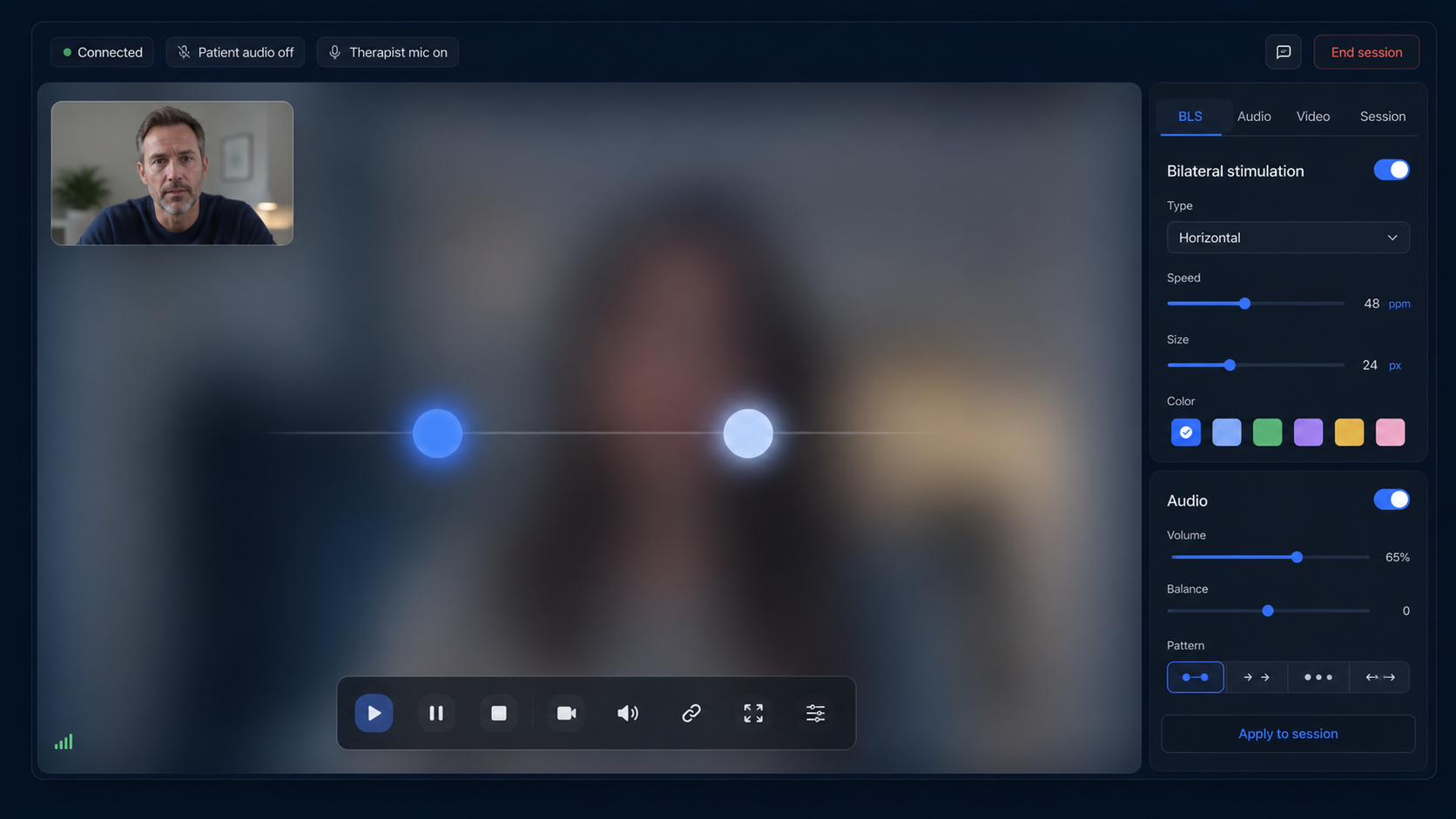
Run remote EMDR with visual BLS, bilateral sounds, secure patient links, video-ready sessions, saved settings, and notes.
Continue with related EMDR guides