Fear of driving can reflect different problems
EMDR for driving anxiety: accident trauma, phobia, and exposure
Differentiate driving phobia, panic, PTSD, and unsafe driving when considering EMDR, using traffic-accident research, exposure evidence, and safety limits.
By the EMDRSuite Editorial Team
Product claims checked against the current EMDRSuite code and interface.
No independent clinical reviewer is named for this guide.
Driving anxiety is not a single diagnosis
Fear may follow a collision, panic attack, near miss, medical event, loss, criticism, or long avoidance. It may fit PTSD, specific phobia, panic disorder with agoraphobic avoidance, another condition, or a realistic response to unsafe skills, vision, medication, fatigue, or road conditions.
Assess the feared outcome, memories, routes, role as driver or passenger, panic, dissociation, avoidance, licences and skills, physical and cognitive health, substances, medication, sleep, legal restrictions, and actual road safety. Therapy cannot certify fitness to drive.
Traffic-accident EMDR evidence is narrower than driving recovery
A randomized study of 39 traffic-accident volunteers compared one EMDR Flash Technique session with a stress-management module. At one month, some anxiety, intrusion, avoidance, total traumatic-stress, and psychological-quality-of-life scores favoured Flash, while several other outcomes did not.
The study did not establish standard EMDR for diagnosed driving phobia, measure safe independent driving as its main outcome, or provide long-term follow-up. Flash Technique also has distinct training and evidence boundaries and should not be presented as interchangeable with full eight-phase EMDR.
PTSD treatment and graded driving exposure answer different questions
VA/DoD guidance recommends EMDR, Prolonged Exposure, and Cognitive Processing Therapy for PTSD. For situational phobia and avoidance, exposure has direct behavioural logic: a childhood spider-phobia trial found in-vivo exposure improved all outcomes while EMDR improved only self-reported fear.
A 14-person driving-simulator pilot reported improved real-traffic tasks after tailored virtual-reality exposure, but lacked a control group. The evidence supports collaborative diagnosis and behavioural measurement, not a claim that either EMDR or a simulator is universally best.
Never conduct bilateral stimulation while someone is driving
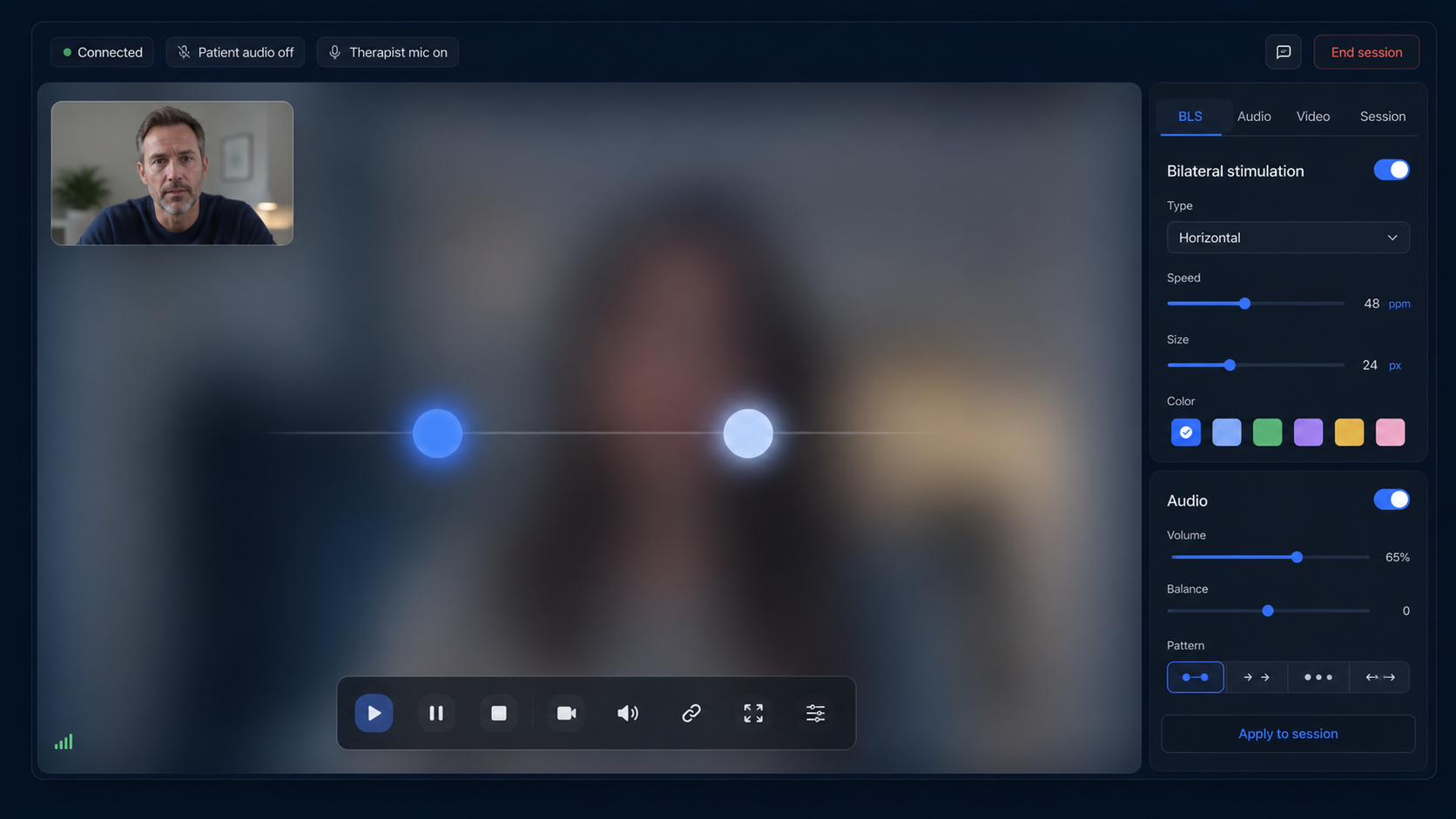
Remote sessions require the patient to be parked, in a private stationary location, and free from responsibility for a vehicle. Plan grounding, stop signals, post-session recovery, transport, reconnection, local support, and criteria for delaying a return to driving.
EMDRSuite supplies video and clinician-controlled visual or auditory stimulation. It must not be used while driving and does not assess driving ability, vision, medication effects, dissociation, road safety, legal fitness, or readiness for in-vivo exposure.
FAQ
EMDR for driving anxiety
Is EMDR proven for driving phobia?
Evidence is stronger for PTSD after trauma than for driving phobia itself; one small traffic-accident Flash trial did not measure full driving recovery.
Is exposure relevant?
Yes. Graded exposure is directly relevant to safe situational avoidance when clinically appropriate.
Can EMDR be used in a moving car?
No. Bilateral stimulation sessions should never be conducted while the patient is driving.
Can EMDRSuite decide when driving is safe?
No. It cannot assess legal or practical fitness to drive.
References
EMDR for driving anxiety: accident trauma, phobia, and exposure
EMDRSuite
Put the guide into practice with EMDRSuite
Run remote EMDR with visual BLS, bilateral sounds, secure patient links, video-ready sessions, saved settings, and notes.
Continue with related EMDR guides