Individual trauma treatment and conjoint therapy create different duties
EMDR in couples therapy: evidence, consent, and safety boundaries
Compare individual EMDR alongside couples therapy with conjoint EMDR work, including evidence limits, consent, confidentiality, coercion screening, pacing, and remote delivery.
By the EMDRSuite Editorial Team
Product claims checked against the current EMDRSuite code and interface.
No independent clinical reviewer is named for this guide.
First identify who the client is and what treatment is being offered
A therapist can provide individual EMDR while couples therapy happens separately, alternate individual and conjoint meetings under one agreed framework, or use a named conjoint adaptation. These arrangements are not equivalent. Define the client, goals, records, confidentiality and no-secrets policy, information sharing, contact between sessions, and who may withdraw consent.
A partner's presence can support orientation and corrective interaction, but it can also inhibit disclosure, create pressure, expose sensitive material, or shift attention from trauma treatment to relationship conflict. Informed consent must cover the actual format, not merely the label EMDR.
Evidence for specifically conjoint EMDR remains preliminary
Published literature includes clinical articles and case material, a preliminary EMDR Couple Protocol study, and qualitative interviews with 13 therapists integrating EMDR and emotionally focused therapy. These sources can describe feasibility, hypotheses, and clinician experience but do not establish comparative efficacy or a universal protocol.
A Cochrane review of couple and family therapies for adult PTSD found only four randomized trials, none establishing conjoint EMDR. It judged evidence insufficient for substantive benefits and relationship outcomes particularly uncertain. Evidence for individual EMDR for PTSD cannot be transferred automatically to treating a couple together.
Safety and freedom to participate come before conjoint processing
Screen each partner privately for current violence, coercive control, retaliation risk, stalking, fear, suicidality, substance use, dissociation, and whether speaking openly is safe. Conjoint processing may be inappropriate where one person cannot consent freely or disclosure could increase danger. A couples intervention must never be used to equalize responsibility for abuse.
Plan targets, turn-taking, stop signals, regulation, observer roles, what the partner may learn, and how the therapist will respond if conflict escalates. Protect each person's autonomy and avoid using bilateral stimulation to press for disclosure, forgiveness, reconciliation, or a particular relationship decision.
Remote conjoint work adds privacy and identity checks
Confirm who is in each room, whether anyone is off camera, private communication options, exact locations, emergency contacts, device and headphone use, recording rules, reconnection, and how either person can end participation. Separate devices or locations may require different contingency plans.
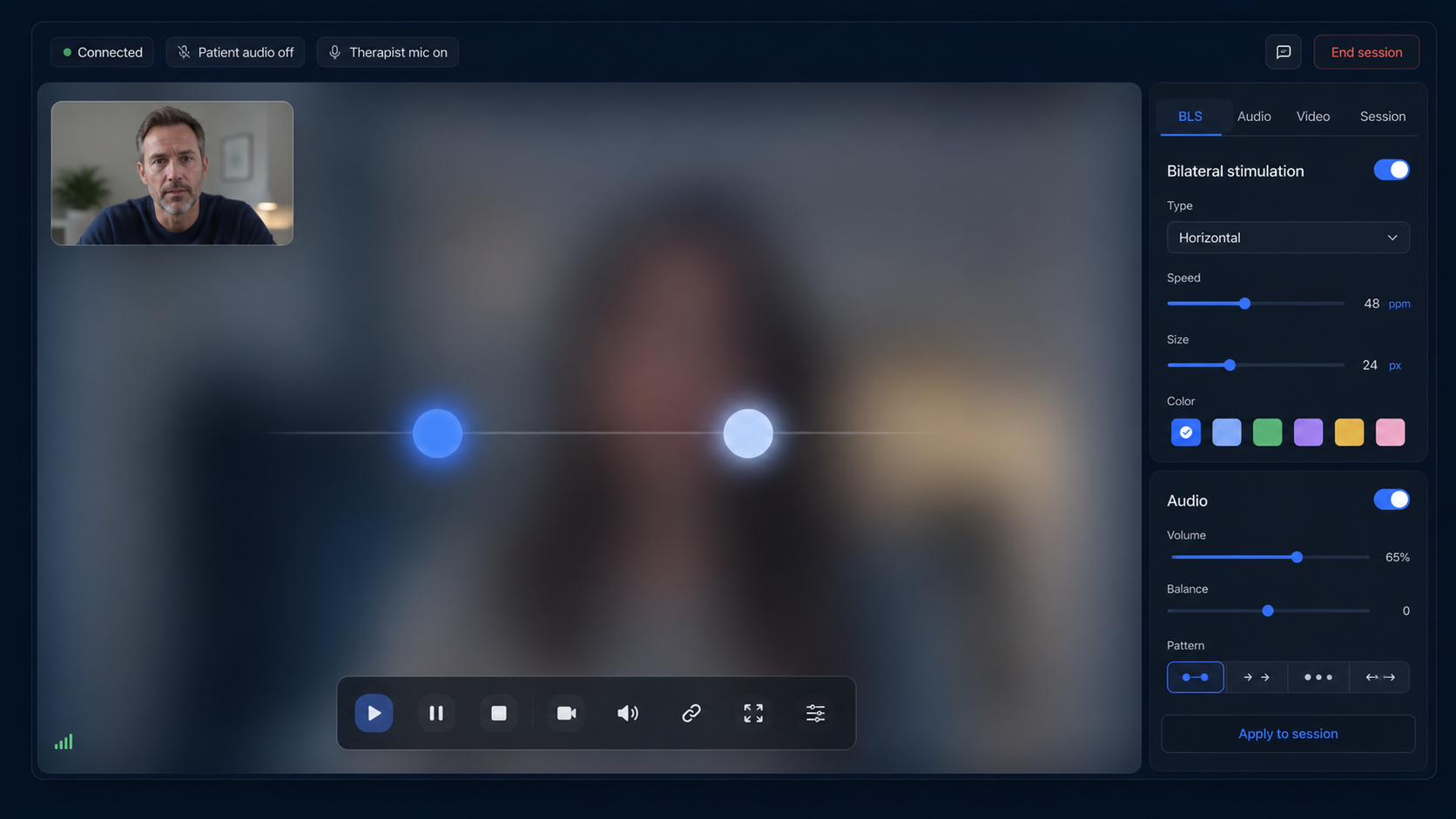
EMDRSuite provides a private link, live video, and therapist-controlled visual or auditory stimulation. It does not screen for abuse, verify free consent, manage secrets, decide who the client is, mediate conflict, or implement a couples protocol. Those remain clinical, ethical, and legal responsibilities.
FAQ
EMDR couples therapy
Can EMDR be done with both partners present?
It can be intentionally adapted by a competent clinician, but format, consent, safety, confidentiality, and evidence limits must be explicit.
Is conjoint EMDR proven to improve relationships?
No. The specifically conjoint evidence is preliminary and does not establish reliable comparative relationship outcomes.
Should couples EMDR be used when there is partner violence?
Current violence or coercive control requires private safety assessment; conjoint processing may be unsafe and must not distribute responsibility for abuse.
Does EMDRSuite provide couples therapy?
No. It supplies session technology and does not define the client, assess safety, or deliver a couples protocol.
References
EMDR in couples therapy: evidence, consent, and safety boundaries
EMDRSuite
Put the guide into practice with EMDRSuite
Run remote EMDR with visual BLS, bilateral sounds, secure patient links, video-ready sessions, saved settings, and notes.
Continue with related EMDR guides