DID requires specialist, phase-oriented care rather than routine early processing
EMDR for dissociative identity disorder: evidence and safeguards
How modified EMDR may fit specialist treatment for dissociative identity disorder, why readiness and internal cooperation matter, and where the evidence remains limited.
By the EMDRSuite Editorial Team
Product claims checked against the current EMDRSuite code and interface.
No independent clinical reviewer is named for this guide.
DID is not interchangeable with ordinary detachment or PTSD dissociation
Dissociative identity disorder involves identity disruption and discontinuities in agency, memory, perception, and functioning that require qualified diagnostic assessment. A high dissociation score, feeling unreal, parts language, or changing states does not by itself establish DID. Differential diagnosis, safety, comorbidity, substance effects, sleep, neurological factors, and cultural context matter.
Evidence from PTSD samples with dissociative symptoms cannot automatically be generalized to DID. Conversely, a DID diagnosis does not mean trauma processing can never occur. The relevant question is who should deliver which procedure, at what phase, with what readiness and safeguards.
Guidelines place EMDR inside specialist phase-oriented treatment
ISSTD guidance says EMDR should not be a standalone DID treatment. It recommends use only by clinicians knowledgeable in dissociative disorders after readiness is assessed, with adequate stability, coping, internal cooperation, and dual attention. Modified procedures may support containment, strengthening, cooperation, or carefully bounded trauma work.
This is substantially different from applying a standard trauma target immediately. Ongoing abuse, severe instability, active substance misuse, psychosis, internal opposition, memory barriers, rapid switching, amnesia, or loss of present orientation can require further assessment, stabilization, coordination, or a different priority.
The treatment evidence is emerging and mostly non-randomized
A 2025 systematic review found 19 studies of phase-oriented or other psychological treatments for DID or OSDD. Symptoms and functioning often improved, but 58% of studies were rated weak and only 11% strong; high-powered controlled trials are still needed. Another systematic review described the DID psychotherapy evidence as observational and descriptive.
Published modified-EMDR literature includes reviews, protocols, case material, and clinical guidance rather than robust trials proving a specific EMDR protocol for DID. It supports caution and specialist adaptation, not claims of rapid integration, memory recovery, universal sequencing, or superiority.
Remote tools cannot supply the missing clinical safeguards
For remote work, establish location, privacy, emergency response, communication with relevant providers, stop and orientation signals, camera framing, loss-of-contact procedures, session closure, and what happens if state-dependent access or amnesia affects consent or continuity. Record only what is clinically and legally necessary.
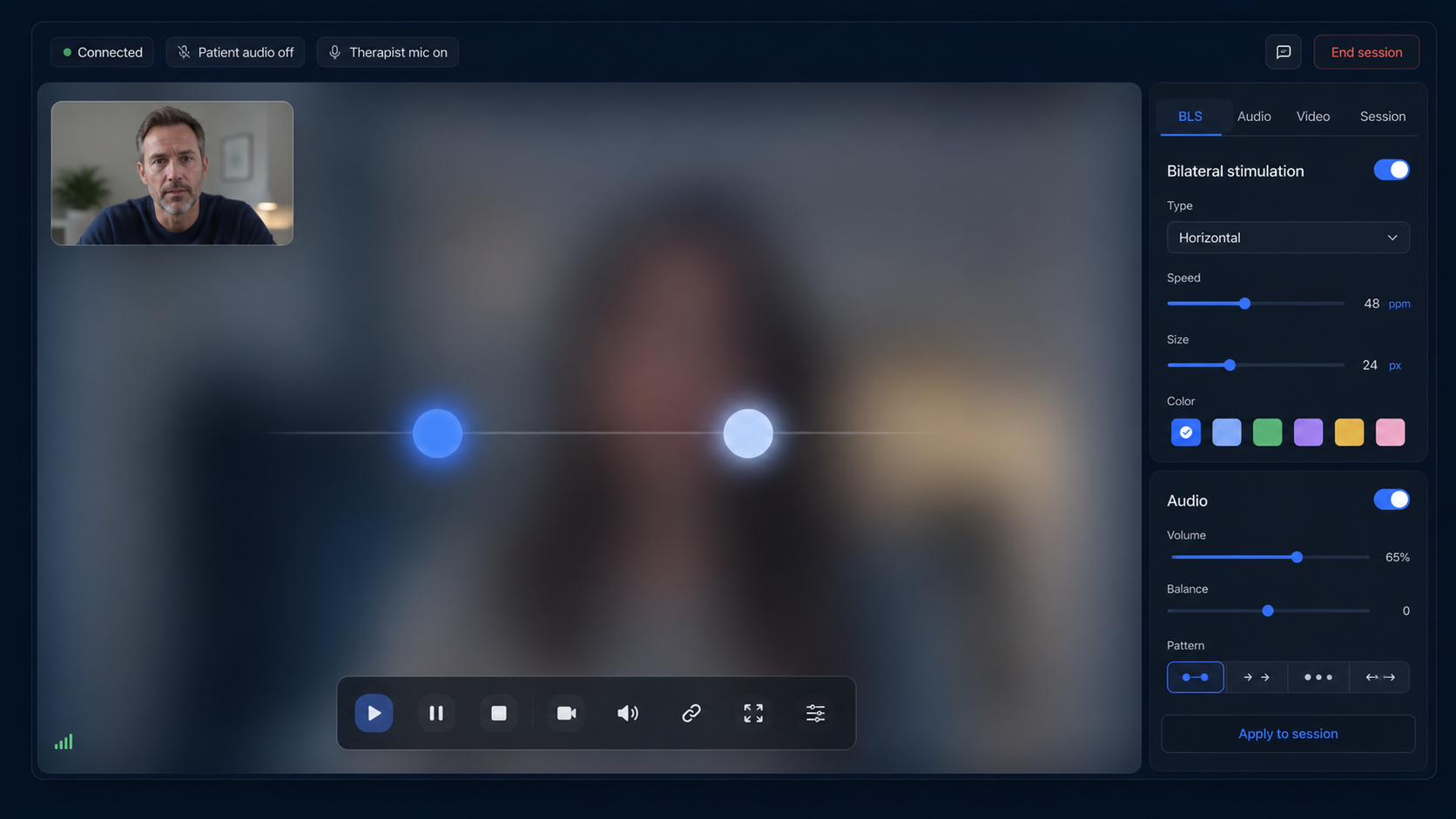
EMDRSuite supports live therapist contact and adjustable visual or auditory stimulation. It does not diagnose DID, identify identity states, verify internal consent, detect switching or dissociation, recover memories, decide readiness, or replace specialist training and supervision.
FAQ
EMDR for dissociative identity disorder
Can EMDR be used with DID?
Modified EMDR may be used within specialist phase-oriented treatment after careful readiness assessment; standard early processing is not the default.
Does DID always require years of stabilization before any trauma work?
No universal duration applies. Phase priorities can overlap, but timing and procedure must follow individual safety, capacity, consent, and specialist judgment.
Is evidence from dissociative PTSD enough for DID?
No. Findings from PTSD with dissociative symptoms should not be assumed to establish efficacy or safety for DID.
Can EMDRSuite detect switching or dissociation?
No. It is session technology and does not observe, diagnose, or alert on dissociative states.
References
EMDR for dissociative identity disorder: evidence and safeguards
EMDRSuite
Put the guide into practice with EMDRSuite
Run remote EMDR with visual BLS, bilateral sounds, secure patient links, video-ready sessions, saved settings, and notes.
Continue with related EMDR guides